

Audio By Carbonatix
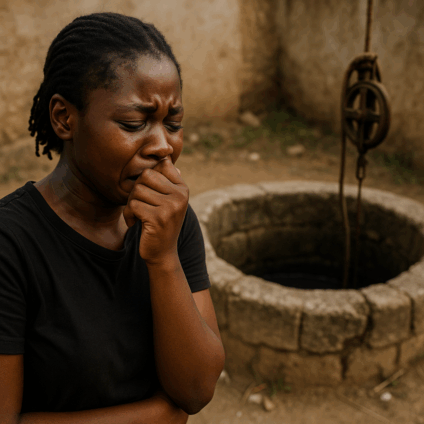
A chilling confession has emerged in the tragic death of a four-year-old boy, whose body was retrieved from a well at Karlo in the Suaman District of the Western North Region.
Akua Afriyie, the 23-year-old mother, has reportedly admitted to police that she intentionally dumped her son in the well to satisfy a condition set by a man she hoped to marry.
Adom TV's Western North Regional Correspondent, Augustine Boah, reported that the harrowing incident occurred on Saturday, July 19, 2025, and was promptly reported by Mr. Eric Armah, the Assemblyman for the Karlo Electoral Area.
According to Mr. Armah, the young mother, upon interrogation by police, confessed that the unnamed man allegedly told her he would only marry her if she did not have a child.
Driven by a desperate desire to secure this new relationship, Afriyie tragically decided to take her son's life.
Upon receiving the report, police swiftly dispatched a team to the scene.
The body of the child was successfully retrieved from the well and has since been transported to the mortuary of a local hospital for preservation and autopsy, which will officially determine the cause of death.
This deeply disturbing case brings to the forefront the devastating issue of child abandonment and murder, often tragically linked to complex social and economic pressures as well as harmful beliefs.
While the specific motive cited by the mother points to a desperate attempt to secure a romantic relationship, such acts of extreme violence against children are a stark reminder of vulnerabilities within society.
In Ghana, child protection laws are enshrined in statutes like the Children's Act of 1998, which aims to protect children from all forms of abuse and neglect.
Infanticide and child murder carry severe penalties under Ghanaian law, reflecting the gravity with which the state views such offenses.
Child abandonment, though less frequently fatal, remains a concern, often influenced by factors such as extreme poverty, lack of support systems for single mothers, societal stigma associated with out-of-wedlock births, and in some tragic instances, a misguided belief that a child poses a barrier to personal advancement or social acceptance.
While statistics on direct child murder for such specific reasons are rare, broader data from UNICEF and the Ghana Statistical Service highlight that a significant percentage of Ghanaian children face various forms of deprivation and vulnerability, underscoring the need for robust social welfare programs and community support.
Latest Stories
-
US seeks changes to rejected $109m health compact with Ghana – Mahama
27 minutes -
Nine dead in mass shooting at Pennsylvania home
44 minutes -
‘Time for Ukraine to get new president,’ says Trump after Zelensky condemns diesel deal
47 minutes -
Hincapie injury adds to Arsenal issues after Guimaraes rescue act
55 minutes -
Henderson scores twice as Chelsea thumb Bournemouth
1 hour -
Photos: Mentapulse Africa convenes health and labour summit to address talent retention
1 hour -
Mahama inspects Nkokɔ Nketenkete plant, eyes Bechem as chicken capital
1 hour -
Ghana not seeking full BRICS membership, applying as Partner Country – Ablakwa
1 hour -
Woman injures three people in third Poland school knife attack in a week
1 hour -
Ghana should join BRICS as partner, not member – NPP Bono East Regional Secretary
1 hour -
Ghana High Commission warns nationals in South Africa over protests in Johannesburg, Durban
1 hour -
Mahama praises Roads Minister for keeping Big Push contractors on their toes
2 hours -
World Cup Visa Scandal: ‘My client has not collected money for visas’ – Ampofo Ankrah’s lawyer
2 hours -
US immigration officials defend ICE agents who shot man in same car as child
2 hours -
Commentator Katie Zacharia picked as new White House press secretary
2 hours