

Audio By Carbonatix
The School of Public Health at Kwame Nkrumah University of Science and Technology, has debunked assertion Ghana will record mass death in the event of coronavirus outbreak in the country.
Head of Department of Global Health, Prof. Sam Newton, says the country’s youthful population structure makes high disease mortality unlikely.
“Even in a place like China, with 3 to 4 per cent mortality, they have issues there,” he pointed out. “People live to very old age, a lot of people smoke, and they have bad air pollution. In a country like ours, life expectancy is about 63 so the mortality will be like 2 percent or less,” he explained.
Prof. Newton is worried about what he says is panic reaction which will cause many people to take irrational decisions.
“Once you’re paralyzed by fear, then you do irrational things. People take alcohol or this chemical to prevent the disease,” he observed.
“Not that we want people to be complacent, but the truth is majority of the people will survive, ‘’ he clarified.
According to the World Health Organization, coronaviruses (CoV) are a large family of viruses that cause illness ranging from the common cold to more severe diseases such as Middle East Respiratory Syndrome (MERS) and Severe Acute Respiratory Syndrome (SARS)
Coronavirus disease (COVID-19) is a new strain that was discovered in 2019 and has not been previously identified in humans.
The viruses are transmitted between animals and people, and common signs of infection include respiratory symptoms, fever, cough, shortness of breath and breathing difficulty.
In more severe cases, infection can cause pneumonia, severe acute respiratory syndrome, kidney failure and even death.
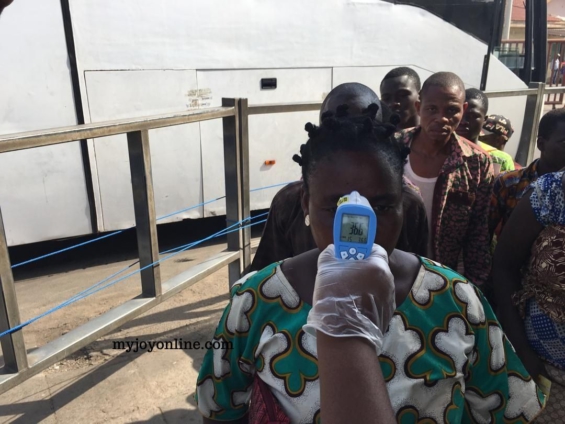
Government has instituted measures to curb the spread of the disease following confirmation of six cases.
Epidemiologist, Dr. John Amuasi says public health professionals are working tirelessly to reduce the number of infections and mortality.
“What we seek to do is to reduce the number of infections and the number of people who die. So as Public Health people, we’re trying to flatten the curve, that is, to reduce rate of spread and number of people who die. What it means is that the pandemic may last a bit longer so what will happen is that a lot of people will die and the disease will die off, but even if we should do nothing, the disease will die off by itself, ” he summed up.
The identification of four new cases has prompted the need to undertake contact tracing.
Recently, an infectious disease specialist, Dr. Bertha Serwaa Aryee, has suggested, “Our next strategy is to immediately try to make sure that we have an excellent contact tracing to locate everybody who could possibly have come into contact with the two patients. ”
The Health Ministry has begun contact tracing in the case of the Anglogold Ashanti worker who exhibited signs of the disease.
Those who came into contact with the employee have been asked to undergo self-isolation and been closely monitored by healthcare professionals.
Dean of the School of Public Health, Prof. Ellis Owusu-Dabo, however, argues before any measure is instituted to slow the spread of the disease “one has to be clear on the rate or degree of infectivity. In other words, if one person gets the disease how many people do they infect over time in Ghana? We don’t have the answer to that question!”
Standard recommendations by the W.H.O. to prevent infection spread include regular hand washing, covering the mouth and nose when coughing and sneezing, thoroughly cooking meat and eggs before eating.
“In Guinea, Liberia and Sierra Leone, I saw these Ebola treatment centers with my eyes. What did the trick was basic sanitation rules, hand washing, sanitizers and the disease went by itself,” Dr. Amuasi recounted.
Avoiding close contact with people showing symptoms of respiratory illness such as coughing and sneezing is recommended.
“We should maintain social distance, it’s very important; we know the distance is about one meter or two meters, said Public Health Physician at KNUST Hospital, Dr. Arti Singh.
“If you have been to an exposed area, we want you to stay indoors,” Prof. Owusu-Dabo endorses President Nana Addo’s directives.
“Don’t interact with anybody for two weeks. If you brought a parcel for anybody, keep it with you till the two weeks is over,” he emphasized.
Latest Stories
-
Ghana retains strong investment potential despite financing challenges – Emerging Market Advisory
3 minutes -
Release climate, gender and environmental funds on time – CSOs urge government
16 minutes -
MAA, KSrelief sign joint implementation programme for 20 solar-powered boreholes in Ghana
43 minutes -
Major Superiors gather in Wa to chart future of consecrated life
44 minutes -
Today’s front pages: Thursday, October 8, 2026
1 hour -
ECG warns customers against fake meter sales, MoMo fraud
1 hour -
Gov’t will not curb free speech under Mahama – Kwakye Ofosu
2 hours -
NDPC, UNIDO discuss new partnership to drive Ghana’s industrial development
3 hours -
Mahama Ayariga calls for innovative financing to make housing more affordable
3 hours -
NDPC reviews 22-year-old guidelines for regional, district planning units
3 hours -
Ghana to champion ECOWAS adoption of Accra Convention on cargo documents – Trade Minister
3 hours -
NHIS coverage rises from 57% to about 70% in less than two years under Mahama — Health Minister
3 hours -
BRICS membership could give Ghana more options in global diplomacy — analyst
3 hours -
GoldBod sells $125m to commercial banks in maiden FX auction
3 hours -
Bawumia mourns former NPP chairman Odoi-Sykes
3 hours