

Audio By Carbonatix
North Korea has said it will cut off all inter-Korean communication lines with the South, including a hotline between the two nations' leaders.
The North said this was the first in a series of actions, describing South Korea as "the enemy".
Daily calls, which have been made to a liaison office located in the North Korean border city of Kaesong, will cease from Tuesday.
The two states had set up the office to reduce tensions after talks in 2018.
North and South Korea are technically still at war because no peace agreement was reached when the Korean War ended in 1953.
North Korea "will completely cut off and shut down the liaison line between the authorities of the North and the South, which has been maintained through the North-South joint liaison office... from 12:00 on 9 June 2020," the Korean Central News Agency (KCNA) report said.
Military communication channels will also be cut, North Korea said.
When the liaison office was temporarily closed in January because of Covid-19 restrictions, contact between the two states was maintained by phone.
The two Koreas made two phone calls a day through the office, at 09:00 and 17:00. On Monday, the South said that for the first time in 21 months, its morning call had gone unanswered, although contact was made in the afternoon.
"We have reached a conclusion that there is no need to sit face-to-face with the south Korean authorities and there is no issue to discuss with them, as they have only aroused our dismay," KNCA said.
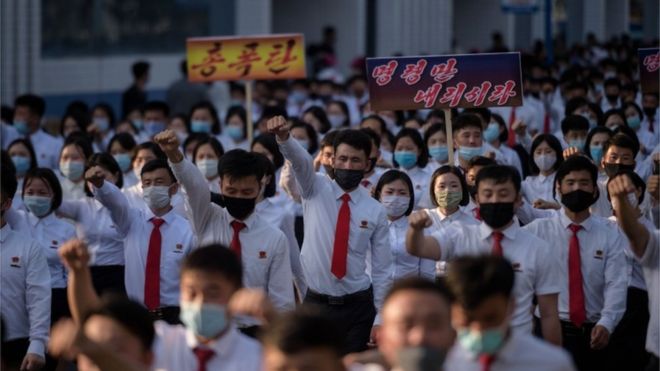
Kim Yo-jong, the North Korean leader's sister, threatened last week to close the office unless South Korea stopped defector groups from sending leaflets into the North.
She said the leaflet campaign was a hostile act that violated the peace agreements made during the 2018 Panmunjom summit between the South's Moon Jae-in and Kim Jong-un.
North Korean defectors occasionally send balloons carrying leaflets critical of the communist region into the North, sometimes with supplies to entice North Koreans to pick them up.
North Koreans can only get news from state-controlled media, and most do not have access to the internet.
Ties between the North and South appeared to improve in 2018, when the leaders of both countries met three times. Such high-level meetings had not taken place in over a decade.
But Pyongyang largely cut off contact with Seoul following the collapse of a summit between Kim and US president Donald Trump in Hanoi last year that left nuclear talks at a standstill.
The two Koreas remain technically at war because the 1950-1953 Korean war ended with an armistice rather than a peace treaty.
Latest Stories
-
Government plans mandatory drug tests for public service jobs — Muntaka
3 minutes -
Media urged to intensify awareness campaigns on breast cancer
8 minutes -
Interior Minister urges public to share drug intelligence
14 minutes -
Afadzato South DCE commissions water projects, teachers’ bungalow
19 minutes -
Council of State urges sustained dialogue, negotiations as teachers resume work
24 minutes -
We are committed to leaving a legacy in Mandari – Bole-Bamboi MP
28 minutes -
Greater Accra teachers resume work after strike suspension
36 minutes -
Education Minister assures teachers of salary adjustments by October 16
41 minutes -
Abass Osabutey declares bid for NDC Deputy National Organiser position
43 minutes -
Education Minister inaugurates NDU Governing Council, announces $25m seed funding
51 minutes -
THE LAW 101: La Beach Demolitions – The State’s own documents, the courts’ orders – and the bulldozers
54 minutes -
DVLA contributes GH¢17.7m to Consolidated Fund in 2025
57 minutes -
Why disaster risk reduction must connect early warnings, preparedness and financial protection to household-level resilience
1 hour -
Fentuo Tahiru narrates how 2018 Commonwealth Games visa scandal became an international embarrassment
1 hour -
The AI Gold Rush: Who strikes gold and who gets left behind?
1 hour