

Audio By Carbonatix
Leaders of selected mining communities in Northern Ghana have been empowered on Ghana’s minerals and mining laws, regulations and policies to ensure responsible mining and maximise benefits of the exploration of the mineral resources to their respective communities.
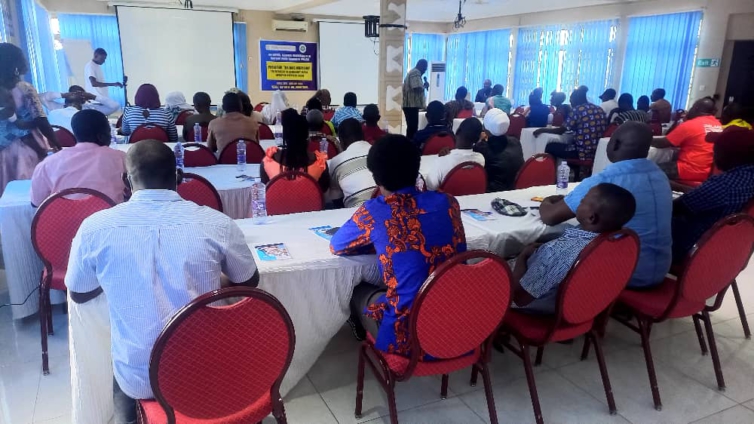
The leaders made up of women and youth leaders, assembly members, civil society organisations among others were sensitised on the rights and responsibilities of state agencies, mining companies, traditional authorities and mining communities to promote respect for human rights and compliance with the mining laws and regulations of Ghana.
The communities selected from seven districts from the five regions of the North were also trained on advocacy and communication skills to enable them negotiate for better compensations and resettlement packages.
The two-day paralegal training was organised by the Transformation of Marginal Areas (TAMA Foundation) Universal, a civil society organisation in collaboration with the Centre for Public Interest Law (CEPIL) with funding support from the Ford Foundation and held in Bolgatanga.
It was part of the implementation of the phase two of the Natural Resource Accountability in Northern Ghana Project, dubbed, “NaRAING II”.
The project seeks to set up Community Action Groups as community level accountability structures to monitor, document, and report on acts perpetuated by mining companies as against the law, human rights abuses, and environmental law violations, among others.
The communities were selected from Bongo District and Bolgatanga Municipal in the Upper East Region, Sissala East and Sissala West Districts in the Upper West Region, Mamprugu Moagduri District in the North East Region, Tatale in Northern Region and Bole in the Savanna Region.
Mr Jonathan Adabre, the Operations Manager of TAMA Foundation Universal explained that mining was part of the development of the country, however, it needed to be done in a manner that brought development to the mining companies, the government and the communities while the environment was maintained for future generations.
“We are seeking to ensure that there is equity, transparency and accountability in the mining sector and people must have the knowledge on the mining laws and regulations, people’s lives, rights and livelihoods must be respected so that there will be no conflict while all benefit,” he said.
Mr Augustine Niber, Executive Director of the Center for Public Interest Law (CEPIL), who took the participants through the Minerals and Mining of 2006, Act 703, explained that most of the mining related conflicts experienced in the country were as result of lack knowledge on the policies and rules regulating mining activities.
“Usually, it is the inception stage of mining that creates most of the legal issues and issues that bring about conflict and once a community of group of people are knowledgeable about the mining law, they are able to ensure that the entry requirements are addressed at the inception stage to prevent any escalation that brings about conflicts,” he said.
He impressed upon the participants to extend the knowledge acquired to their communities and serve as focal points to ensure that, not only the community benefitted from the mineral exploration in their communities, but that they worked to prevent conflicts and ensure sustainable mining.
The participants lauded the efforts of the TAMA Foundation Universal and its partners for organising the training and pledged to work with the community structures and other stakeholders including state agencies to promote responsible mining in their communities that bring benefits to the people. Mr Philemon Ataba, the Assemblyman for Bongo-Soe-Tamolga Electoral Area said the training had equipped him with the knowledge to educate and mobilise his community leadership to work to negotiate with the mining company in their area for better compensation packages.
Latest Stories
-
Ghana moves to regulate growing electric vehicle charging sector
14 minutes -
Poverty must not decide who lives – Ga Mantse
43 minutes -
Meta bans TikTok ads on its platforms in US
54 minutes -
Model markets key to tackling foreign encroachment in informal retail – GIPA CEO
1 hour -
Christa Pike has ‘profound’ health turnaround after botched execution, lawyers say
1 hour -
Outspoken Indian actor Nana Patekar dies suddenly at 75
1 hour -
White House blocks Microsoft from foreign worker hiring program
2 hours -
ICE agent shoots man in New York City
2 hours -
Zambia signs US health deal after disputes over data-sharing
2 hours -
‘I’ll end a serious relationship if I find another guy who’s more attractive’ – Ayra Starr
2 hours -
Guinea-Bissau to delay elections following last year’s coup
3 hours -
‘Bold and inventive’ Canadian poet Anne Carson wins Nobel Prize in Literature
3 hours -
Faustina Ampofo shines at Ghana Airport Customer Service Awards
5 hours -
Venezuela’s ex-leader Nicolás Maduro charged with conspiracy to commit torture
5 hours -
Harry says he ‘slipped into depression’ after leaving UK
5 hours