

Audio By Carbonatix
The Deputy Attorney-General and Deputy Minister for Justice, Justice Srem-Sai, has argued that Parliament lacks the constitutional authority to prosecute criminal cases and, therefore, cannot delegate such powers to any institution, including the Office of the Special Prosecutor (OSP).
His comments follow a recent High Court ruling that questioned the prosecutorial authority of the OSP, triggering intense legal and public debate about the scope of its mandate.
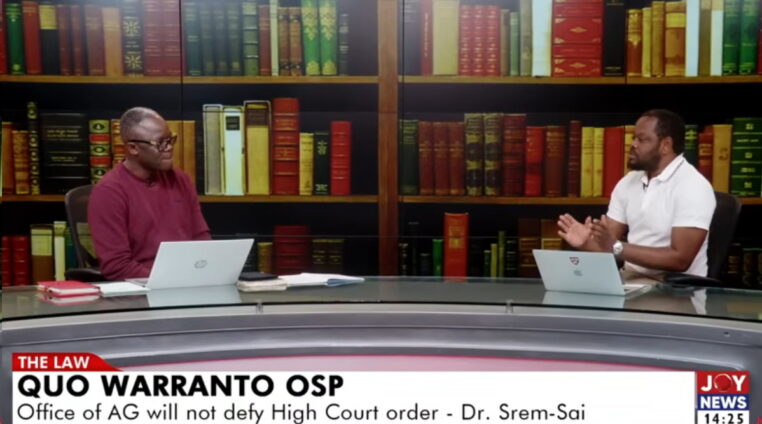
Speaking on The Law on JoyNews with Samson Lardy Anyenini on Sunday, April 19, Mr Srem-Sai said the Constitution clearly vests prosecutorial authority in the Attorney-General, making any attempt by Parliament to transfer that power through ordinary legislation legally untenable.
According to him, Parliament has no power to prosecute and that once it has no power to prosecute, it cannot delegate that power to anybody.
Mr Srem-Sai grounded his argument in Article 88 of the 1992 Constitution, which designates the Attorney-General as the principal legal adviser to the state and the authority responsible for initiating and conducting criminal prosecutions.
He explained that while the Attorney-General may delegate this power, such delegation must follow recognised legal mechanisms, including executive instruments for public officers or fiats for private individuals.
In his view, the OSP’s reliance on provisions in its enabling law does not meet this constitutional requirement.
“The person whom the Constitution gives authority to is the only person who can delegate it,” he said, stressing that legislative instruments or Acts of Parliament cannot substitute that authority.
The Deputy Attorney-General said the High Court’s decision was based on the OSP’s failure to demonstrate that it had obtained the necessary authorisation from the Attorney-General before initiating prosecutions.
He noted that the court interpreted Section 4 of the OSP Act as requiring such authorisation, either through an executive instrument or other legally recognised means.
Without this, he said, any prosecutorial actions undertaken by the OSP risk being declared unlawful.
He added that the court’s directive for the Attorney-General to take over ongoing prosecutions should be understood as providing the required authority for those cases to proceed, rather than a wholesale transfer of cases to a new team.
Parliament cannot amend the Constitution by statute
Mr Srem-Sai further argued that the establishment of an independent prosecutorial body would require a constitutional amendment, not ordinary legislation.
He maintained that Parliament cannot use an Act to alter constitutional provisions, particularly those relating to the distribution of state powers.
“If you want to create an independent prosecutorial authority in Ghana, you must amend the Constitution,” he said.
He described attempts to rely on the OSP Act or related legislative instruments as a “backdoor” approach to constitutional change, warning that such practices could undermine the rule of law.
Addressing arguments that the OSP was intended to operate independently, Mr Srem Sai said the law itself makes it clear that the office prosecutes “on the authority of the Attorney-General.”
He explained that while policy intentions and memoranda accompanying legislation may suggest broader objectives, they cannot override the express provisions of the law.
“When there is a conflict between what is stated in the law and what is in the memorandum, what prevails is what is stated in the law,” he said.
The Deputy Attorney-General cautioned that ignoring constitutional procedures in pursuit of policy goals could set a dangerous precedent.
He warned that if Parliament were allowed to reassign constitutional powers through ordinary legislation, it could lead to future encroachments on other arms of government.
“In public law, the procedure matters as much as the outcome,” he said. “If you don’t follow the prescribed process, whatever you achieve can be struck down.”
Mr Srem-Sai indicated that the Attorney-General’s office would comply with the court’s directives, including taking steps to regularise ongoing prosecutions affected by the ruling.
He also acknowledged concerns about the potential disruption to anti-corruption efforts but insisted that adherence to constitutional principles must remain paramount.
“No one wished for this outcome,” he said, “but it is something many legal minds anticipated. The solution is to follow the Constitution.”
Latest Stories
-
Hohoe floodwaters recede, leaving over 5,000 homeless
10 minutes -
Three arrested after drones allegedly flown over EOCO headquarters during Baffour Awuah probe
11 minutes -
Gender Ministry urges Ghanaians to see older persons as contributors, not beneficiaries
14 minutes -
Flydubai passenger describes hugging his children as plane nosedived during attack
14 minutes -
Africa’s richest man launches Kenya oil refinery despite land protests
15 minutes -
CSOs urge government to review 10,000 sq km offshore gold licences over fisheries concerns
16 minutes -
National Ambulance Service treats 8 casualties after Avenor fire in Accra
17 minutes -
Former Duffuor spokesperson, Antonio Asinyo enters NDC Youth Organizer race
19 minutes -
Zimbabwe tycoon Wicknell Chivayo and wife killed in helicopter crash
20 minutes -
Russia targets busy bridge in central Kyiv in broad daylight
20 minutes -
Putin shows no sign of stopping the war as Russia doubles down on Ukraine
22 minutes -
Gov’t outlines measures to support Ghana’s growing population of older persons
22 minutes -
Star Oil rejoins COMAC, calls for reforms to governance structure
28 minutes -
Norwegian government strengthens soybean value chain to expand market access for farmers
30 minutes -
NPP diaspora executives back proposal to allow dual citizens to contest parliamentary elections
31 minutes