

Audio By Carbonatix
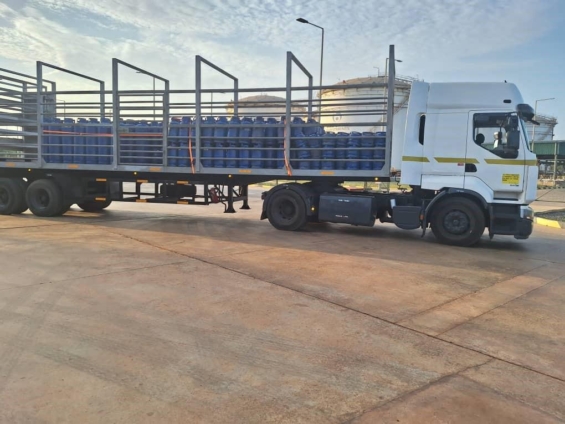
Blue Ocean LPG Bottling Plant has partnered with Puma Energy Ghana to support the government of Ghana's clean cooking initiative and the safe transportation of liquefied petroleum gas (LPG) by distributing more than 1,025 cylinders to six local communities as part of the plan to distribute over 15,000 cylinders by December 2024.
In sub-Saharan Africa, LPG is considered an essential component of the energy mix, where according to the International Energy Agency (IEA), an estimated 970 million people are without access to clean cooking fuels and technology and rely heavily on wood, charcoal and kerosene.
These contribute to poor air quality and environmental degradation including deforestation.
According to the DGB Group, wood remains the primary source of energy for cooking and heating in many rural areas of Ghana.
The high demand for fuel wood has led to the indiscriminate cutting of trees, particularly in areas with low forest coverage causing deforestation.

In Ghana, the use of burning biomass for cooking has led to increase in childhood pneumonia and asthma resulting in lower respiratory tract infection, which is associated with inhaling smoke from traditional fuels, and the third leading cause of death in Ghana, according to the Environmental Markets Lab (mLab).
The partnership between Puma Energy and Blue Ocean is to foster access to clean cooking providing innovative solutions to low-income households that would not otherwise have access to LPG.
These initiatives aim to improve the health and environmental welfare of citizens by transitioning them from traditional fuels like wood and charcoal to cleaner, more efficient LPG.
According to the Ghana Statistical Services' 2022 Ghana Demographic and Health Survey (GDHS) report, about 25% of households in Ghana use clean fuel and technologies for cooking.
The government is therefore actively promoting LPG use and aims to reach a 50% penetration target by 2030.
Blue Oceans' cylinder distribution process aligns with the National Petroleum Authority (NPA)-led Cylinder Recirculation Model (CRM) project to increase access to clean energy for cleaner cooking.
Its state-of-the-art bottling facility guarantees efficiency and safety. An automated, telescopic conveying channel moves empty cylinders through the many phases of the bottling process which includes everything from degreasing and pressure washing to weight checking, programming, leak detection and shrink-wrapping.
The automated 18-head carousel fills 1200 cylinders including 3, 6, 12.5, and 14 kg per hour.
Additionally, the plant contains a manual filling installation that can fill 36 and 52 kg cylinders and acts as a standby should the automated system fail, always ensuring 100%operability.
Over 60 Puma Energy retail outlets and 40 community exchange centres will serve as distribution centres to deploy over 15,000 filled cylinders of various sizes. Currently, the filled cylinders have been deployed to Puma Energy's retail service stations in Nmai Dzorn, Adentan, Kissehman, amongst other places.
Further distribution is expected to be carried out across communities in rural and urban areas in 11 regions by the end of 2024.
Zwelithini Mlotshwa, General Manager of Puma Energy Ghana, an affiliate of Blue Ocean Investments, emphasised the value of the partnership and the contribution of the partnership to enabling Puma Energy's commitment to the clean cooking initiative.
“As partners in this programme, we are committed to enabling access to clean cooking to improve the well-being of unserved communities. We believe that by reducing household reliance on harmful traditional cooking fuels, we can make a positive impact on both people's health and the environment,” he said.
The plant guarantees safety and accessibility, it is a welcome boost to energy efficiency in Ghana and makes it possible to implement the Cylinder Recirculation Model (CRM) project, said Michael S. Kyeremanteng, the Operations Manager, Blue Ocean LPG Bottling Plant.
The Puma Energy Clean Cooking Initiative seeks to drive the National Petroleum Authority's low-income African communities access to affordable, accessible and clean cooking alternatives.
The programme aims to increase LPG accessibility especially, and raise knowledge of the advantages of clean cooking.
Alongside governments, private sector companies, international organisations and civil society, Puma Energy joined the Clean Cooking Declaration at the International Energy Agency's (IEA) Summit on Clean Cooking in Africa in Paris in May 2024, a commitment to making 2024 the pivotal year for clean cooking.
By participating in the declaration, Puma Energy pledged to take concrete steps towards advancing the clean cooking agenda, through action on the ground, raising awareness, and fostering greater collaboration among the key stakeholders.
Latest Stories
-
Nigerian military aircraft crashes, killing 32
1 minute -
MTN encourages Ghanaians to use MoMo for saving, investing and financial planning
1 minute -
Absa Bank Ghana names Stephen Ato Frimpong as Board Chair
9 minutes -
Pickford ‘almost caused crash’ with careless driving
11 minutes -
Author and former politician Jeffrey Archer dies aged 86
22 minutes -
No education reform can succeed without teachers – Education Ministry
31 minutes -
Gauff condemns racist abuse after China Open win
47 minutes -
Medvedev disqualified for hitting spectator with ball
56 minutes -
Oliseh scores twice in late comeback win for France
1 hour -
Pentagon stops using Anthropic AI tools after blacklisting company, BBC told
1 hour -
From despair to dance: Family of nurse Salomey Baffoe rejoices after GH¢100k bail granted
2 hours -
Kejetia Phase III pricing talks loom as government moves to restart stalled works
2 hours -
Nchiraa Yam festival: Two killed, 14 injured as police restore calm
2 hours -
I draw inspiration for my songs from Reggae music – Lyrical Joe
2 hours -
AI must not replace human judgment in public spending – BoG Governor
3 hours