

Audio By Carbonatix
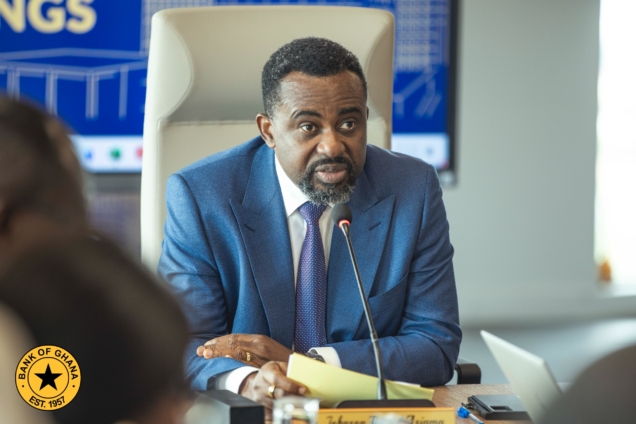
The Governor of the Bank of Ghana, Dr. Johnson Asiama, has admitted that the path ahead in restoring macroeconomic stability remains complex and fraught with risks, both global and domestic.
According to him, this underscores the importance of today’s Monetary Policy Committee (MPC)meeting and the decisions they are set to make.
Giving opening remarks ahead of the three-day MPC meeting, Dr. Asiama said since its last meeting, there had been further moderation in inflation, citing the Ghana Statistical Service's April 2025 inflation.
He, however, noted that the inflation rate is still well above the medium-term target band of 8 ± 2%, breaching the upper consultation band of 19%.
In March 2025, the MPC responded decisively to the inflation outlook by raising the policy rate by 100 basis points to 28%.
The Governor said preliminary evidence suggests this action has contributed to dampening inflation momentum.
“Importantly, the cedi has appreciated sharply by nearly 19% between April and May 2025, helping to ease imported inflation pressures and restore public confidence. The appreciation reflects a combination of factors, including prudent monetary policy, improved market sentiment, and external sector gains”, he explained.
“We are also seeing encouraging signs of macroeconomic progress. Ghana has reached a Staff-Level Agreement with the IMF on the Fourth Review of the ECF [Economic Credit Facility] Programme, and although some prior actions remain outstanding, the trajectory is clearly positive. The recent S&P upgrade of Ghana’s sovereign rating from Selective Default to CCC+ further affirms this progress. External reserves have strengthened, the trade balance has improved, and consumer and business confidence indices are rising steadily”, he added.

The Governor, however, said significant challenges persist, mentioning the inflation outlook, while improving, remains vulnerable to second-round effects, food supply constraints, especially from northern Ghana and the Sahel and external price shocks, particularly given volatile global commodity markets.
He pointed out that geopolitical tensions and evolving global trade dynamics, including the recent US-led tariff disputes, have heightened market uncertainty and could affect commodity prices, exchange rates, and financial flows in emerging markets including Ghana.
Latest Stories
-
SOE comments controversy: ‘We must never abandon our humanity because of judicial office’ – CJ
19 seconds -
Samuel Kojo Brace declares intention to contest NPP parliamentary primary in Ahanta West
2 minutes -
Dr Apaak calls for evidence-based education response to emergencies
5 minutes -
Pilot may have sought to crash Israel-bound flight after stabbing other pilot, Netanyahu says
10 minutes -
Report flags potential money laundering, terrorist financing risks among Ghana’s NGOs
10 minutes -
Breast Cancer Awareness Month launched: 2,695 women die from breast cancer annually — Dr Ann-Dadzie
18 minutes -
Mahama’s proposed airline looks to South America, Caribbean as Ghana confronts mounting drug trafficking cases
33 minutes -
5% progress on Suame Interchange Phase One inadequate – Roads Minister tasks contractor to speed up work
36 minutes -
Photos: Vice President joins GAAS Awards to celebrate outstanding women leaders
37 minutes -
OSP vs Ken Ofori-Atta, SML and others: Court gives OSP four more weeks to serve Ofori-Atta with summons
38 minutes -
High Commission sends caution to Ghanaians in South Africa ahead of planned protests
41 minutes -
Okai Mintah outlines vision for NDC Youth Wing as he engages MMDCEs
47 minutes -
Mahama Ayariga leads renewed push for stronger local governance through partnerships
50 minutes -
NDC youth organiser aspirant Okai Mintah consults MMDCEs ahead of elections
51 minutes -
PHOTOS: Ayikuma Methodist Basic School wins National Juniors Challenge
54 minutes