


Audio By Carbonatix
Portugal has set a new record high temperature in May, with 40.3 °C recorded in the central town of Mora, as countries in western Europe grapple with sweltering-hot weather.
The temperature recorded on Wednesday bests Portugal's previous record of 40 °C set in May 2001.
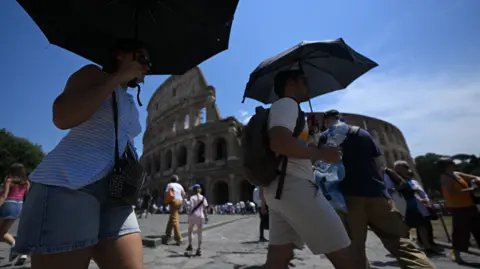
Ministers in France are meeting to assess the country's preparedness for heatwaves, while tennis number one Jannik Sinner bowed out of the French Open after suffering from the heat. Meanwhile, Italian authorities issued a red heatwave alert for the capital, Rome, where it topped out at 32C on Thursday.
The heatwave is forecast to continue into the weekend, with Germany, Spain and Switzerland having also faced unusually hot conditions.
Parts of Portugal will peak above 35C on Friday, before the heat begins to recede, according to the nation's meteorological office.
French Prime Minister Sébastien Lecornu chaired a ministerial meeting on Thursday afternoon to develop a readiness plan for extreme heat events, including combating forest fires and ensuring adequate water supplies over the summer.
Baccalaureate exams - the French equivalent of A-levels - will continue during the heatwaves, despite some schools having to close their doors due to uncomfortably high temperatures inside.
A primary school in Souston, in the Landes region, will remain shut on Friday after it reached 53 °C inside earlier in the week, a local official told French media.
Education Minister Édouard Geffray told BFMTV that exam centres would be able to choose rooms with the most shade, adding that exams would go ahead "simply because the students are prepared and... there is also a schedule according to which they expect their results".
The decision has attracted criticism from education unions and teachers, with one telling French radio that teachers "forced to bring in their own fans".
A survey by France's secondary school union found nearly 78% had recorded temperatures above 30 °C this week, and said it had received reports of teachers bringing in screwdrivers to prise windows open.
Seventeen departments of France - in the north-west, as well as Paris - are under an orange alert, indicating people should be "very vigilant" about the weather.
Temperatures reached 33C in Paris on Thursday, and are expected to top out at 34C on Saturday and Sunday.
Police have announced measures to ease traffic in the capital until Saturday, including only allowing lower-emission cars on roads and lowering speed limits. A single fare for the entire public transport network will be offered at the same time.
At the French Open in Paris, Sinner appeared to be cruising to a victory before suddenly taking a turn for the worse.
The Italian complained of dizziness and feeling lethargic before hitting a wall.
"It was a tough spot to be in," he commented afterwards, but added, "Really, it was nothing against the heat, nothing against the weather. It was just me today, but it happens."
Meanwhile, Italy's red alert in Rome - as well as in Florence, Bologna, Brescia and Turin - is the first of the year, warning of "possible negative effects on the health of healthy, active people".
Temperatures will climb to 35C in Madrid over the weekend. Though the current spell does not officially qualify as a heatwave in Spain, the nation's meteorological office has said the heat is that usually seen in July and August.

The immediate cause of the heatwave is a "heat dome" - an area of high pressure that becomes "stuck", trapping warm air underneath it.
While it is difficult to link individual extreme weather events to climate change, scientists say climate change makes heatwaves more frequent and more intense.
Over the last 30 years, Europe has been warming by 0.56 °C per decade, according to the Copernicus climate service - enough to make heat extremes significantly more severe.
The UN warned on Thursday that global average temperatures were likely to continue at or near record levels this year and for the next four years.
The 11 hottest years ever recorded occurred from 2015 onwards, and the UN's weather and climate agency said this trend was expected to continue, with a new hottest-ever year "likely" before 2031.
Latest Stories
-
NPP’s new executives will not alter our 2028 preparations – Tanko-Computer
31 minutes -
Tema East MP urges men to take active role in breast cancer awareness
36 minutes -
Hawa Koomson vows to bring experience and maturity to NPP women’s wing
40 minutes -
Opare Addo cautions NDC against adopting NPP’s aggressive politics
41 minutes -
NPP has 35 months to prepare for 2028 after early reorganisation – Political strategist
47 minutes -
All six passengers presumed dead after plane went missing off US coast
58 minutes -
Teachers’ promotion arrears to be paid by Oct. 30 – Education Minister
1 hour -
Stop talking too much on stage – Kafui Dey warns MCs
1 hour -
Government has Ho, Volta Region at Heart — Warlord of Asogli
1 hour -
Mahama reaffirms commitment to Volta development at Asogli Te Za
1 hour -
REGSEC orders immediate demolition of fire-ravaged building at Koforidua Jackson Park
2 hours -
Ambassador Boateng congratulates new NPP leadership, urges reconciliation, rebuilding
2 hours -
50 vetted to contest Effutu NDC executive positions
2 hours -
GACL enhances security screening at Accra International Airport
2 hours -
COCOBOD raises GH¢3.39bn at 11% in first Commercial Paper tranche
2 hours