

Audio By Carbonatix
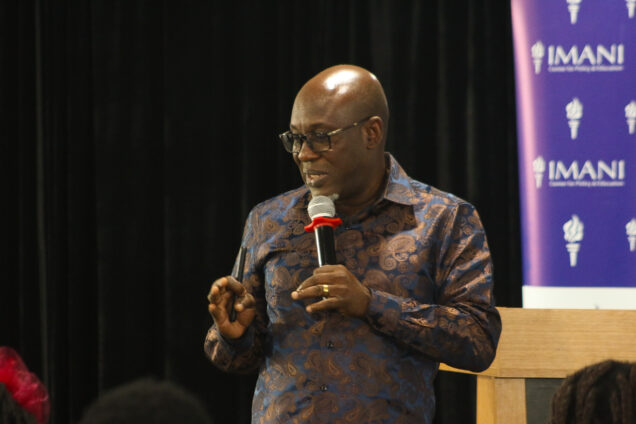
Lawyer and Vice President of IMANI Africa, Kofi Bentil, has rejected calls for greater military involvement in enforcing discipline in Africa, arguing that effective law enforcement and the rule of law, rather than military intervention, are critical to maintaining order.
Mr Bentil said countries that had achieved high levels of development generally relied on functioning civilian institutions and law enforcement systems rather than using the military to enforce discipline among citizens.
He was speaking on Tuesday, August 25, at the Students and Young Professionals African Liberty Academy (SYPALA) 2026, organised by the IMANI Centre for Policy and Education in partnership with the University of Professional Studies, Accra (UPSA).
Mr Bentil said the argument for a stronger military role in addressing indiscipline was raised during a recent engagement he had with military leaders from several African countries.
He said the military leaders had argued that Africa needed greater discipline, including stronger measures to address problems such as traffic violations and disorder.
However, he said he disagreed with the proposed approach.
“When I finished talking, I said, look, we should do exactly the opposite. It is not because the discipline is not a problem,” he said.
Mr Bentil argued that the presence of the military on the streets was not a substitute for effective civilian law enforcement.
He said developed countries had demonstrated that discipline could be maintained through functioning institutions and enforcement of laws without giving the military a dominant role in civilian affairs.
“Look at the United States. Look at Europe. Look at the United Kingdom. Look at Norway. Look at Switzerland. The places that are most developed are the places where the military stays in the barracks,” he said.
He said the key difference was the effectiveness of the rule of law and civilian law enforcement.
“The only reason why they don't change is because there is rule of law. There is law enforcement. And law enforcement has nothing to do with having the military walking the streets,” he said.
According to him, effective enforcement means citizens understand that violations of the law will have predictable consequences, regardless of who is involved.
“Law enforcement means you cross the traffic lights, you are arrested, and you pay a fine. And as long as that works, people will follow you,” he said.
Mr Bentil also questioned the credibility of arguments that the military should be used to solve Africa's indiscipline when military institutions themselves had, in some instances, been involved in unconstitutional seizures of political power.
“The military in Africa is the most indisciplined institution. Because they break the law, overthrow government, and abuse people,” he said.
He said the issue was therefore not simply about imposing discipline, but about building institutions capable of enforcing laws consistently and within constitutional limits.
His argument formed part of a broader discussion on limited government, rule of law and the need for institutions to exercise power within clearly defined boundaries.
Mr Bentil said governments were created by citizens and entrusted with specific powers to provide services and protect citizens, but warned that those powers could become tools of oppression when they were not properly checked.
“No government has the right to be self-sufficient from its people. Or to exceed the authority it has been given by its people. If allowed, that leads to oppression,” he said.
Latest Stories
-
Power restoration fault suspected in Kumasi Central Market fire
4 hours -
The 7-foot giant of Ngleshie Amanfro: Seven-foot Ghanaian Ephraim Saawa dreams of joining the national basketball team
5 hours -
Government promises support for Kumasi Central Market fire victims
5 hours -
Vibes The Movie: Big Ghun’s Ghanaian film earns five nominations at 2026 REFFA
5 hours -
MamaCare CEO warns unresolved conflicts among health workers could undermine maternal and neonatal care
6 hours -
Health professionals urged to translate medical knowledge into practice to save mothers
6 hours -
Conflicts among care providers linked to maternal, neonatal deaths – Expert
7 hours -
GIS marks 10th TIME conference, champions improved teaching practices
8 hours -
BRICS Or Balance? What Ghana’s bid really means
8 hours -
GPRTU wants full TRAFFITECH-GH implementation to start in 2027
8 hours -
How 10-mile walks for basic education birthed a 50-year legal career for Justice Korbieh
8 hours -
Mahama announces plans to import electric wheelchairs for PWDs
8 hours -
KGL U17 Colts 2026: Western beat Prempeh Elite Academy to set up final final with Greater Accra Region
9 hours -
Late Solanke strike salvages 10-man Spurs draw at Man United
9 hours -
Gender Ministry to monitor welfare of Nana Akua Addo’s children amid domestic violence case
9 hours