

Audio By Carbonatix
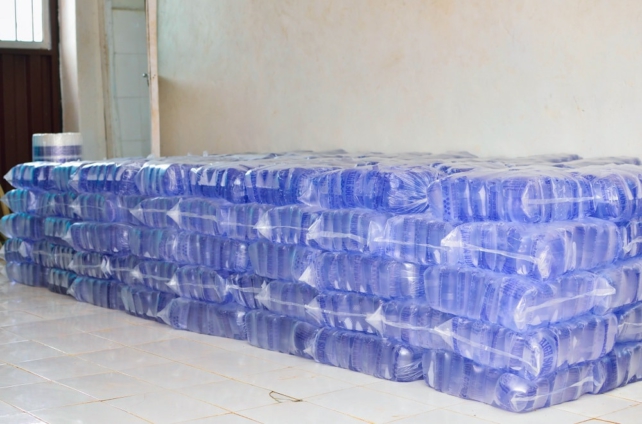
The Ghana Statistical Service has described as worrying the growing consumption of sachet water as its previous studies reveal significant faecal contamination in a number of the packaged water on the market.
The Service indicates that consumption of sachet water by households in Ghana has quadrupled in the last decade, from 9% to 37.4%.
However, its multiple indicator cluster survey in 2017 revealed that 34.1% of households had their sachet water contaminated with an appreciable amount of Escherichia Coli.
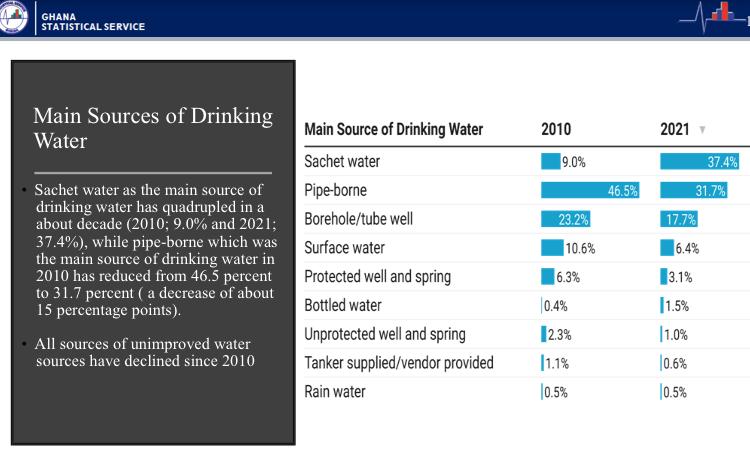
In 2010, pipe-borne water was pegged as the main water drinking source in most homes in Ghana.
But, the figure is reported to have reduced from 46.5% to 31.7% over the last decade with sachet water becoming the preferred source of drinking water.
According to the 2021 Population and Housing Census, about 37% of the 8.3 million households in Ghana consume packaged-sachet water as their main source of drinking water.
The figure represents a quadruple increase from 9% in 2010.
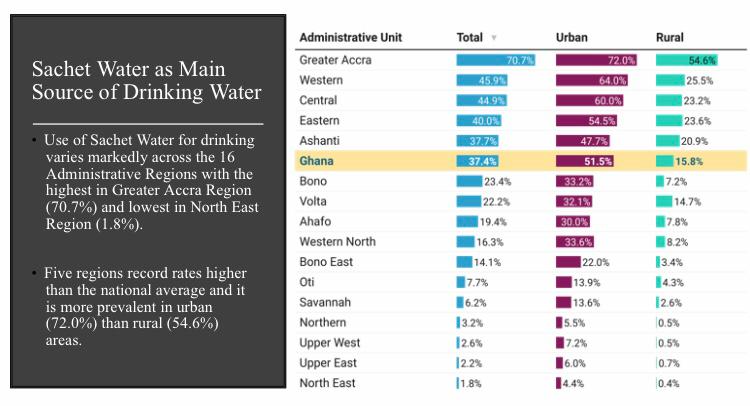
The consumption of sachet water is said to be prevalent in urban areas (72%) with five regions cumulatively recording higher rates than the national percentage points.
Greater Accra region recorded the highest (70.7%) use of sachet water for drinking while the North-East region was the lowest (1.8%).
However, the Ghana Statistical Service is worried the figure poses a public health threat as a number of water sources for packaged water production have been found to contain faecal matter.
Assistant Chief Statistician with the Ghana Statistical Service, Dr. Peter Takyi Peprah, was speaking at a stakeholder engagement in the Water, Sanitation and Hygiene Sector.
“We need to pay attention to those who are in the production of sachet water. In 2017, a multiple indicator cluster survey was conducted which we didn’t just collect information about the source of drinking water but we tested the quality of these drinking water sources for a household. We realized 34.1% of household drinking water sources have faecal contamination. Faecal contamination simply means we have toilet in our water,” he said.
The engagement in Kumasi was to keep stakeholders in the WASH sector abreast of the findings from the census to inform policy.
Dr. Takyi Peprah is therefore calling for thorough examination of produced sachet water on the Ghanaian market.
“The Food and Drugs Authority must embark on thorough monitoring and supervision of the production of these sachet water. They should try their best to test on regular basis the sources of water in the production of these waters. So that in case the water is contaminated they can advise them to change the source of water or close that company. They always say the water source is either spring water or underground water. Looking at the number of people drinking sachet water it can pose a public threat,” he suggested.
Latest Stories
-
Friends of Bridget Bonnie Marks her 35th birthday with donation to Kasseh Model Health Centre
4 minutes -
Landfilling waste management creates no value, it’s an economic waste
32 minutes -
Photos: Speaker Bagbin Commissions MPs constituency office under parliamentary decentralisation programme
47 minutes -
Black Stars technical advisor Winfried Schäfer sacked as GFA shakes up backroom staff
52 minutes -
Wenchi water project almost complete, critical to gov’t agenda – GWL MD
1 hour -
Anti-LGBTQ+ bill not part of government’s legislative agenda – Inusah Fuseini
1 hour -
Anti-LGBTQ Bill: Forget the rumour mongers, I’m a man of action, and will pass the bill – Speaker
2 hours -
Women and children among those killed in Sudanese army shelling of wedding celebration
2 hours -
President Mahama is not sincere with Ghanaians on LGBTQ bill matter – Hassan Tampuli
2 hours -
Gov’t to establish Prison Industrial Hub to equip inmates with income-generating skills – Prison Service boss
3 hours -
Alhassan Tampuli donates cement, roofing sheets to support storm victims in Gushegu
3 hours -
Alhassan Tampuli appeals for urgent support for storm victims in Gushegu
3 hours -
The hypocrisy must stop; pass Anti-LGBTQ+ Bill now – Alhassan Tampuli to Mahama
3 hours -
Imprisonment should be rehabilitative, not punitive – Ghana Prisons boss at UNGA
3 hours -
Ga Adangbe traditional priests petition Mahama over McDan aviation licence revocation
3 hours