

Audio By Carbonatix
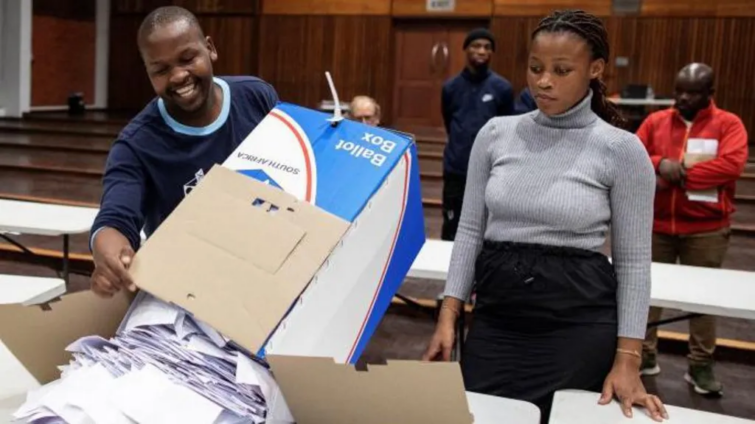
South Africa's ruling party, the African National Congress (ANC), is on course to lose its majority in parliament for the first time since it came to power 30 years ago, partial results from Thursday's parliamentary election suggest.
With results from around 43% voting districts counted so far, the ANC is leading with 43%, followed by the Democratic Alliance (DA) with 24%.
Both the radical Economic Freedom Fighters (EFF) and the uMkhonto weSizwe Party (MK Party) of former President Jacob Zuma are on around 10%.
Final results are expected over the weekend.
Many voters blame the ANC for the high levels of corruption, crime and unemployment in the country.
The respected Council for Scientific and Industrial Research (CSIR) and the News24 website have projected that the party's final vote could be around 42%, a big drop from the 57% it obtained in the 2019 election.
This would force it go into a coalition with one or more of the other parties in order to form a majority in parliament.
The DA has liberal economic policies, while both the EFF and MK favour more state intervention and nationalisation, so the choice of partner would make a huge difference to South Africa's future direction.
It is unclear whether President Cyril Ramaphosa will remain in power, as he could come under pressure from the ANC to resign if the party gets less than 45% of the final vote, said Prof William Gumede, chairman of the non-profit Democracy Works Foundation.
"The ANC could turn him into a scapegoat, and a faction within the party could push for him to be replaced by his deputy, Paul Mashatile. The EFF and MK are also likely to demand his resignation before agreeing to any coalition with the ANC," Prof Gumede told the BBC.
South Africans do not directly vote for a president. Instead they vote for members of parliament who will then go on to elect the president.
According to the electoral commission, the last polling station closed at 0300 on Thursday morning local time.
One electoral official in Johannesburg told the BBC the queues were reminiscent of the historic 1994 election, when black people could vote for the first time.
Sifiso Buthelezi, who voted in Johannesburg's Joubert Park - the biggest polling station in South Africa - told the BBC: "Freedom is great but we need to tackle corruption."
Change has been a recurring sentiment, especially among young voters.
"The turnout amongst them was high, and they voted against the ANC," Prof Gumede said.
Ayanda Hlekwane, one of South Africa's "born-free" generation, meaning he was born after 1994, said despite having three degrees he still did not have a job.
“I’m working on my PhD proposal so that I go back to study in case I don’t get a job,” he tells the BBC in Durban.
But Mr Hlekwane said he was optimistic that things would change.
Support for the ANC is expected to be higher among the older generation.
One 89-year-old woman, Elayne Dykman, told the BBC she hoped that young people in South Africa did not take their vote for granted.
According to the electoral commission, the last polling station closed at 0300 on Thursday morning local time.
One electoral official in Johannesburg told the BBC the queues were reminiscent of the historic 1994 election, when black people could vote for the first time.
Sifiso Buthelezi, who voted in Johannesburg's Joubert Park - the biggest polling station in South Africa - told the BBC: "Freedom is great but we need to tackle corruption."
Change has been a recurring sentiment, especially among young voters.
"The turnout amongst them was high, and they voted against the ANC," Prof Gumede said.
Ayanda Hlekwane, one of South Africa's "born-free" generation, meaning he was born after 1994, said despite having three degrees he still did not have a job.
“I’m working on my PhD proposal so that I go back to study in case I don’t get a job,” he tells the BBC in Durban.
But Mr Hlekwane said he was optimistic that things would change.
Support for the ANC is expected to be higher among the older generation.
One 89-year-old woman, Elayne Dykman, told the BBC she hoped that young people in South Africa did not take their vote for granted.
Latest Stories
-
From ShattaFest to MoMo Fest: Entertainment takes centre stage in youth engagement
3 minutes -
Nigerian military aircraft crashes, killing 32
8 minutes -
MTN encourages Ghanaians to use MoMo for saving, investing and financial planning
8 minutes -
Absa Bank Ghana names Stephen Ato Frimpong as Board Chair
16 minutes -
Pickford ‘almost caused crash’ with careless driving
18 minutes -
Author and former politician Jeffrey Archer dies aged 86
29 minutes -
No education reform can succeed without teachers – Education Ministry
38 minutes -
Gauff condemns racist abuse after China Open win
54 minutes -
Medvedev disqualified for hitting spectator with ball
1 hour -
Oliseh scores twice in late comeback win for France
1 hour -
Pentagon stops using Anthropic AI tools after blacklisting company, BBC told
1 hour -
From despair to dance: Family of nurse Salomey Baffoe rejoices after GH¢100k bail granted
2 hours -
Kejetia Phase III pricing talks loom as government moves to restart stalled works
2 hours -
Nchiraa Yam festival: Two killed, 14 injured as police restore calm
3 hours -
I draw inspiration for my songs from Reggae music – Lyrical Joe
3 hours