

Audio By Carbonatix
An estimated 4,000 illegal gold miners are hiding underground in South Africa after the government cut off food and water in an effort to "smoke them out" and arrest them.
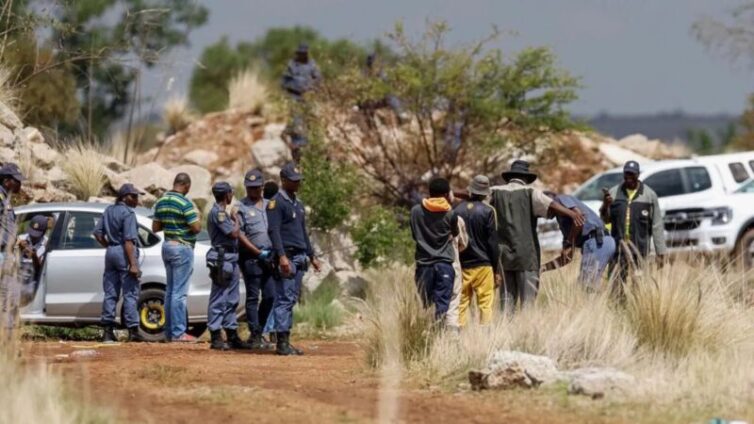
The miners have been in a mineshaft in Stilfontein, in the North West province, for about a month.
They have refused to cooperate with authorities as some are undocumented - coming from neighbouring countries like Lesotho and Mozambique - and fear being deported.
Illegal miners are called "zama zama" ("take a chance" in Zulu) and operate in abandoned mines in the mineral-rich country. Illegal mining costs the South African government hundreds of millions of dollars in lost sales each year.
Many South African mines have closed down in recent years and workers have been sacked.
To survive, the miners and undocumented migrants go beneath the surface to escape poverty and dig up gold to sell it on the black market.
Some spend months underground - there is even a small economy of people selling food, cigarettes and cooked meals to the miners.
Local residents have pleaded with the authorities to assist the miners, but they have refused.
"We are going to smoke them out. They will come out. We are not sending help to criminals. Criminals are not to be helped - they are to be persecuted [sic]," said Minister in the Presidency Khumbudzo Ntshavheni on Wednesday.
Police are hesitant to go into the mine as some of those underground may be armed.
Some are part of criminal syndicates or "recruited" to be in one, Busi Thabane, from Benchmarks Foundation, a charity which monitors corporations in South Africa, told the BBC's NewsDay programme.
Without any access to supplies, conditions underground are said to be dire.
"It is no longer about illegal miners – this is a humanitarian crisis," said Ms Thabane.
On Thursday, community leader Thembile Botman told the BBC that volunteers had used ropes and seat belts to pull a body out of the mine.
"The stench of decomposing bodies has left the volunteers traumatised," he said.
It's not clear how the person died.
Although the authorities have been blocking food and water, they have temporarily allowed local residents to send some supplies down by rope.
Mr Botman said they had been communicating with the miners by notes written on pieces of paper.
Police have blocked off entrances and exits in an effort to compel the miners to come out.
This is part of the Vala Umgodi, or "Close the Hole", operation to curb illegal mining.
Five miners were pulled out on Wednesday by rope, but they were frail and weak. Paramedics attended to them, and then they were taken into police custody.
In the last week, 1,000 miners have emerged and been arrested.
Police and the army are still at the scene waiting to detain those who are not in need of medical care after resurfacing.
"It’s not as easy as the police make it seem – some of them are fearing for their lives," said Ms Thabane.
Many miners spend months underground in unsafe conditions to provide for their families.
"For many of them it's the only way they know how to put food on the table," said Ms Thabane.
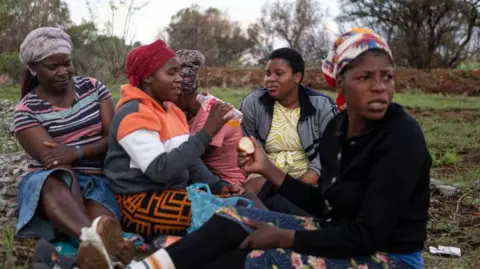
Local residents have also attempted to convince the miners to come out of the mineshaft.
"Those people must come out because we have brothers there, we have sons there, the fathers of our kids are there, our children are struggling," local resident Emily Photsoa told AFP.
The South African Human Rights Commission says it will investigate the police for depriving the miners of food and water.
It said there is concern that the government’s operation could have an impact on the right to life.
Minister Ntshavheni's remarks have provoked mixed reaction from South Africans, with some praising the government's unyielding approach.
"I love this. Finally, our government is not tiptoeing on these serious matters. Decisiveness will help this country," one person wrote on X.
While others felt the stance was inhumane.
"In my view, this kind of talk from the Minister in the Presidency is disgraceful and dangerous hate speech," one user said.
Another wrote: "They are criminals but they have rights too."
Illegal mining is a lucrative business across many of South Africa's mining towns.
Since December last year, nearly 400 high-calibre firearms, thousands of bullets, uncut diamonds and money have been confiscated from illegal miners.
This is part of an intensive police and military operation to stop the practice that has severe environmental implications.
Latest Stories
-
Landfilling waste management creates no value, it’s an economic waste
13 minutes -
Photos: Speaker Bagbin Commissions MPs constituency office under parliamentary decentralisation programme
29 minutes -
Black Stars technical advisor Winfried Schäfer sacked as GFA shakes up backroom staff
33 minutes -
Wenchi water project almost complete, critical to gov’t agenda – GWL MD
49 minutes -
Anti-LGBTQ+ bill not part of government’s legislative agenda – Inusah Fuseini
52 minutes -
Anti-LGBTQ Bill: Forget the rumour mongers, I’m a man of action, and will pass the bill – Speaker
2 hours -
Women and children among those killed in Sudanese army shelling of wedding celebration
2 hours -
President Mahama is not sincere with Ghanaians on LGBTQ bill matter – Hassan Tampuli
2 hours -
Gov’t to establish Prison Industrial Hub to equip inmates with income-generating skills – Prison Service boss
2 hours -
Alhassan Tampuli donates cement, roofing sheets to support storm victims in Gushegu
2 hours -
Alhassan Tampuli appeals for urgent support for storm victims in Gushegu
2 hours -
The hypocrisy must stop; pass Anti-LGBTQ+ Bill now – Alhassan Tampuli to Mahama
2 hours -
Imprisonment should be rehabilitative, not punitive – Ghana Prisons boss at UNGA
3 hours -
Ga Adangbe traditional priests petition Mahama over McDan aviation licence revocation
3 hours -
Anti-LGBTQ Bill: NDC’s arrogance is worrying – Hassan Tampuli
3 hours