

Audio By Carbonatix
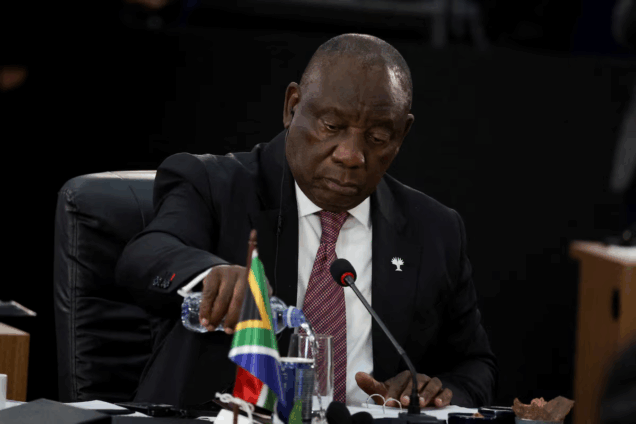
South African President Cyril Ramaphosa on Thursday launched a G20 experts taskforce to examine global wealth inequality and its impact on growth, poverty and multilateralism — the first initiative of its kind for the G20.
The six-member taskforce, chaired by Nobel Economics Prize laureate Joseph Stiglitz, is expected to present its findings to G20 leaders due to convene in Johannesburg in November.
South Africa has sought to use its Group of 20 presidency this year to highlight issues affecting poorer nations, including rising inequality and sovereign debt burdens.
"South Africa's G20 presidency today is proud to launch an initiative that will target this issue of global wealth inequality - a first for the G20 - and offer a practical way forward," Ramaphosa said in a statement.
He said people globally were aware of how inequality undermines dignity and the chance for a better future, citing unfair vaccine distribution during the COVID-19 pandemic as an example.
"They see the impacts of rising food and energy prices, of debt, of trade wars, all driving this growing gap between the rich and the rest of the world, undermining progress and economic dynamism," Ramaphosa added. "A new oligarchy in our global economy is becoming apparent."
Stiglitz said the task force's goal is to turn public frustration over inequality into actionable policy proposals for G20 leaders. "Inequality was always a choice – and G20 nations have the power to choose a different path on a range of economic and social policies," Stiglitz said.
According to the World Inequality Report, the poorest half of the world's population owned just 2% of global wealth in 2021, while the richest 10% controlled 76% of it.
The task force includes other prominent figures such as UNAIDS Executive Director Winnie Byanyima and Jayati Ghosh, a development economist and professor at the University of Massachusetts Amherst.
The United States is set to take over the rotating G20 presidency at the end of this year.
The G20 was founded to coordinate financial policy after the Asian financial crisis of the late 1990s, before expanding to state leaders during the 2008 global financial crisis.
Latest Stories
-
Pregnant woman and husband found dead in a room at Anloga-Kportorgboe
9 minutes -
Man, 87, jailed 20 years for defiling nine-year-old girl at Ofankor
19 minutes -
Maresca says ‘feeling is fantastic’ among Man City squad
31 minutes -
Sam George warns FBI Director against taking sole credit for Ghana cybercrime operation
34 minutes -
Foreign capital no passport to Ghana’s informal retail market – GIPA CEO
44 minutes -
E&P model should be seen as a blueprint for building local mining giants – GIPA Boss
51 minutes -
Govt’s decision to reduce nurse training long overdue – GRNMA
53 minutes -
Ghana needs emergency health fund to respond swiftly to outbreaks – SEND Ghana
1 hour -
Gov’t must prioritise local vaccine manufacturing for future outbreaks – SEND Ghana
1 hour -
Salomey Awiti Baffoe reunites with family and colleagues after release
1 hour -
Fumigation must begin immediately to contain suspected yellow fever – SEND Ghana
1 hour -
Yellow fever response too slow; gov’t must cut bureaucracy – SEND Ghana
1 hour -
National Security Implications of the Security and Intelligence Agencies Act, 2026 (Act 1168) of Ghana
1 hour -
NACOC, INL deepen cooperation to combat drug trafficking and organised crime
2 hours -
GEPA CEO calls for investment to transform Ghana’s economic opportunities
2 hours