

Audio By Carbonatix
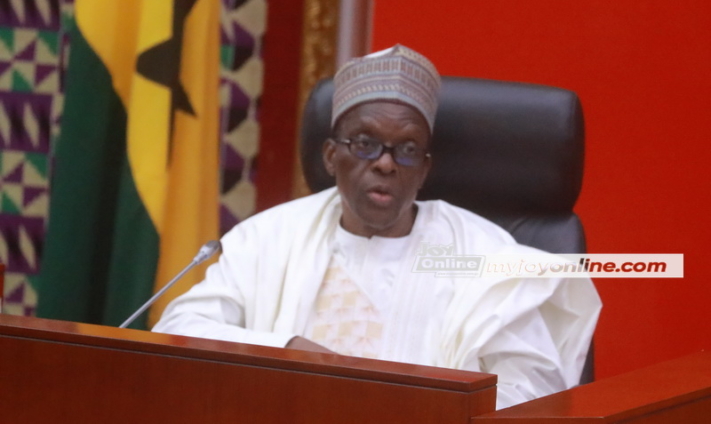
Speaker Alban Sumana Kingsford Bagbin has informed Parliament that he disagrees with the decision of President Nana Addo Dankwa Akufo-Addo not to assent to the abolition of death penalty/witchcraft bills.
The Speaker said he would within this week deliver a statement to the House on the issue, after which the House could debate on the matter.
The Speaker made the remarks in his statement on the floor of Parliament after reading out to the House, President Nana Addo Dankwa Akufo-Addo’s letter.
Speaker Bagbin admitted that the President invited him to discuss the matter concerning the Bills; saying “And when he raised this, I told him (the President) that I completely disagree with him, and I gave my reasons”.
The President in the said letter to Parliament explained his decision not to assent to the Criminal Offences Amendment Bill 2023, the Criminal Offences Amendment Bill Number 2, 2023 and the Ghana Armed Forces Amendment Bill 2023, citing financial implications for not assenting to the Bills.
President Akufo-Addo said upon a thorough review of the relevant constitutional and legislative frameworks, specifically Article 108 of the Constitution and Section 100 of the Public Financial Management Act 2016 (Act 921) it was evident that the Bills introduced as Private Member’s Bills by the Honourable Member of Parliament for Madina, Francis-Xavier Kojo Sosu, do not conform with the provisions of the Constitution.
The Armed Forces (Amendment) Bill, 2023, seeks to amend relevant Sections of Act 29 and the Armed Forces Act, 1962 (Act 105) to replace the Death Penalty with life imprisonment whereas the Criminal Offences (Amendment), Bill Number Two, 2023, seeks to abolish the Death Penalty.
On the other hand, the Criminal Offences (Amendment) Bill, 2023, seeks to proscribe witchcraft accusations.
The President said these Bills, which abolished the Statutory Death Penalty and Criminalizes the activities of witch doctors or witch-finders entail substantial financial obligations on the Consolidated Fund and other public funds of Ghana, due to the projected costs related to imprisonment, sustenance, and healthcare for those who would be convicted under the Bills when they became laws.
The Bills were passed by the House in July 2023 and presented to the President in August and November this year for his assent.
But the President after holding a discussion with the Speaker on the Bills at the former’s office on 28th November, issued a letter to Parliament dated 28th November, informing the House of his inability to assent to the Bills.
Latest Stories
-
Prime Insight: Making room for meaningful national conversations on Joy Prime
1 second -
FABAG commends Ato Forson’s over removal of 20% excise duty on locally manufactured fruit juices
7 minutes -
HIV stigma discourages testing, prevention and treatment in Ghana – Ghana AIDS Commission
10 minutes -
Blocking cocaine probe lends weight to claims of political protection for traffickers – Assin South MP
13 minutes -
NPP Vice Chair race: I may be the youngest, but most experienced – Nana B
15 minutes -
Last UK and US troops leave Iraq as anti-Islamic State mission ends
15 minutes -
Don’t stay home idle, embrace entrepreneurship while awaiting posting – Unemployed nurses urged
27 minutes -
Aayalolo buses not speeding on contra-flow lanes – GAPTE assures commuters
30 minutes -
Effia MP calls for Kurt Okraku’s removal, overhaul of Ghana football structure
31 minutes -
CAS hearing on AFCON final appeal by Senegalese Football Federation set for October 8
31 minutes -
STC fares to go up by up to 8% this week – Deputy MD
32 minutes -
Photos: Accra-Kumasi bypasses get new lease of life as contractors return to site
32 minutes -
Man allegedly swallows five SIM cards to conceal evidence after arrest
33 minutes -
After three finals, Ayikuma Methodist Basic School finally lifts National Juniors Challenge trophy
33 minutes -
Black Stars management ignored players’ health conditions ahead of Gambia game – Ernest Thompson alleges
35 minutes