

Audio By Carbonatix
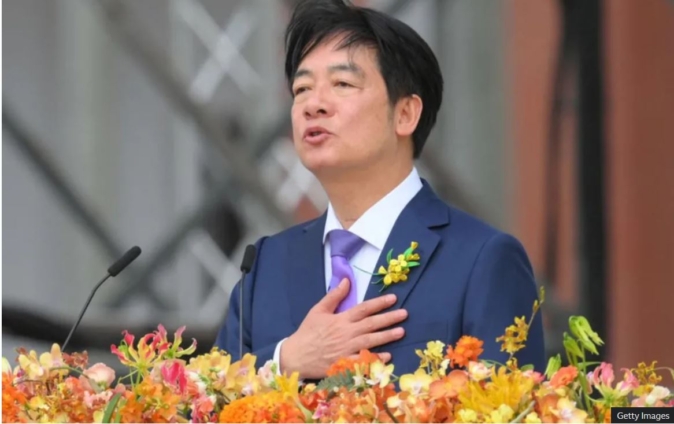
Taiwan's newly inaugurated president William Lai has called on China to stop threatening the island and accept the existence of its democracy.
He urged Beijing to replace confrontation with dialogue, shortly after being sworn in on Monday.
He also said Taiwan would never back down in the face of intimidation from China, which has long claimed the island as its own.
China responded by saying, "Taiwan independence is a dead end".
"Regardless of the pretext or the banner under which it is pursued, the push for Taiwan independence is destined to fail," China's Foreign Ministry spokesperson Wang Wenbin said at the daily press briefing on Monday afternoon.
Beijing dislikes Mr Lai and his Democratic Progressive Party (DPP), which they see as pro-independence. And it has ramped up military incursions around Taiwan's waters and airspace since his election win in January.
Such military incursions by China have become a routine affair in the past few years, triggering fears of conflict. In his speech, Mr Lai called this the "greatest strategic challenge to global peace and stability".
But the 64-year-old also stuck closely to the formula used by his predecessor president Tsai Ing-wen, whose legacy will be defined by her cautious but steady handling of Beijing.
Mr Lai, a doctor turned politician, won a three-way presidential race in January, securing an unprecedented third term for his. He had served as Ms Tsai's vice-president since 2020, and before that as her premier. In his younger days, he was known to be a more radical politician who openly called for Taiwanese independence, much to Beijing's ire. It labelled him a "troublemaker" ahead of the polls, and Chinese state media even suggested he should be prosecuted for secession.
The Chinese government is yet to issue a statement on Mr Lai's inauguration. However, the Chinese embassy in the UK held a press briefing over the weekend, asking the UK government to not endorse it. And earlier last week, a spokesperson for China's Taiwan Affairs Office warned that the island's new leader "must seriously" consider the question of whether he wants peaceful development or confrontation.
And just as Mr Lai was being sworn in, China's Commerce Ministry announced sanctions against several US companies "involved in arms sales to Taiwan".
But on Monday, Mr Lai struck a far more conciliatory note. He reiterated he would not do anything to change the status quo - an ambiguous diplomatic status, which doesn't recognise Taiwan as a country despite its constitution and sovereign government. China insists on this and accuses major Taiwan allies such as the US of altering this delicate agreement by supporting the island.
Vowing peace and stability, Mr Lai also said he would like to see a re-opening of exchanges across the Taiwan straits including Chinese tourist groups coming to Taiwan. But he said people on the island must not be under any illusion about the threat from China and that Taiwan must further strengthen its defences.
This too was a continuation of Tsai's policy. Taiwan's former president believed that strengthening defence and earning the support of key allies such as the US and Japan was key to deterring China's plans of invasion. Her biggest critics say this military investment risks provoking China, making Taiwan even more vulnerable.
Nevertheless, yearly defence spending increased up to about $20bn (£16bn) under Ms Tsai, and Mr Lai has pledged even more funds. Taiwan has purchased new battle tanks, upgraded its fleet of F-16 fighter jets and bought new ones, and has built and launched a fleet of new missile ships to patrol the 100-mile Taiwan strait. Last September came the completion of what Ms Tsai considers the crowning achievement of her military program: Taiwan's first indigenously developed submarine.
Taiwan's own allies are watching closely too, to see if his rhetoric is likely to aggravate tensions further. Mr Lai's caution was also aimed at his American audience. His vice-president Hsiao Bi-Khim, widely believed to be Ms Tsai's protege, is yet another source of assurance for Washington. The 52-year-old was born in Japan and mostly grew up in the US, where she also served as Taiwan's representative for three years.
Mr Lai also faces big challenges at home. Unemployment and cost of living cost the DPP the youth vote in January, and Taiwan's economy is seen to be heavily dependent on its hugely successful semiconductor industry - it supplies more than half the world's chips
And a divided parliament, where the DPP no longer has a majority, is likely to deny him a honeymoon period. The differences spilled into the spotlight over the weekend when lawmakers were caught brawling in parliament over proposed reforms. The bitter dispute and the protests that followed marred Mr Lai's address.
But how he deals with Beijing will be the biggest question that will determine his presidency, especially as both sides have had no formal communication since 2016.
Lawyer Hsu Chih-ming who attended the inaugurations told BBC Chinese that Taiwan had fared quite well under Ms Tsai but added that there is a need to maintain "good communications" with China.
"Lai said he was a 'practical worker for Taiwan independence'. I hope he wouldn't emphasise this too much and worsen cross-strait relations," he said. "Otherwise all of us wouldn't be able to escape if a war broke out."
Latest Stories
-
Church of Pentecost supports over 2,000 BECE candidates in Obuasi with career guidance seminar
8 minutes -
Brandon Asante and Coventry all but promoted to Premier League despite Sheffield Wednesday draw
29 minutes -
GPL 2025/26: Late Kwartemaa strike downs Hearts in Tema
36 minutes -
Ghana Faces Sierra Leone Moment as Prosecutorial Powers come under strain
46 minutes -
Don’t consume fish or seafood from Tema Shipyard until further notice – FDA warns
50 minutes -
Why volunteering might be Africa’s most underrated career accelerator
57 minutes -
ActionAid Ghana raises concern over gender gaps in Feed Ghana Programme
59 minutes -
Windstorm wreaks havoc in Gushegu, displacing nearly 2,000 residents and damaging schools
1 hour -
Friends of Bridget Bonnie Marks her 35th birthday with donation to Kasseh Model Health Centre
2 hours -
From Ekumfi Kokodo to the Pulpit Stage: Essi Donkor’s gospel journey takes shape
2 hours -
Landfilling waste management creates no value, it’s an economic waste
2 hours -
Photos: Speaker Bagbin Commissions MPs constituency office under parliamentary decentralisation programme
3 hours -
Black Stars technical advisor Winfried Schäfer sacked as GFA shakes up backroom staff
3 hours -
Wenchi water project almost complete, critical to gov’t agenda – GWL MD
3 hours -
Anti-LGBTQ+ bill not part of government’s legislative agenda – Inusah Fuseini
3 hours