

Audio By Carbonatix
Nearly 69 per cent of Ghanaians are satisfied with the way democracy is functioning in the country, a new nationwide study has indicated.
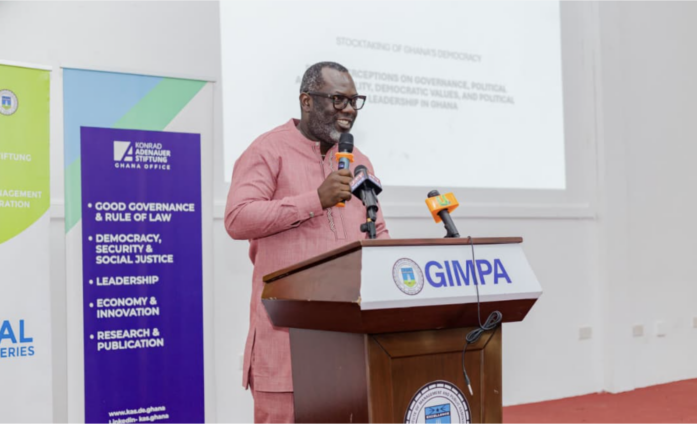
The study, conducted by the Konrad-Adenauer-Stiftung (KAS) Ghana in collaboration with the Ghana Institute of Management and Public Administration (GIMPA), assessed public perceptions of governance, political accountability and democratic values.
Dr Joseph Darmoe, Senior Lecturer at GIMPA and lead researcher of the study, presented the findings of the report titled “Stocktaking of Ghana’s Democracy: Public Perceptions on Governance, Political Accountability, Democratic Values, and Political Leadership in Ghana.”
The study found that 49.8 per cent of respondents were satisfied with Ghana’s democracy, while 18.9 per cent said they were very satisfied.
It also showed that 17.8 per cent of respondents remained neutral about the functioning of democracy, while 13.4 per cent expressed dissatisfaction.
The report further indicated strong support for democracy as a system of governance, with 69 per cent of respondents describing democracy as “very important” and 28.2 per cent saying it was “somewhat important.”
Dr Darmoe said the survey was based on a large national sample designed to ensure strong representation across the country.
“If we use a 99 per cent confidence interval and a plus or minus two margin of error, what we are supposed to have was about 4,147 respondents, but we increased the number to about 13,000 to ensure meaningful representation not only at the national level but also at the regional and constituency levels,” he said.
Dr Darmoe explained that the research team used a Computer Assisted Personal Interviewing (CAPI) system to collect data in real time, which helped reduce errors and allowed instant validation of responses.
Through stratified sampling and daily field supervision, the team collected responses across multiple demographic groups, including gender, age, education and settlement types.
Dr Darmoe said 51.6 per cent of respondents were female and 48.39 per cent male, reflecting Ghana’s population structure.
He noted that dissatisfaction with economic conditions or government performance did not necessarily translate into rejection of democratic governance.
“Even where citizens may express dissatisfaction with economic conditions or government performance, this does not translate into rejection of democratic rule itself,” he said.
The study also examined public confidence in state institutions and found varying levels of trust across the democratic system, including Parliament, the Electoral Commission, the Judiciary and the media.
It also found that about 81 per cent of respondents believed their votes genuinely counted in elections, although 41.8 per cent said they had either witnessed or personally experienced vote-buying.
More than 85 per cent of respondents indicated that they engaged in civic or political activities occasionally, while over 90 per cent described Ghanaians as at least somewhat tolerant of differing political opinions.
Ms Anna Lena Sabroso-Wasserfall, Country Representative of KAS Ghana, said the study sought to provide reliable empirical data on how citizens perceived democratic governance.
“At its core, this study is based on a simple idea that democracy benefits from regular reflection,” she said.
Professor Samuel Kwaku Bonsu, Rector of GIMPA, said Ghana’s democratic journey under the Fourth Republic had made significant progress over the past three decades but required continuous reflection and improvement.
“Democracy does not sustain itself. It has to be consciously nurtured, and studies like this help us take the pulse of the nation and understand the issues affecting our democratic development,” he said.
He said the findings should encourage policymakers, civil society and citizens to strengthen democratic institutions and deepen Ghana’s democratic culture.
Latest Stories
-
Walter Mosley visits W.E.B. Du Bois Centre in Accra: A New York Secretary’s homecoming story on where Du Bois spent his final years.
1 hour -
MTN set to deploy 5G services after winning spectrum licenses worth US$202m
4 hours -
NPP national elections: 3,000–4,000 police to handle security, traffic in Kumasi – Karbo
6 hours -
Atta Akyea fumes as Manhyia MP is to spend another night in EOCO custody
6 hours -
SSNIT says La Beach clearance was to protect hotel investments, beaches to remain public
7 hours -
APSU congratulates St Augustine’s College after back-to-back National Investment Quiz wins
7 hours -
Renewed flood intervention at Mallam Junction raises hopes among residents, businesses
8 hours -
St Augustine’s College retain National Investment Quiz title after nail-biting grand finale
8 hours -
Education infrastructure investment will drive Banda’s development – Ahmed Ibrahim
8 hours -
Teacher unions strike: Gov’t presents fresh proposals as talks end inconclusively
9 hours -
51,000 teachers’ promotion arrears to be validated for October payment – Education Minister
9 hours -
Kwabena Boamah appointed Board Chair for Impact Investing Ghana
9 hours -
Striking teacher unions to meet Fair Wages and Salaries Commission on October 6
10 hours -
EOCO working with AG to arraign Nana Baffour Awuah before weekend court
10 hours -
Duraplast reassures customers after fire, announces October 5 reopening
10 hours