

Audio By Carbonatix
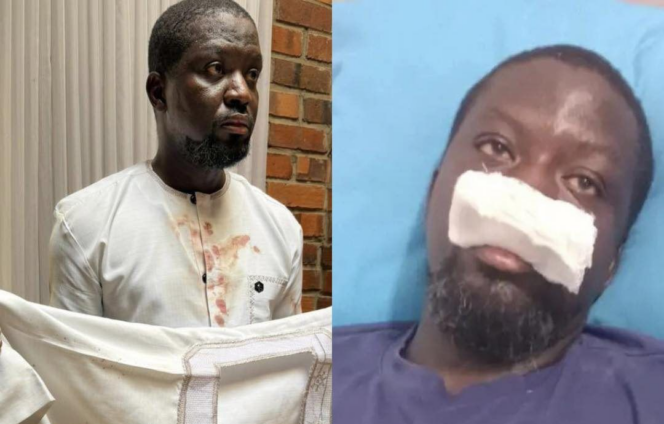
The images that circulated this past weekend of the Ghanaian artist Ibrahim Mahama, a man whose work brings global prestige to our nation, allegedly being subjected to assault and abuse by the IGP’s Special Force, are not just disturbing; they are a symptom of a systemic rot.
When those sworn to protect the citizenry become the primary source of their terror, the social contract is not just strained- it is broken.
The Ibrahim Mahama incident is, unfortunately, not an isolated aberration. We recall the tragic ‘Zongo Seven’ incident in Manso Nkwanta, where seven young men were gunned down under the guise of being armed robbers, only for a committee to later find they were innocent.
We remember the brutal assault on journalists at the Ghanaian Times, and the countless daily indignities faced by ordinary Ghanaians at checkpoints that never make the evening news.
In almost every instance, the script is the same: public outrage, a promise of investigation by the Police Professional Standards Bureau (PPSB), and then silence.
The PPSB is tasked with maintaining professional standards and investigating misconduct. Its mission statement speaks of integrity and human rights. However, there is a widening chasm between this rhetoric and the reality of police accountability.
The central crisis is not just a lack of "will"; it is a structural defiance of a fundamental legal maxim: nemo judex in causa sua. As long as the police remain the sole judges of their own conduct, public trust will continue to bleed out.
In the study of Administrative Law, few principles are as sacred as nemo judex in causa sua the rule against bias, which dictates that "no man shall be a judge in his own cause." This principle exists because human nature makes it nearly impossible to remain impartial when one’s own interests, colleagues, or institution are on the line.
The PPSB, as an internal unit of the Ghana Police Service, operates in direct violation of this principle. When a citizen files a complaint against an officer, that complaint is handled by fellow officers who share the same uniform, the same mess halls, and the same institutional loyalty. As noted in legal scholarship regarding the Police Service Act, 1970 (Act 350), giving the power to adjudicate complaints entirely to the police enables them to be ‘judge and jury.’
This creates a ‘Blue Wall of Silence.’ Unless a case gains massive social media traction, as seen with Ibrahim Mahama, the internal machinery often moves with the speed of a glacier.
Investigations are frequently opaque, and internal disciplinary action often results in nothing more than a quiet transfer to another region. This perceived partiality makes the victim feel like they are being victimised a second time by the very system designed to provide redress.
The consequences of this structural flaw are devastating. When the public perceives that the PPSB is a shield for the police rather than a sword for justice, they stop reporting misconduct. Why go through the stress of filing a report at a police station against the very people who run that station?
This leads to a dangerous cycle of cynicism. When citizens lose faith in formal accountability, they either suffer in silence, which emboldens rogue officers, or they resort to ‘mob justice’ and confrontations with the police. This undermines the very essence of democratic policing.
A police force that is not accountable to the law it purports to enforce is not a protective service; it is an occupying force. The lack of swift, transparent punishment for those who abused Ibrahim Mahama or the victims of past brutalities signals to every officer in the country that they are essentially ‘untouchable’ as long as they don't cause a national scandal.
To fix this, we must move beyond internal investigations. We need a model that separates the investigator from the investigated.
1. The Independent Police Complaints Commission (IPCC) Model:
Taking a cue from mature democracies like the United Kingdom or South Africa (with their Independent Office for Police Conduct (IOPC) and Independent Police Investigative Directorate IPID respectively), Ghana must establish a fully independent, civilian-led oversight body. This body must have the statutory power to subpoena evidence, investigate serious misconduct (killings, sexual assault, and corruption), and recommend direct prosecution to the Attorney General, bypassing the IGP’s office entirely.
2. Civilian Oversight Boards at the Regional Level:
While the Police Service Act mentions Regional Police Committees, these must be empowered with actual ‘teeth.’ Including representatives from the Ghana Bar Association, human rights NGOs, and traditional authorities would ensure that local police conduct is monitored by the community they serve.
3. Judicial Oversight and Mandatory Reporting:
The judiciary should have a more active role. Any instance where a citizen is injured in police custody should trigger a mandatory, automatic inquiry by a Magistrate, independent of any police report.
The primary "pro" of these models is the restoration of public trust. When a civilian sees an independent body punishing a rogue officer, they regain faith in the state.
The "con" is often cited as a blow to police morale or "interference" in command, but true professional morale is built on honour and accountability, not the protection of criminals in uniform.
In all, the assault on Ibrahim Mahama is a wake-up call. We cannot continue to rely on a system where the police grade their own homework.
The PPSB, despite the good intentions of some of its officers, is structurally incapable of providing the impartial justice Ghanaians deserve because it remains trapped by the conflict of interest inherent in its design.
Justice must not only be done; it must be seen to be done. We urge policymakers to move toward an independent oversight model that honours the rule of law and protects the dignity of every Ghanaian. If we do not act now, the "protectors" will continue to be the predators, and the silence of the state will eventually be drowned out by the cries of a public that has finally had enough.
Latest Stories
-
‘At the age of 12, I was teaching people and collecting money from them’ – Forty Under 40 Awards
37 minutes -
I broke my virginity at the age of 26 after university – Richard Abbey Jnr.
1 hour -
Sacked for fees, saved by faith: The untold story of Forty Under 40 Awards founder Richard Abbey Jnr
2 hours -
GCB Bank surges GH¢0.45, ETI gains GH¢0.06 as GSE ends week higher
2 hours -
Two teens jailed 55 years for robbery
3 hours -
UDS demands apology for MPhil student wrongly branded as Tamale robber
3 hours -
“We don’t sell fish!” – Tema Shipyard CEO hits back over dead fish discovery
4 hours -
Sam George defends anti-LGBTQ+ Bill as ‘national priority’ amid debate over gov’t focus
4 hours -
Artemis II astronauts safely back on Earth after trip around moon
5 hours -
Sam George unveils massive 1,150-cell site rollout to end network woes
5 hours -
This Saturday on Prime Insight: Fuel levy suspension, LGBTQ+ legislation, and Damang Mine controversy
5 hours -
Struggling Real suffer title blow with Girona draw
6 hours -
Mahama nominates Pamela Graham as Auditor-General
6 hours -
The five big sticking points in US-Iran talks
7 hours -
Melania Trump’s speech propels Epstein crisis back to forefront
8 hours