

Audio By Carbonatix
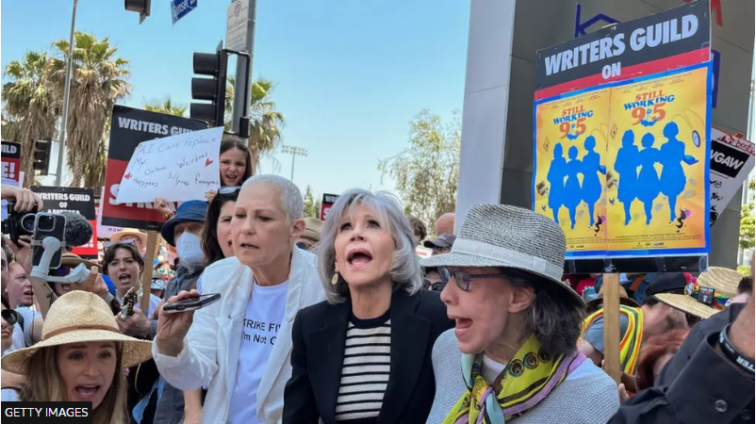
Hollywood's writers have been on strike for two months and soon the actors may join them, swapping the red carpet for the picket lines.
The Screen Actors Guild-American Federation of Television and Radio Artists (SAG-AFTRA) contract expires at midnight local time on 12 July, following a deadline extension that delayed the possibility of a mega-strike by almost two weeks.
They would join the Writers Guild of America, which went on strike on 2 May after failing to reach a deal with the Alliance of Motion Picture and Television Producers (AMPTP), an umbrella group representing studios like Disney, Netflix, Amazon and Apple.
Both SAG-AFTRA and AMPTO have said they will not comment while contract negotiations are ongoing.
It would be the first time that unions representing both writers and actors would strike at the same time since 1960, when future US President Ronald Regan was president of the actors' union.
A third union, the Directors Guild of America, has already negotiated a contract and will not join the strike.
Dozens of productions have already been halted since the writers went on strike, including Stranger Things, Billions and Marvel's Blade.
If there is an actors' strike, there could be even more delays, and some shows may be cancelled altogether.
For audiences, that likely means the next season of your favourite TV show will be delayed, and many shows may disappear forever.
While some international productions will continue, it will be limited, because SAG-AFTRA represents more than 160,000 performers around the world - like writer and actor Phoebe Waller-Bridge, who addressed the strike at the London premiere of the latest Indian Jones movie.
"I really hope we can get this sorted. Writers are the most important people in this industry, I really believe that," she said.
Like the writers already on strike, actors say that streaming services haven't shared the wealth, even as they have led to an explosion of entertainment content. The never-ending quest for new subscribers is an unsustainable business model, they say, and studio executives are reaping huge salaries while many actors and writers can't make a decent living.
Actors and writers used to make money from re-runs on network TV. They would get a cheque in the post every time a movie or show they worked on was re-broadcast and that allowed actors to survive between projects in the business, which has always been a feast-or-famine job.
But streaming services upended Hollywood, and now actors and writers get little or nothing when someone watches their work on a streaming service, which also traditionally pays less than network TV.
The negotiations are being conducted in secret so it's not clear what might be the sticking points or if a deal is imminent. Members overwhelmingly voted in favour of a strike if a deal cannot be reached.
"If they could replace us, they would have done it many years ago," writer and actor Adam Conover said while picketing outside Netflix.
"Are they going to replace you with reality TV? Or with YouTube stars? Well, they can try," he said, adding that people around the world turn on the TV to watch shows like Stranger Things and sports.
In a surprise move, many of Hollywood's A-list actors signed a letter to their union supporting a strike if they cannot get a "transformative" new contract from studios.
The letter - which has been widely circulated in Los Angeles - was signed by the likes of Meryl Streep, Mark Ruffalo, Jennifer Lawrence and Quinta Brunson - has more than 1,000 signatures now, according to industry publication Deadline.
Both the writers and actors are striking for not only better pay, but for restrictions on using artificial intelligence (AI) in productions, which they say is an "existential" threat.
Actors say AI could create a doomsday scenario where deep fakes and dead actors could be the stars of tomorrow through computer-generated faces and voices.
For many in the business, it's a bleak thought - computer generated moviemaking without a camera crew, actor or writer involved.
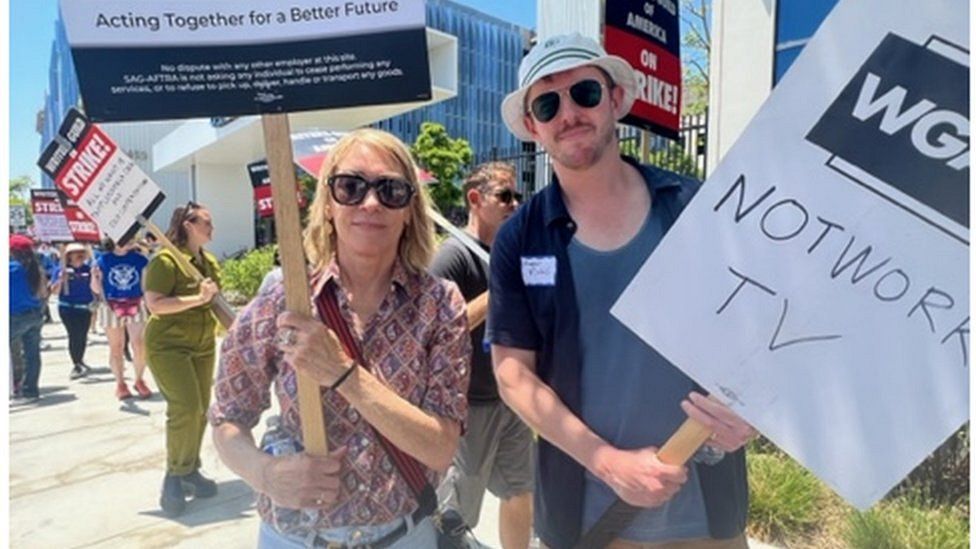
Influential musician and artist Kim Gordon, the founder of Sonic Youth and a Screen Actors Guild member, said she'd never consider allowing an AI version of herself.
"It's important to be worried about it," Ms Gordon said while picketing outside Netflix. "But I feel like AI will never replace creativity."
Latest Stories
-
Renewed flood intervention at Mallam Junction raises hopes among residents, businesses
12 seconds -
St Augustine’s College retain National Investment Quiz title after nail biting grand finale
9 minutes -
Education infrastructure investment will drive Banda’s development – Ahmed Ibrahim
17 minutes -
Teacher unions strike: Gov’t presents fresh proposals as talks end inconclusively
59 minutes -
51,000 teachers’ promotion arrears to be validated for October payment – Education Minister
1 hour -
Kwabena Boamah appointed Board Chair for Impact Investing Ghana
2 hours -
Striking teacher unions to meet Fair Wages and Salaries Commission on October 6
2 hours -
EOCO working with AG to arraign Nana Baffour Awuah before weekend court
2 hours -
Duraplast reassures customers after fire, announces October 5 reopening
2 hours -
Call off strike, gov’t will not renege on promotion arrears pledge – Haruna Iddrisu appeals to teacher unions
2 hours -
Committee set up to validate teachers eligible for 20% deprived-area allowance – Education Minister
2 hours -
Five-member committee to search for new Black Stars coach after Sports Ministry-GFA meeting
3 hours -
Pinktober: Breast cancer survival exceeds 90% when detected early – Breast Society of Ghana
3 hours -
TCDA to adopt Upper West’s MATCO mango farm as northern prototype, issues warning against felling shea trees
3 hours -
‘Fear delegates’ tag: Afoko touts genuineness among delegates ahead of NPP delegates conference
3 hours