

Audio By Carbonatix
TikTok users have told the BBC they think a viral tool which makes people appear overweight should be banned from the platform.
Known as a "chubby filter", the artificial intelligence (AI) tool takes a photo of a person and edits their appearance to look as though they have put on weight.
Many people have shared their before and after images on the platform with jokes about how different they look - however, others say it is a form of "body shaming" and should not be permitted.
Experts have also warned the filter could fuel a "toxic diet culture" online and potentially contribute to eating disorders.
TikTok has not responded to a request for comment.
Sadie, who has 66,000 followers on TikTok, is one of those calling for the "mean" filter to be banned.
"It felt like girls being like, 'oh, I've won because I'm skinny and wouldn't it be the worst thing ever to be fat'," the 29-year-old from Bristol said.
She said she had been contacted by women who said they had deleted TikTok from their phones because the trend made them feel bad about themselves.
"I just don't feel like people should be ridiculed for their body just for opening an app," she said.
Dr Emma Beckett, a food and nutrition scientist, told the BBC she felt the trend was "a huge step backwards" in weight stigma.
"It's just the same old false stereotypes and tropes about people in larger bodies being lazy and flawed, and something to be desperately avoided," she said.
She warned that could have a broad social effect.
"The fear of weight gain contributes to eating disorders and body dissatisfaction, it fuels toxic diet culture, making people obsess over food and exercise in unhealthy ways and opening them up to scam products and fad diets.
"And it pressures everyone to conform to narrow beauty and health standards, rather than finding what works best for their own body - that causes harm to everyone, both in physical and mental health."
Testing the 'chubby filter'
By Jessica Sherwood, BBC Social News
Filters - which use AI to manipulate a person's appearance - are common on TikTok.
Many are harmless - for example one popular trend makes it appear as if a person was made out of Lego.
They are often designed by individuals with no link to TikTok - as appears to be the case with the new "chubby filter".
Some of the most popular videos using the filter have been liked tens of thousands of times.
For this article, I used the filter on myself.
I felt incredibly uncomfortable.
As someone who is very body positive and has struggled with their self-image in the past, using it couldn't be further away from how I personally use social media and I was unhappy that TikTok pushed it to me in the first place.
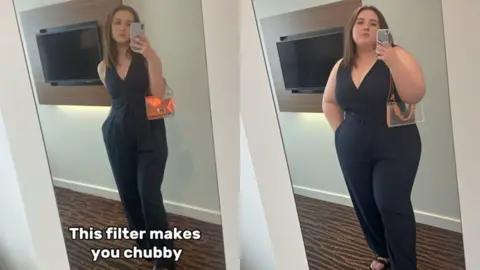
This filter appeared on my TikTok "For You" page the other day despite my not engaging with any weight-related or health content.
After watching the video and reading the comments that was it - the way TikTok's algorithm works means it began to suggest me similar videos from other people using the filter, and even another where AI can turn you thinner.
Thankfully it also began to start showing me creators who were criticising the trend, some of whom we've spoken to for this article.
AI images and filters have become commonplace on TikTok and quickly accepted to be used for fun - the same way some Gen-Zs and Millennials might remember Snapchat filters.
But filters like these, although they may seem fun, can be very damaging to someone's mental health and encourage them to compare themselves not only to others but an unrealistic version of themselves.
'Damaging' and 'toxic'

The BBC has spoken to a number of TikTok users who said they were uncomfortable with the filter.
Nina, who lives in north Wales, said she felt it fed into a "narrative" being spread online tying together people's appearance with their self-worth.
"This is a toxic view that I thought we were moving away from," she said.
"If a filter is clearly offensive it should be removed," she told the BBC.
Emma, who lives in Ayr, agreed.
"My first thought when I saw the 'chubby filter' was how damaging that would be.
"People were basically saying they looked disgusting because they were 'chubby' and as a curvier woman, who essentially looks like the "after" photo on this filter, it was disheartening for me."
Nina said she was happy to see people criticising the trend, which she called "immoral and insensitive".
"We should be lifting each other up, not shaming each other's bodies," she said.
Sadie agreed that it should not be allowed - however she felt there might be other things TikTok could do.
"Maybe it should have a warning," she said.
"If there are themes of body shaming or an eating disorder or anything like that, I think there should be a way of flagging it where, if these people want to post it, they post it, but it doesn't get pushed to a wider audience."
Latest Stories
-
ECG announces planned power outages in parts of Tema from Sept. 29 to October 1
11 minutes -
Sylvester Mensah urges Latenu FM to promote trade, export opportunities in Ga
24 minutes -
Ga language under threat of decline as children shy away from speaking it – Sylvester Mensah
29 minutes -
‘Let every Ga child you raise know the Ga language and story’ – Sylvester Mensah
36 minutes -
‘We are not deterred’ – Ablakwa responds to backlash over South Africa evacuation
37 minutes -
NCA announces major voice and data disruption across Northern Ghana due to fibre cuts
1 hour -
Photos: Housing solutions take centre stage at Day 2 of the 3rd Republic Bank-JoyNews Habitat Fair
2 hours -
Ghana Air Force passes out 293 recruits after six months of intensive training
3 hours -
EOCO vrs Baffour Awuah: EOCO should have secured warrant before arrest attempt at court – Inusah Fuseini
3 hours -
Triple fibre cuts disrupt telecom services across Northern, Oti regions – Sam George
3 hours -
Politicisation could undermine parliamentary probe into cocaine seizures – Dr Osae-Kwapong
3 hours -
EOCO chases MP: Can Section 41 cure lacuna in EOCO Act? – Inusah Fuseini asks
3 hours -
GNFS, GWL inspect fire hydrants in Ministries enclave; 23 found faulty
3 hours -
Gov’t directs release of 50,000 bags of grain to ECOWAS
3 hours -
Ghana, Germany deepen cooperation on railways, labour mobility
3 hours