

Audio By Carbonatix
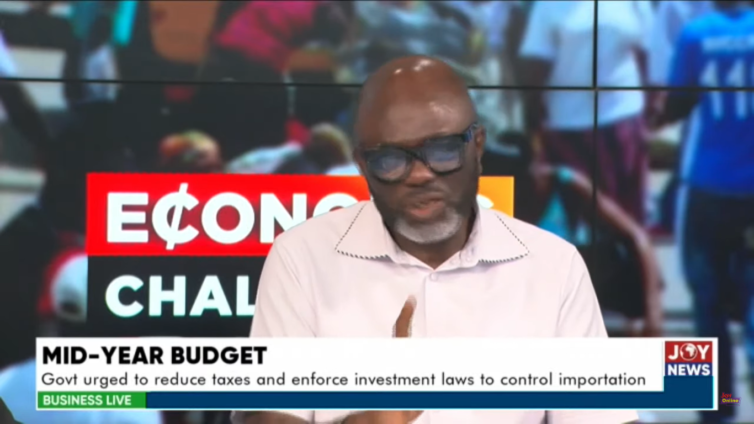
The trading community in Ghana is mounting pressure on the government to use the Mid-Year Budget to cut taxes while enforcing the investment laws to control the rising level of importation into the country.
This will also help control imported inflation and consequently reduce year-on-year inflation.
According to the Ghana Union of Traders Association (GUTA), the economic climate is already not favorable, thus driving most of them out of business.
They contend if the mid-year budget doesn’t address their concerns, most of them will be forced to fold up.
Speaking on the Joy Business Pre-Budget Forum on the theme “What Should the Policy Direction be in the 2023 Mid-Year Budget”, President of GUTA, Joseph Obeng, said the concerns of businesses mustn’t be taken with a pinch of salt.
“We don’t have the space to develop and grow. That has been our main problem. Excessive taxation has put a toll on the private sector, making us uncompetitive. We cannot even sell our produce to the neighboring countries because of the cost of the produce”.
Touching on importation, Dr. Obeng argued that Ghana only owns about 60% of its export earnings which he believes is worrying.
“I have a serious problem with importation. Ghanaians do not own the economy, the export earnings we get only about 60% as a nation. That’s why you always have a problem with foreign exchange”.
“The excessive importation that we do, only about 20% is for the locals and the 80% belongs to foreigners”.
According to the data from the Bank of Ghana, the total import bill for the first four months of 2023 was provisionally estimated at $4.0 billion, down by 13.9% year-on-year. The decline in imports was driven largely by non-oil imports and, to a lesser extent, by oil and gas imports.
Again, the trade surplus improved further to $1.6 billion in the first four months of 2023, driven mainly by import compression. The value of total exports was estimated at $5.65 billion, down by 3.6 percent year-on-year.
The fall in export earnings was driven largely by crude oil exports and to a lesser extent by non-traditional exports, as gold and cocoa exports increased.
Latest Stories
-
Tarkwa court jails labourer for three years over GH¢123,000 theft
27 minutes -
GAEC must retain nuclear scientists for Ghana’s nuclear ambitions – Minister
59 minutes -
Man reportedly mistaken for game and shot by hunter dead in forest
1 hour -
19-year-old mason jailed 15 years for defiling seven-year-old pupil
1 hour -
Ghana’s banking sector assets rise 20.47% to GH¢500.2bn – BoG Governor
1 hour -
22 injured as Sprinter bus overturns at Sege after tyre burst
1 hour -
UN housing expert urges Ghana to strengthen Rent Control Department amid housing affordability concerns
1 hour -
Delta-BCI partnership reaches 166,000 people with breast cancer education
1 hour -
Power restoration fault suspected in Kumasi Central Market fire
7 hours -
The 7-foot giant of Ngleshie Amanfro: Seven-foot Ghanaian Ephraim Saawa dreams of joining the national basketball team
7 hours -
Government promises support for Kumasi Central Market fire victims
7 hours -
Vibes The Movie: Big Ghun’s Ghanaian film earns five nominations at 2026 REFFA
8 hours -
‘I’m a fulfilled man’—Justice Korbieh on missing out on Supreme Court despite two nominations
8 hours -
MamaCare CEO warns unresolved conflicts among health workers could undermine maternal and neonatal care
8 hours -
Health professionals urged to translate medical knowledge into practice to save mothers
8 hours