

Audio By Carbonatix
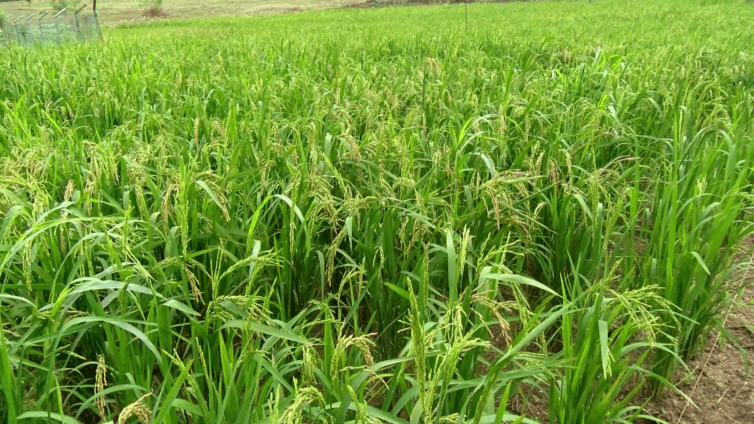
On a small plot of land at the Fumesua campus of the Crops Research Institute of the Council for Scientific and Industrial Research, a rice plantation tassels, but not in its usual wetland. Rather on dry ground where wheat once grew.
This is the new rice variety developed by the CSIR-CRI – the new upland rice variety, which is seeking to transform the rice value chain in Ghana.
Farmers in the country have long known rice to be grown in flooded fields, but the new variety is a result of local research and development to adapt to the changing climatic conditions.
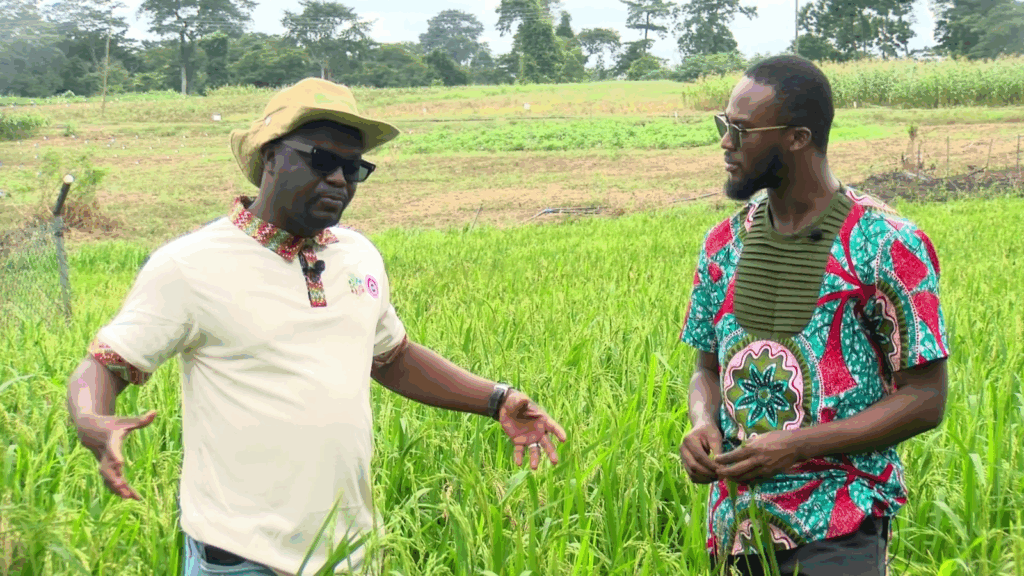
Research Scientist at the CSIR-CRI, Dr. Felix Frimpong, explained that dryland or upland rice cultivation opens opportunities for farmers who do not have access to wetlands.
“With upland rice, you don’t need a wetland. Any good upland soil can grow rice just like maize, and the taste is the same as lowland rice,” Dr. Frimpong said.
Beyond its convenience, the upland rice has been identified as environmentally friendly.
Unlike the lowland rice, which generates high methane emissions due to flooded conditions, the upland rice eliminates such risks.
Scientists explain that the wetland creates a fine environment for anaerobic conditions, where microbes are able to exchange gases into the atmosphere, contributing to greenhouse gas emissions.
In a country feeling the pressures of climate change, such a shift could contribute to Ghana’s climate commitments.
“Because upland rice does not grow in wetlands, there are no anaerobic conditions, so the process that generates methane is cut off completely,” Dr. Frimpong explained.
Since 2010, the CRI has developed more than 30 rice varieties, including nine released in 2022 alone, of which three of these varieties are upland rice variants.
Among its popular lowland varieties is the high-yielding “Agyapa Rice,” which produces up to nine tons per hectare and competes with any imported brand.
Even as the research institute continues to develop these varieties to match the farm needs of local producers, its adaptability in the country is a challenge.
Ghana spends nearly one billion dollars annually on rice imports, despite having the land and climate to produce its own. By expanding rice cultivation beyond wetlands, upland rice makes it possible for more farmers, even smallholders, to participate in the sector.
Director of the Crops Research Institute, Professor Maxwell Asante, has been leading the breeding of rice varieties in the country.
With his rich experience in the field, he expressed concern over the country’s heavy reliance on imported rice despite the availability of quality local varieties.
“It is unfortunate that Ghana continues to import rice when our resources and varieties are as good as anywhere in the world,” he said. “Other African countries are already adopting our rice varieties, and we must invest in our own value chain.”
He advocated for a public-private investment in rice production and research to facilitate Ghana’s quest to achieve rice self-sufficiency.
For farmers and traders, the upland rice is more than science; it is an opportunity. It gives rural households a crop that feeds families, cuts national imports, and grows resilience against climate change.
With CRI’s innovation, Ghana’s rice sector could transform from a net drain on the economy into a pillar of self-reliance, one upland harvest at a time.
Latest Stories
-
Padel for Parkinson’s cycling event promotes awareness at University of Ghana
42 seconds -
GPL 2025/26:Samuel Tetteh brace fires Nations FC past Basake Holy Stars
9 minutes -
Ghana’s oil trade position close to net neutral in near term – Fitch
31 minutes -
IMANI Africa President urges greater awareness and support for Parkinson’s Disease patients
42 minutes -
T-bills: Government records 29% undersubscription; interest rates continue to surge
43 minutes -
Perceptions of Judicial partisanship ‘unfortunate’ – Justice Adjei-Frimpong urges greater public engagement to build trust
47 minutes -
Ghana to honour Christina Hammock Koch for historic Artemis II mission
2 hours -
Supreme Court appointments require more than 15 years’ experience – Justice Adjei-Frimpong
2 hours -
Fire destroys 3-bedroom house at Bogyawe
2 hours -
Why the Supreme Court is a “policy court” – Justice Richard Adjei-Frimpong breaks it down
2 hours -
Playback: The Law discussed Supreme Court @150
4 hours -
MTN Momo staff walk to promote wellness and fitness
4 hours -
Assafuah: Sedina Attionu’s return from Nevada will test government’s commitment to accountability
4 hours -
How GRA’s Modified Taxation Scheme is boosting revenue compliance & SMEs competitiveness
4 hours -
Stonebwoy Can Do It: A call to unite behind 2026 BHIM Fest
5 hours