

Audio By Carbonatix
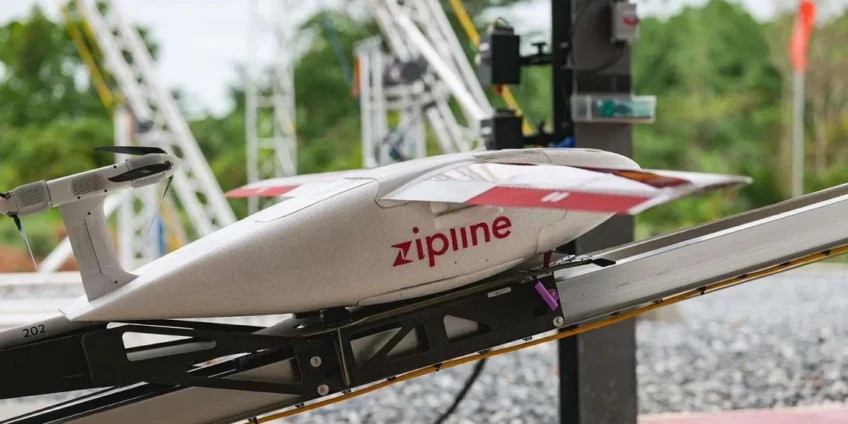
The United States Government has pledged up to $150 million to support Zipline International Inc. in scaling up its drone-enabled medical delivery operations across five African countries—Côte d’Ivoire, Ghana, Kenya, Nigeria and Rwanda.
The investment will help extend access to blood, vaccines, and other essential health supplies to as many as 15,000 health facilities.
The announcement was made during a U.S. Embassy digital press briefing on December 2, outlining the initiative as part of the U.S. Department of State’s new America First Global Health Strategy.
The strategy aims to boost the value of U.S. foreign assistance by reducing waste, avoiding dependency, and aligning global health investments with U.S. policy goals.
Speaking at the briefing, Jeff Graham of the State Department said the partnership prioritises reaching remote and underserved communities with critical health commodities.
He explained that working with Zipline—an American robotics and drone-technology firm—is central to modernizing the U.S. approach to global health logistics.
Under the agreement, U.S. support will drive the deployment of Zipline’s advanced, American-made autonomous aircraft to tackle slow and unreliable delivery systems that hinder timely access to medical supplies.
Graham described the investment as a significant step toward strengthening health systems’ capacity to respond swiftly to disease outbreaks and medical emergencies.
He emphasised that while the U.S. is providing initial capital, partner governments will ultimately assume operational responsibility for their national health delivery networks.
Zipline will open new distribution centres across the participating countries, with Rwanda expected to double its daily delivery capacity, enabling the network to eventually serve up to 130 million people across Africa.
Caitlin Burton, CEO of Zipline Africa, noted that the company’s autonomous, all-weather drones already operate around the clock to maintain a responsive, on-demand medical supply chain—often outperforming traditional delivery systems.
Supported by partners such as the Elton John AIDS Foundation, Zipline has demonstrated that its model is both impactful and cost-effective.
Burton said the new U.S. partnership will help Zipline reach nationwide scale in all five countries, creating an estimated 1,000 jobs and contributing more than $1 billion in annual economic gains.
She stressed that Zipline’s mission goes beyond logistics, aiming to equip health systems to end preventable deaths—from HIV transmission to maternal mortality and severe malnutrition.
“This system is meant to operate nationwide and at a scale that truly changes health outcomes,” she explained.
“We now know how to solve challenges like maternal mortality and malnutrition, and the network is built to meet those goals.”
Burton added that while the U.S. may provide seed capital, governments will cover predictable long-term operating costs, enabling them to replace multiple vertical health programmes with one unified national delivery system.
“You’re not funding a single programme or one-off intervention,” she said.
“You’re ensuring essential medical products reach patients everywhere—including communities where distance or stigma might prevent people from seeking care.”
Latest Stories
-
Power restoration fault suspected in Kumasi Central Market fire
3 hours -
The 7-foot giant of Ngleshie Amanfro: Seven-foot Ghanaian Ephraim Saawa dreams of joining the national basketball team
4 hours -
Government promises support for Kumasi Central Market fire victims
4 hours -
Vibes The Movie: Big Ghun’s Ghanaian film earns five nominations at 2026 REFFA
4 hours -
MamaCare CEO warns unresolved conflicts among health workers could undermine maternal and neonatal care
5 hours -
Health professionals urged to translate medical knowledge into practice to save mothers
5 hours -
Conflicts among care providers linked to maternal, neonatal deaths – Expert
6 hours -
GIS marks 10th TIME conference, champions improved teaching practices
6 hours -
BRICS Or Balance? What Ghana’s bid really means
7 hours -
GPRTU wants full TRAFFITECH-GH implementation to start in 2027
7 hours -
Mahama announces plans to import electric wheelchairs for PWDs
7 hours -
KGL U17 Colts 2026: Western beat Prempeh Elite Academy to set up final final with Greater Accra Region
7 hours -
Late Solanke strike salvages 10-man Spurs draw at Man United
8 hours -
Gender Ministry to monitor welfare of Nana Akua Addo’s children amid domestic violence case
8 hours -
Benedict Okyere Yeboah: Ghana’s football problem goes beyond sacking a coach
8 hours