

Audio By Carbonatix
The United States has officially named Colombia as a country which has "demonstrably failed" to uphold its obligations to control drug trafficking, but stopped short of cutting off the flow of US aid to Colombia.
Each year, the US government formally certifies whether several countries are fully cooperating with US-led counternarcotic efforts, and those which are found to be wanting risk having their US funding cut.
On Monday, the Trump administration said that cocaine production in Colombia had surged to an all-time high under its left-wing president, Gustavo Petro, which the Colombian leader denied.
In response, the Colombian government said it would stop buying weapons from the US.
Interior Minister Armando Benedetti told local radio that his government would stop the purchase of US arms "from this moment on".
The other countries the US said had failed to meet their targets were Afghanistan, Bolivia, Myanmar and Venezuela.
Colombia was added to the list for the first time since 1997.
The move is likely to further sour relations between its left-wing government and the Trump administration.
President Petro took to social media to respond to the US allegation that during his time in office the area planted with coca bushes and the production of cocaine had reached record levels.
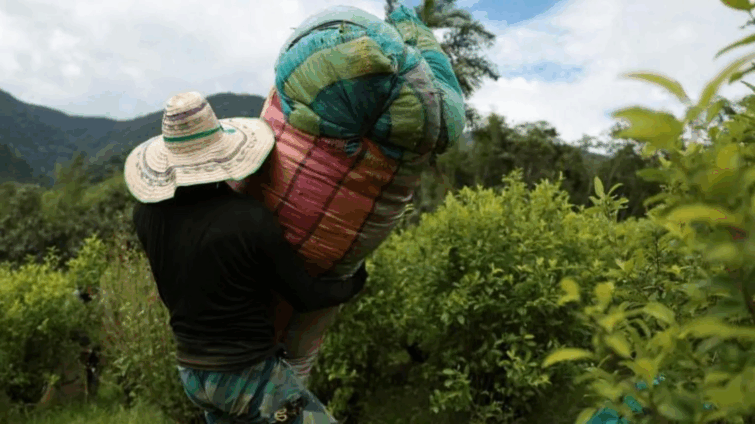
Coca leaves are the key ingredient in cocaine and Colombia has long been the top producer of the illegal drug.
A survey by the United Nations Office on Drugs and Crime (UNDOC) found that coca bush cultivation had increased by 10% in 2023. The figures for 2024 are due to be released next month.
But Petro insisted that it had been during the government of Iván Duque, his predecessor in office who governed from 2018 to 2022, that the area planted with coca saw large increases.
According to figures released by the Colombian presidency, a record 1,764 tonnes of cocaine were seized by government security forces between August 2022, when Petro came into office, and November 2024. Drug seizures have continued at a high level in 2025, official tallies suggest.
Petro also said that in order for coca cultivation to decrease, what was needed was for demand for cocaine to go down in the US and in Europe.
The US on the other hand laid the blame firmly at Petro's door, saying that the president's peace talks with several armed groups - many of which finance themselves through drug trafficking - had hindered the fight against drugs.
"His failed attempts to seek accommodations with narco-terrorist groups only exacerbated the crisis," the presidential determination submitted to US Congress said.
The document goes on to praise the "skill and courage" of Colombia's security forces in confronting criminal groups.
It then concluded that "the failure of Colombia to meet its drug control obligations over the past year rests solely with its political leadership".
However, it does leave the door open to recertifying Colombia if its government "takes more aggressive action to eradicate coca and reduce cocaine production and trafficking".
And while the rhetoric coming out of Washington has clearly angered President Petro, his government will also be relieved that the decertification did not result in a cut of the US aid flow, BBC News Mundo's correspondent in Bogotá, José Carlos Cueto, says.
Colombia's decertification comes at a time when President Trump has made the fight against "narco-terrorists" a priority.
On Monday he announced the US military had destroyed an alleged Venezuelan drug vessel in international waters in the South Caribbean.
Three people were killed in the strike, Trump said.
He added the US had recorded proof that the boats belonged to narco-terrorist groups but has not yet made that evidence public.
Latest Stories
-
Insults generally are not crimes, but some may be criminal under the law – Samson Lardy Anyenini
5 minutes -
IGP deploys specialised police team, armoured vehicle to strengthen security in Nkwanta
5 minutes -
Dr Bawumia advocates solar power, access to credit, training and certification for artisans
8 minutes -
Trade Minister engages Russia, UAE and UNDP to boost trade, investment
9 minutes -
7 best foods to help keep blood sugar levels steady
12 minutes -
Ghana to host signing of UN trade convention to modernise global cargo documentation on October 26
28 minutes -
Family announces memorial mass for Nana Konadu Agyeman-Rawlings
31 minutes -
Mahama, Trade Minister, tours Afienya and Tema factories, schedules meeting on Free Zones incentives
36 minutes -
Gyakie and FlipTheMusic unveil ‘Your Body’ following a new distribution deal with Warner Music Africa
37 minutes -
Stop looking down on new media practitioners as if they don’t matter – New Media President
38 minutes -
Ghana’s BRICS partnership bid aimed at broadening development opportunities – Mahama
44 minutes -
Fiabci-Ghana inaugurated to promote professionalism and global collaboration in real estate sector
1 hour -
‘No flying in just for matches’ – Kofi Adams sets conditions for next Black Stars coach
1 hour -
Ghana and BRICS: Strategic opportunity, economic imperative or geopolitical gamble?
1 hour -
SML vs GRA: Court grants preservation order in dispute over US$500 million investment
1 hour