

Audio By Carbonatix
The United States has pledged $2 billion (£1.5bn) to fund United Nations (UN) humanitarian programmes, but has warned the UN it must "adapt or die".
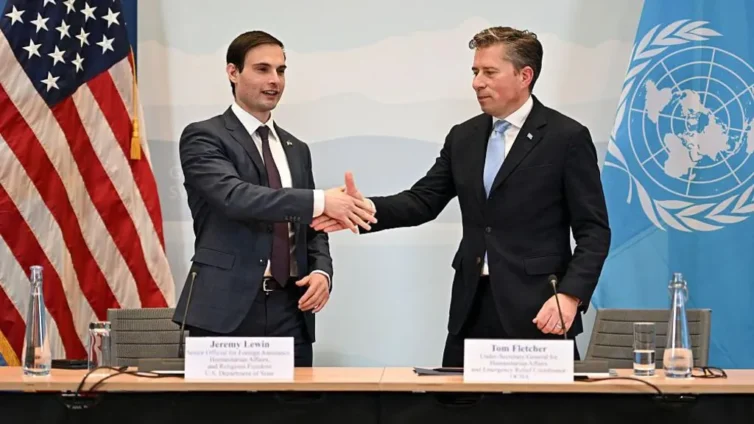
The announcement was made in Geneva by Jeremy Lewin, President Trump's Under Secretary for Foreign Assistance, and the UN's emergency relief chief, Tom Fletcher.
It comes amid huge cuts in US funding for humanitarian operations, and further cuts are expected from other donors, such as the UK and Germany.
Mr Fletcher welcomed the new funds, saying they would save "millions of lives". But $2 billion is just a fraction of what the US has traditionally spent on aid. In 2022, its contribution to the UN's humanitarian work was estimated at $17 billion (£12.6bn).
And the funding comes with some strings attached. Although UN donors do sometimes earmark specific projects, the UN funding prioritises just 17 countries, among them Haiti, Syria, and Sudan.
Afghanistan and Yemen will not, Mr Lewin said, receive any money, adding that Washington had evidence that in Afghanistan, UN funds were being diverted to the Taliban and that "President Trump will never tolerate a penny of taxpayers' money going to terrorist groups".
Such restrictions will be hard for aid agencies working in countries not on the list. The impact of funding cuts has already led to the closure of mother and baby clinics in Afghanistan and reductions in food rations for displaced people in Sudan. Globally, child mortality, which has been declining, is set to rise this year.
The conditions placed on the new US funding also rule out spending money on projects related to tackling climate change, which Mr Lewin said were not "life saving", and not in "the US interest".
Mr Lewin, a Trump loyalist who reportedly masterminded the shutdown of USAID and the firing of its thousands of staff, warned the UN that it must "adapt or die", saying that the US "piggy bank is not open to those organisations that just want to return to the old system".
The US says funding must be focused and efficient, with no duplication among aid projects. These are qualities Tom Fletcher and the entire UN system say they wholeheartedly support. It's in no one's interests, least of all those of the estimated 200 people caught up in crises, for money to be spent unwisely.
But while the UN is gratefully welcoming the new US funding, there remain big questions about whether the conditions around it are too politicised. The fundamental principles of humanitarian aid are that it should be neutral, impartial, and directed at those most in need. Eliminating specific countries or specific crises, such as climate change, challenges those principles.
But, as it struggles with a continued funding crisis and, in Washington, a very skeptical donor, many in the UN will acknowledge that $2 billion is better than nothing.
Latest Stories
-
Ghana Enterprise Brands Awards 2026: Leading brands, business trailblazers to shine on November 30
16 minutes -
T-bills auction: Demand improves as government exceeds target by about 76%; interest rates soften
21 minutes -
Ziope undertakes initiative to build a technologically inclined community, commissions self-help ICT lab
46 minutes -
ECG announces power outage in parts of Tema, Central Region due to network fault, maintenance
1 hour -
When the Gospel Becomes a Weapon: The church, blackmail and the abuse of faith
2 hours -
JoyNews’ Jacqueline Ansomah Yeboah selected for UK Media Excellence for Emerging Technology Fellowship
2 hours -
Mental Health Alliance urges government to operationalise Mental Health Fund
2 hours -
Ghana–Holy See agreement heads to Parliament after Cabinet approval
2 hours -
Luv FM Corporate Games 2026: Kumasi Central Prisons, Amanfiman Bank win big amid fun
2 hours -
WAFU B U17: Ghana top Group A after win over Togo
3 hours -
Ho Central Mosque reopens amid unresolved leadership dispute that led to closure
4 hours -
Minority caucus questions GH¢16.4m in Ablakwa’s SA evacuation spending, demands independent audit
4 hours -
Gender Ministry meets Nana Akua Addo’s husband over domestic violence after hospital discharge
5 hours -
UG Vice-Chancellor urges swift operationalisation of National Research Fund
6 hours -
Pope Leo to have surgery after lump found in lung
6 hours