

Audio By Carbonatix
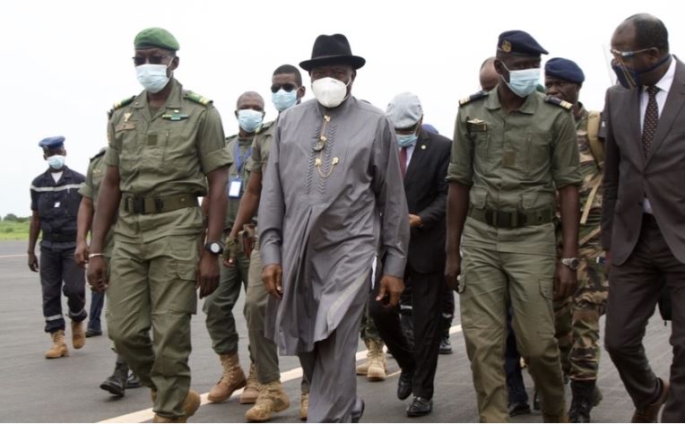
West African leaders have lifted punishing sanctions imposed on Mali following a military coup in August that overthrew embattled President Ibrahim Boubacar Keita.
In a statement on Tuesday, the Economic Community of West African States (ECOWAS) said “heads of state and government have decided to lift sanctions” in order to “support” the handover to civilian rule.
It noted the nomination of retired Colonel Bah Ndaw as interim president and former Foreign Minister Moctar Ouane as prime minister of the transition that is expected to last 18 months.
The move came a day after Ndaw, who was sworn in last month, appointed a 25-strong government tasked with leading the country to elections.
At least four central cabinet posts – defence, security, territorial administration and national reconciliation – went to military officials. One of the August 18 coup leaders, Colonel Sadio Camara, was named defence minister, while Colonel Modibo Kone got the security and civil protection portfolio. Colonel Ismael Wague, who broke the news of the coup in a dramatic night-time television broadcast, was appointed national reconciliation minister.
Civilians were also appointed to the transitional government, including former prosecutor Mohamed Sidda Dicko as justice minister and former ambassador Zeini Moulaye as foreign affairs minister.
The coup came after months of anti-Keita protests over the country’s worsening security situation, chronic economic malaise and alleged electoral malpractices.
Mali has been plagued by an eight-year conflict that began as a separatist movement in the north but soon devolved into a multitude of armed groups jockeying for control in the country’s central region. The insecurity has spilled into neighbouring Burkina Faso and Niger, with groups exploiting the poverty of marginalised communities and inflaming tensions between ethnic groups.
Former armed groups that signed a peace agreement in 2015 will also be represented in the transitional government. Members of Tuareg groups in 2012 led a rebellion in the north were awarded the agriculture and fisheries as well as youth and sports ministries, while pro-Bamako groups also received posts.
The movement that led the protests that built up to the coup received three ministerial posts.
ECOWAS had heaped pressure on Mali’s military to swiftly restore civilian rule, including imposing crippling sanctions. After protracted negotiations, the coup leaders finally agreed to complete that transition.
Last week, they also abandoned a contentious measure that would have enabled their leader, Colonel Assimi Goita, to potentially replace Ndaw if ever he was incapacitated. Goita officially holds the post of interim vice president.
Latest Stories
-
GAEC must retain nuclear scientists for Ghana’s nuclear ambitions – Minister
21 minutes -
Man reportedly mistaken for game and shot by hunter dead in forest
23 minutes -
19-year-old mason jailed 15 years for defiling seven-year-old pupil
28 minutes -
Ghana’s banking sector assets rise 20.47% to GH¢500.2bn – BoG Governor
32 minutes -
22 injured as Sprinter bus overturns at Sege after tyre burst
33 minutes -
UN housing expert urges Ghana to strengthen Rent Control Department amid housing affordability concerns
42 minutes -
Delta-BCI partnership reaches 166,000 people with breast cancer education
51 minutes -
Power restoration fault suspected in Kumasi Central Market fire
6 hours -
The 7-foot giant of Ngleshie Amanfro: Seven-foot Ghanaian Ephraim Saawa dreams of joining the national basketball team
7 hours -
Government promises support for Kumasi Central Market fire victims
7 hours -
Vibes The Movie: Big Ghun’s Ghanaian film earns five nominations at 2026 REFFA
7 hours -
‘I’m a fulfilled man’—Justice Korbieh on missing out on Supreme Court despite two nominations
7 hours -
MamaCare CEO warns unresolved conflicts among health workers could undermine maternal and neonatal care
8 hours -
Health professionals urged to translate medical knowledge into practice to save mothers
8 hours -
Retired judge Justice Francis Korbieh charges 1,568 new lawyers to uphold integrity
9 hours