

Audio By Carbonatix
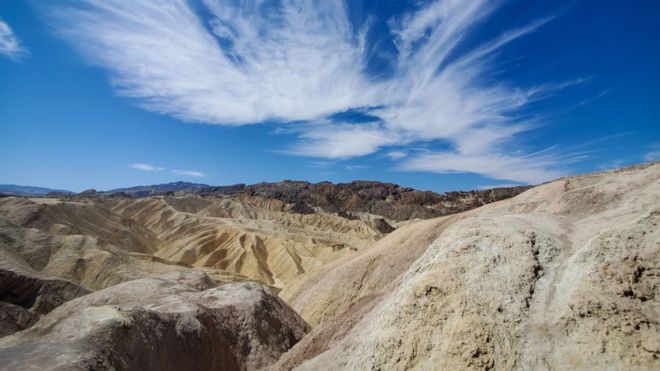
What could be the highest temperature ever reliably recorded on Earth - 130F (54.4C) - has been reached in Death Valley National Park in California.
The recording is being verified by the US National Weather Service.
It comes amid a heatwave on the US's west coast, where temperatures are forecast to rise further this week.
The scorching conditions have led to two days of blackouts in California, after a power plant malfunctioned on Saturday.
Sunday's reading was recorded in Furnace Creek in Death Valley.
Before this, the hottest temperature reliably recorded on Earth was 129.2F (54C) - also in Death Valley in 2013.
A higher reading of 134F, or 56.6C a century earlier, also in Death Valley, is disputed.
It is believed by some modern weather experts to have been erroneous, along with several other searing temperatures recorded that summer.
According to a 2016 analysis from weather historian Christopher Burt, other temperatures in the region recorded in 1913 do not corroborate the Death Valley reading.
Another record temperature for the planet - 131F, or 55C - was recorded in Tunisia in 1931, but Mr Burt said this reading, as well as others recorded in Africa during the colonial era, had "serious credibility issues".
The current heatwave stretches from Arizona in the south-west, up the coast to Washington state in the north-west.
It is expected to hit its peak on Monday and Tuesday, before temperatures start to drop later in the week. However, the sweltering heat will continue for at least another 10 days.
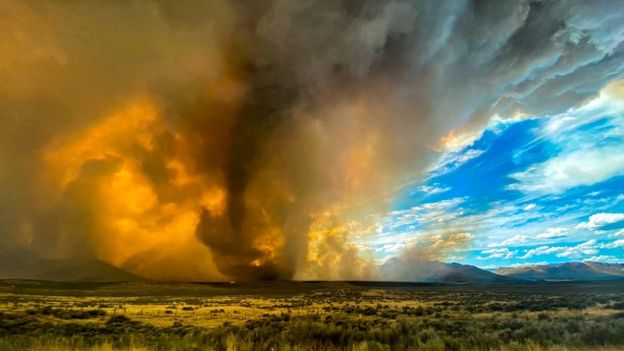
As temperatures soared in California, a large "firenado" was observed on Saturday in Lassen County.
California's Independent System Operator (CISO), which manages the state's power, has declared a Stage 3 Emergency, meaning "when demand [for electricity] begins to outpace supply".
Because so much of the region's power relies on solar and wind energy, and because people use their electricity for air conditioning, during heatwaves the power grid becomes strained and is at risk of completely malfunctioning.
In order to manage the state's demand for power and prevent a complete shutdown, officials are using scheduled rolling blackouts to control and conserve energy.
Latest Stories
-
Mr President, Ghana was mentioned at the UN; why aren’t we talking about it?
1 hour -
Accra to convene Africa’s regulators and markets on tokenisation at AVAS 2026
1 hour -
The Paradox of Plenty — When every smartphone becomes a newsroom
2 hours -
GTA sensitises taxi drivers in ‘Know Ghana’ tourism campaign
3 hours -
Archbishop Agyinasare calls for responsible speech amid growing social media abuse
3 hours -
‘It will be inexcusable for gov’t not to honour payment of teachers’ arrears by 30th October’ – Haruna Iddrisu
3 hours -
Forbes’ World’s Best Employers 2026: No Ghanaian firm ranked among 900 companies
3 hours -
Electronic processing of teachers’ data: ‘The decision is the Controller’s’ – GES boss
3 hours -
Teachers’ Strike: Haruna Iddrisu questions paper-based processing of promoted teachers’ data
4 hours -
Savannah Region: Kunfusi bridge collapses again, leaving nearly 4,000 residents cut off
4 hours -
Teachers’ strike: GES targets Monday deadline to submit promotion data to Controller
4 hours -
Inflation to average 11.3% in 2027 – Fitch Solutions
4 hours -
‘I didn’t campaign for NDC to come and do this nonsense’ – Kpebu on EOCO’s conduct
4 hours -
Fitch Solutions maintains policy rate forecast of 14% by December 2026
4 hours -
Diaspora Nasara Caucus congratulates Mohammed Ali Suraj, new NPP executives
6 hours