

Audio By Carbonatix
In Ghana today, funerals are no longer just solemn farewells to the departed. They have become grand spectacles stages where wealth is paraded, status is displayed, and grief is dressed in splendour.
Once sacred ceremonies of mourning, funerals have increasingly turned into social festivals. Coffins gleam under the sun, brass bands play triumphantly, and mourners arrive in luxurious attire.
In a society where even sorrow now comes with a price tag, death feels less like a loss and more like a performance.
The Changing Face of Death
Ever since funerals evolved into platforms for the rich to showcase their wealth, death no longer feels like a moment of sorrow.
It feels like a festival dressed in black. The drums beat louder, the coffins shine brighter, and grief itself has become a show of status.
Funerals were once deeply sacred moments when family, neighbours and clan members gathered to honour the deceased, help them transition into the ancestral realm, and support the bereaved in genuine mourning.
Today, however, the meaning has shifted. The funeral is still about the dead, but in practice, it has become about display status, consumption, and competition.
“They say death is no respecter of persons,” goes the old saying. Yet these days, it seems to walk more often through corridors of luxury than the streets of poverty. The rich die in comfort, surrounded by gold and grandeur, while the poor look on, confused, suspicious, and sometimes afraid.
A Celebration of Wealth, Not a Farewell
In modern Ghana, funerals have become more than farewells; they are exhibitions of power and influence gatherings where the living try to outshine the dead.
Society has reached a point where even mourning is measured by money. The way a funeral is organised, the materials used, and the splendour on display all serve as evidence that the deceased belonged to a wealthy and respectable family.
Funerals today are less about mourning and more about proving a family’s social standing — celebrating it, showing it off. This has given rise to what some call funeral extravaganzas, where families spare no expense to stage elaborate ceremonies.
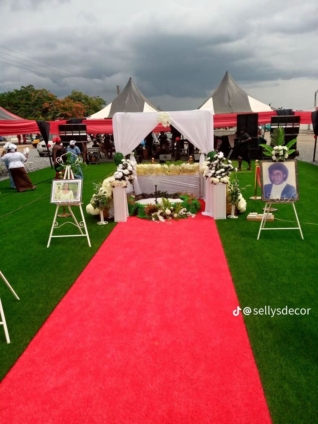
In the manicured lawns of affluent homes and under lavishly decorated canopies, death is invited to perform. The coffin becomes a billboard, the procession a parade, and the family the audience of their own spectacle. The dead are draped in designer textiles, escorted by luxury vehicles, and saluted by crowds.
Each detail from the sound system to the fabrics and décor becomes a declaration: we belong, we have arrived, we mattered. But in this process, something sacred is lost. Mourning blends with competition. Grace is overshadowed by grandeur.
Counting Costs Beyond the Grave
Behind the spectacle lies a heavy burden. Families go into debt to fund funerals that meet societal expectations. The corridors of privilege echo not only with eulogies but also with ledgers records of what was spent, who attended, and how many cars lined up.
The scoreboard measures not just the life lived, but the funeral thrown. For many families, the financial strain lingers long after the last hymn is sung. Children and grandchildren often bear the cost of ceremonies they did not choose, for loved ones they still mourn.
Tradition Meets Transformation
Among the Akan, funerals begin with solemn customs the body laid in state, mourners gathering, women lamenting, and men restrained by the proverb “Barima nsu” (“A man does not cry”). Traditionally, the rite marked both the passage of the deceased into the ancestral world and the living’s renewed sense of community.
Today, however, as scholars observe, funerals have also become major economic events. Hosting large crowds, providing food, drinks, souvenirs, and elaborate decorations all add to the financial weight. Mourning clothes, public donation lists, and lavish wake-keeping ceremonies have become integral parts of the ritual.
Respect for the dead, once measured by sincerity of grief, is now partly gauged by the scale of display.
The Art and Industry of Death
On the coast, among the Ga people of the Greater Accra Region, a distinct funeral tradition has captured international attention the fantasy coffin.
These colourful coffins, shaped like fish, aeroplanes, tools, or even soda bottles, are designed to reflect the deceased’s profession, aspirations, or status.
Beyond these, families also perform rituals using items known as kotsagbamo nibii symbolic belongings such as boxer shorts, singlets, and suits meant to accompany the deceased on their journey.
The send-off becomes an exhibition of craftsmanship, taste, and social position. Mourners stream in, brass bands play, and the family proudly displays how far they have come.
A Mirror to Society
These practices extend across Ghana’s many ethnic groups, each with unique beliefs and interpretations. Yet a common thread runs through them: funerals still honour the departed, but they increasingly glorify the living.
Ritual meets spectacle. Community meets status. Grief meets glamour.
When the departed become the backdrop for display, one question remains are we truly sending someone off, or simply showing everyone how we do it?
As the number of deaths continues to rise in recent times, the deeper question persists: Are people really dying or are they being taken?
May our farewells remain rooted in respect, memory, and meaning.
Latest Stories
-
Asantehene plants trees to commence Jimi Watercourse Rehabilitation destroyed by galamsey
22 minutes -
15 arrested, 6 trucks impounded over sandwinning activities on Kumasi-Accra Expressway
22 minutes -
OFFICIAL: Vinicius will miss El Clásico, suspended four games
25 minutes -
Prayer vigil held after four arson attack murders
32 minutes -
GRA fully recovers $154k legacy debt owed by foreign entities between 2022 and 2024
34 minutes -
Kwesi Pratt Jr warns bus preachers are adding to passengers’ stress with accident prophecies
35 minutes -
MTN Ghana to spend $1.1bn in 3 years, build 500 new sites as MoMo hits 44% Growth
37 minutes -
I have no regrets joining Assemblies of God – Mahama
37 minutes -
Starlink restrictions in Ukraine war linked to political situation, Zelensky aide says
40 minutes -
Furniture boost for Techiman North schools as MP donates to 20 institutions
40 minutes -
Assemblies of God to loan 10,000-seater dome for Ghana@70 celebrations
41 minutes -
Government to audit 2,016 community network sites – Communications Minister
41 minutes -
Heritage Series notes: BoG promises more inclusive cedi with improved sizes, tactile features
58 minutes -
‘We want answers’ – Family seeks probe into 14-year-old’s death 12 days after starting SHS
1 hour -
No preacher has the right to impose beliefs on bus passengers – Kwesi Pratt Jr backs preaching ban
1 hour