

Audio By Carbonatix
The Ghana Statistical Service (GSS) has released the findings of its latest Integrated Business Establishment Survey (IBES), providing a comprehensive map of the nation’s 2,644,358 recorded businesses.
The data paints a picture of a resilient and evolving enterprise landscape where non-traditional operations play a critical role in national commerce.
While the majority of businesses, approximately 1.87 million (70.6%), are conducted within fixed structures, the survey highlights the massive scale of the informal and semi-formal sectors.
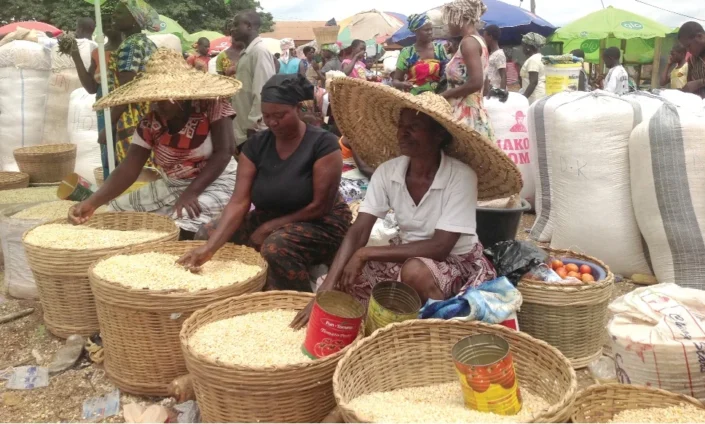
Enterprises operating in open spaces and mobile units now account for nearly 30% of all businesses in Ghana. These 776,668 entities are more than mere points of trade; they are essential pillars of daily access to goods and services.
The economic footprint of open-space businesses is particularly striking:
- Employment: These businesses alone provide livelihoods for over 922,000 people.
- Urban Concentration: Activity is heavily concentrated in the Greater Accra and Ashanti regions, reflecting the high commercial demand of Ghana’s primary urban centres.
- Operating Hours: Nationally, 63.7% of these businesses operate at least six days a week. This figure rises to 77.5% in Greater Accra and 73.1% in Ashanti, while in the Northern Region, nearly half (48%) remain open seven days a week.
Gender and ownership dynamics
The IBES data reveals a significant gender lean within the sector. Nearly 80% of all persons engaged in open-space, fixed-location businesses are women, underscoring the sector's role as a primary engine for female economic empowerment in Ghana.
Furthermore, the data reinforces the indigenous nature of this micro-economy, with 99.2% of all open-space businesses being entirely Ghanaian-owned.
Beyond fixed spots and open stalls, the survey identified 82,920 mobile businesses operating nationwide.
These "businesses on wheels" or on foot further bridge the gap in local commerce, ensuring that even the most remote or transient populations have access to essential trade.
The GSS findings suggest that while formalisation remains a policy goal, the informal and semi-formal sectors remain the heartbeat of Ghanaian economic activity.
With high employment levels and a deep-rooted presence in every region, these non-traditional enterprises continue to be the primary source of income generation for millions across the country.
Latest Stories
-
Libya’s military seizes narcotics after firefight with smugglers
2 hours -
At least 139 migrants dead, including some children, after boat from Djibouti to Yemen capsizes, UN agency says
2 hours -
“US Embassy introduced TRIBE Culture Fest to NSA, GTA” – Kofi Adams
2 hours -
“NSA did not tell us of any embassy arrangement” – Kofi Adams
3 hours -
Kumasi records third commercial fire in three days
4 hours -
Trump faces growing backlash over plans to import diesel from Russia
4 hours -
AI is less regulated than milk, says Microsoft president
4 hours -
Boots sold in £7bn deal to Canadian billionaire family
4 hours -
Glasner suffers loss on Selhurst return as Palace beat Forest
4 hours -
WAFU B U17: ‘We won but I expected more from my boys’ – Kassim Ocansey
4 hours -
Royal Mail plans to cut 2,500 jobs
4 hours -
Man City cruise to statement win over 10-man Liverpool
4 hours -
Citroen revives the 2CV for an electric age
4 hours -
Blind guide dog owner says quiet EVs put lives at risk
5 hours -
Hamilton apologises to Ferrari as Antonelli moves to brink of title
5 hours