

Audio By Carbonatix
The International Monetary Fund (IMF) has made it clear to the Government of Ghana that it cannot impose or intensify import restrictions for balance of payments purposes.
This is an agreement contained in the IMF bailout package which has pledged to support Ghana’s balance of payment with some $3 billion between 2023 and 2026.
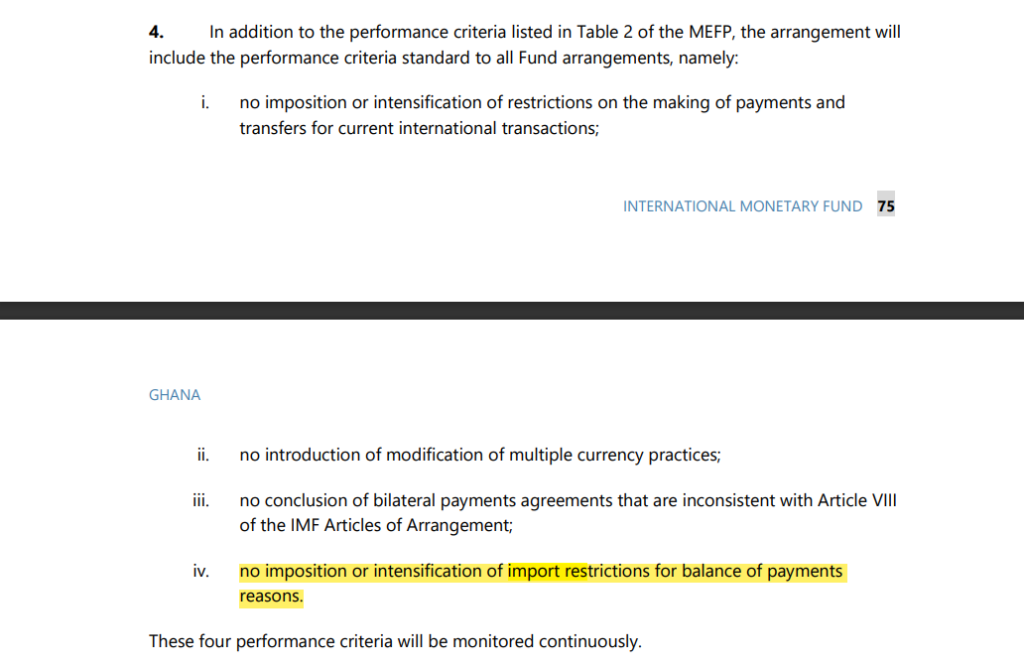
“No imposition or intensification of import restrictions for balance of payments reasons”, the Fund stressed on page 76 of the programme document. Amongst other things, there are four decisions the Government of Ghana cannot take while it is still under the IMF programme. These decisions align with performance criteria common to all Fund arrangements, which include:
- No imposition or intensification of restrictions on making payments and transfers for current international transactions.
- No introduction or modification of multiple currency practices.
- No conclusion of bilateral payments agreements inconsistent with Article VIII of the IMF Articles of Arrangement.
- No imposition or intensification of import restrictions for balance of payments reasons.
The Fund emphasised that these four performance criteria will be monitored continuously.
The Government of Ghana on Thursday made a surprising suspension of the decision to put the L.I. before parliament, which sought to place the importation of 22-listed products under restrictions. It had tried on three occasions, without success, to lay the bill before the house.
The Minority in Parliament urged President Akufo-Addo to immediately withdraw the regulation seeking to restrict the importation of rice, cement, fish, sugar, guts, bladders, and animal stomachs, known as 'yemuadie'.
The Trade Minister, K.T Hammond, who was pushing this regulation hoped it will help the cedi appreciate as well as help grow local industries.
Per the proposed regulation, any person seeking to import the selected products would have been required to obtain permission from the Trade Minister.
Ghana’s import bill according to Finance Minister Ken Ofori-Atta, exceeds $10 billion annually and is accounted for by a diverse range of items including palm oil, toilet roll, and even toothpick. While Ghana needs over $500 million to import rice, the trade minister says the importation of ‘yemuadie’ cost the state some $164 million in imports.
Latest Stories
-
Drug bust case: Only Customs officers, MPS officials in scanning room – NACOC
26 minutes -
I don’t mind being insulted; I have a crocodile skin – President Mahama
38 minutes -
Samson’s Take: Verify the badge – and verify the story
50 minutes -
President Mahama explains why Ghana must rethink regulation of TikTok, other new media platforms
1 hour -
Rule of law must be protected – GBA condemns EOCO action against Baffour Awuah
2 hours -
950,000 barrels of Sankofa crude head to TOR as GNPC deepens domestic refining
3 hours -
Scales of deception removed – Annoh-Dompreh attacks new cocoa price
3 hours -
Young Positivist Writes : My Experience with GCLP
4 hours -
Strong Day 1 turnout sets tone for Day 2 of Republic Bank-JoyNews Habitat Fair Clinic
5 hours -
Ghana Army warns new soldiers against social media misuse, uniform abuse
5 hours -
AMA calls for science-led action to tackle environmental health risks in Accra
5 hours -
NPP Canada Organizer BigMo urges Diaspora to support Kodua Frimpong
6 hours -
He entered at eight; he is now 16: Ghana’s children growing up in prayer camps
9 hours -
‘Development must not always begin from Accra’ — Anwelle Foundation launched in Jirapa
9 hours -
PKO trio eye victories at Odwira Festival
11 hours