

Audio By Carbonatix
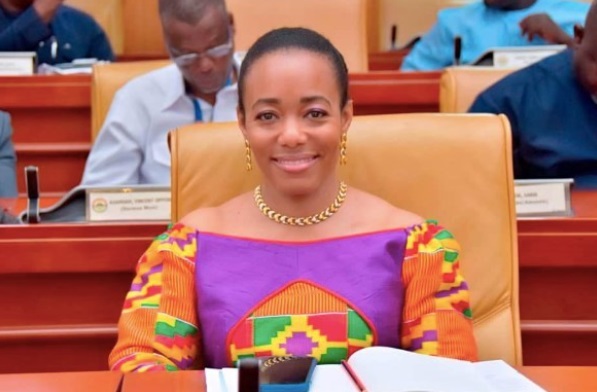
Dr Zanetor Agyeman-Rawlings is not the first Minister for Environment, Science, Technology and Innovation (MESTI) with a science background. Two of her predecessors, Prof. Kwabena Frimpong-Boateng and Dr Kwaku Afriyie, were medical doctors.
So why are scientists at the Council for Scientific and Industrial Research grinning from ear to ear and exchanging high-fives on account of her appointment? Actually, it is not her appointment, per se; it is the words of hope coming out of her mouth.
Fact: though her predecessors made mention of CSIR at their vetting, the treatment was more or less like a footnote. Zanetor has been the first to elevate CSIR into the news headlines.
Obviously an Apostle of Domestication, she made her intentions known at her vetting: that her regime will wage a relentless war on the plastic waste menace, with local solutions; she will end the situation in which the country is being buried alive under mountains of rubbish.
Part of the solution, she says, "is to channel some funding towards the CSIR, so that they can actually look into biological alternatives, for example hemp, for example cassava”.
It is not only CSIR scientists who are brimming with hope; their counterparts at the Environmental Protection Agency also believe that Dr Agyeman-Rawlings “said their say” for them.
“We should start the issue of segregation of waste,” she preached, stressing its adoption at the household, school and community levels.
The EPA has been at waste segregation all their lives. Why it has not become a culture, I am not told, but here is a Minister who shares EPA’s faith.
Zanetor’s third declaration is one this country seldom talks about: poor motivation for scientific researchers, generally. Not only that. Hopefully, her plans also include the laughable paradox where, at CSIR and other scientific institutions, governments have money only to pay scientists (paltry as it is) but not enough to fund the research itself. Most scientific research is funded by development partners, European and American donors, as usual.
But talk is good. Question: where will the money come from? Will she find Cabinet support when there are bread-and-butter issues that will translate into votes? That is why, if Zanetor is reading this article, I ask one question: If Frimpong Boateng couldn’t get Akufo-Addo to increase investment in science, technology, and innovation (STI), what makes her hopeful that a Mahama government would turn attention away from bread-and-butter issues toward science?
Yet, knowing what I know about science and technology for development, I am convinced that STI is, and remains, the surest route to national development since God created Adam; no government that has channelled funds into it has regretted the decision. Kwame Nkrumah did, and in the First Republic, we were manufacturing glass; we were putting together an atomic reactor for cheap electricity.
In 1960, South Korea was so poor that Kenya gave it a US$10,000 loan, along with relief food (as Ghana did for Guinea). Fast forward to the 2000s, the tables have turned. In 2026, Kenya secured a U$83.8 million loan from South Korea to fund the Nairobi Intelligent Transport System.
While in 1960 Ghana had a higher GDP than South Korea, today this Southeast Asian nation's GDP per capita is roughly 11 times Ghana's, and its total economy is more than 16 times larger.
What changed? It is documented: South Korea's rapid economic transformation from a war-torn agrarian society into a global tech powerhouse was fundamentally driven by its strategic reliance on science, technology, and education.
At CSIR, there is a problem that has defied a solution forever: marketing the research findings. Previous governments tasked the council to market its research. But that proposal runs into a problem: scientists are not entrepreneurs capable of mass production; secondly, scientists are not marketers; thirdly, marketing requires money. Where is the money?
Because of that, many research solutions are still gathering dust on CSIR shelves. I have toured CSIR, and I know that there is no agricultural problem for which it has no solution. Take the example of the Institute of Industrial Research (IIR), which has developed a way to irrigate a farm remotely. The institute’s scientists have developed a mobile application (App) that enables farmers to irrigate their farms remotely, even from up to a thousand kilometres away.
The remote-controlled irrigation device works with a borehole fitted with a submersible pump. Solar panels convert energy from the sun into alternating current (AC), which is then stored in dry cell batteries. The app turns on the pump that moves water from the borehole into PVC pipes around the farm to water the crops.
The world is driven by technology. Technology is why only 5 per cent of Americans are engaged in agriculture yet can feed the whole nation, while 70 per cent of Ghanaians are in farming yet cannot feed us.
Will Zanetor find the money? For some reason, I find myself praying for her – to prove that no route beats the science route.
Latest Stories
-
Government procures over 2,000 transformers as Ghana’s electricity access hits 89.13% – Energy Minister
24 minutes -
UTAG-UG threatens strike on October 19 over unpaid allowance
32 minutes -
Let The Constitution direct Chieftaincy to deliver “All Development Is Local”
2 hours -
John Jinapor outlines renewable energy, nuclear power priorities for 2027
2 hours -
Ghana explores centre of excellence for hearing, communication and cochlear implant care
3 hours -
Schizophrenia-related disorders lead mental health cases recorded in Ghana
3 hours -
Dutch authorities enlist Ghana in hunt for fugitive drug lord Bolle Jos
4 hours -
Ghana housing finance conference adopts communiqué to improve affordable housing access
8 hours -
Special Initiatives Minister urges Wa Technical Institute to enrol more girls as EU-backed solar training lab opens
9 hours -
In the matter of my first year at the Bar
9 hours -
ActionAid Ghana calls for an end to child marriage, greater investment in girls’ rights
9 hours -
Newsfile to tackle World Cup visa scandal, beach demolitions, education strikes, BRICS bid
9 hours -
UK-Ghana Trade & Investment Summit: Trade Resource Centre to help businesses maximise UK-Ghana trade opportunities
10 hours -
Embassy of Denmark celebrates World Maritime Day
10 hours -
Linking LEAP to productive inclusion could cut extreme poverty by 2030 – UNICEF
11 hours