

Audio By Carbonatix
Ghanaian creatives are wont to envy their counterparts in Nigeria for one thing: government support. It began in 2013, when former Nigerian President Goodluck Jonathan awarded a 3 billion naira grant to support and upgrade the Nigerian film industry.
As recently as September 2025, the Federal Ministry of Arts, Culture, Tourism, and Creative Economy launched the Creative Economy Development Fund (CEDF), through which it offers grants, equity, and affordable loans for film, music, fashion, and visual arts.
Under this scheme, Nigerian creatives can use registered intellectual property—such as songs, films, and fashion designs—as collateral for loans instead of traditional physical assets.
Also in place is the Creative Industry Financing Initiative, established by the Central Bank of Nigeria (CBN) to provide low-interest loans (around 9% per annum) up to ₦500 million for fashion, IT, movies, and music. Any duly registered/incorporated company in Nigeria operating in the entertainment and creative industry is eligible for funding under this scheme.
In the midst of such multiplicity of funding sources, the Nigerian artist wants for nothing; they spend more time creating than whining.
There is hope for the future, though. President John Dramani Mahama recently disbursed GH¢20 million directly into the Film Development Fund, alongside a separate GH¢20 million for the Creative Arts Fund, totalling a GH¢40 million package for the creative sector.
Sounds paltry, considering that in the National Film Authority’s Presidential Pitch Series in 2021, the budget for a single film among the 25 selected for a match-up fund was US$5 million. The lowest budget was US$500,000, for a docu-drama.
But I console myself with the knowledge that Mahama’s GHc40 million grant this year shows a pattern of growth. It is an improvement on his own performance in 2016 when his government gave out GHc810,000 to creatives through the Ghana Culture Forum.
Since the Second Republic, it has always been: “not enough money to go round.”
That is why mixed emotions did many somersaults in my belly when former television news anchor Gideon Aryeequaye, now the Executive Secretary of the Creative Arts Agency, announced on Tuesday, August 25, plans to build houses for retired creatives. He was addressing a stakeholder forum at the National Theatre for domains under the agency.
Sounded like wishing for the moon. How is the agency hoping to come by the billions needed to build houses for retired creatives?
The idea of housing for artists reminds me of one of the Greatest Creatives Of All Time: Lord Bob Cole. Over decades, from the 1950s onward, this musician, comedian, concert performer, and screen actor produced a vast body of work of exceptionally high quality.
The arts not only gave him fame; materially, they also gave him comfort. He was successful, by all definitions, so successful that around town, he rode an American DeSoto, a convertible fit for celebrities. Sadly, in the final stages of his life in the early 1990s, Bob Cole had nowhere to lay his head. He was sleeping under the sheds at the Arts Centre!
I bring up the tragic end of this legend to suggest that the Creative Arts Agency should develop to the point where it can pay life coaches and consultants to offer counsel to artists.
But where is the money going to come from?
That, dear readers, is where my piece for the week is finally about to begin. Inside the Creative Arts Agency Law, Act 1048 of 2020, there is an animal called CREATIVE ARTS FUND, to be financed with a 1% levy. Like the 1% Tourism Levy, the Creative Arts Levy will be a fee levied on the net cost of services or products purchased from all creative enterprises in Ghana.
With hundreds, if not thousands, of creative enterprises around, some of whose musical events gross in the millions of cedis, you don’t need a mathematical brain to calculate how much will accrue to the sector from this levy within a year. The 1% tourism levy alone fetches between GH¢15 million and GH¢20 million per annum.
With the levy, a Creative Arts Loans Scheme is very possible. To qualify for a loan, all the applicant needs is to (i) prove that they are artists, and (ii) that they are registered under the Creative Arts Agency. That is all.
Do I need to do advocacy? We should no longer hear stories to the effect that a former Executive Secretary of the Creative Arts Agency brought two military trucks to carry away all the furniture in the offices after her term expired. It doesn’t matter that she was the daughter of the President of Ghana. They were her personal property.
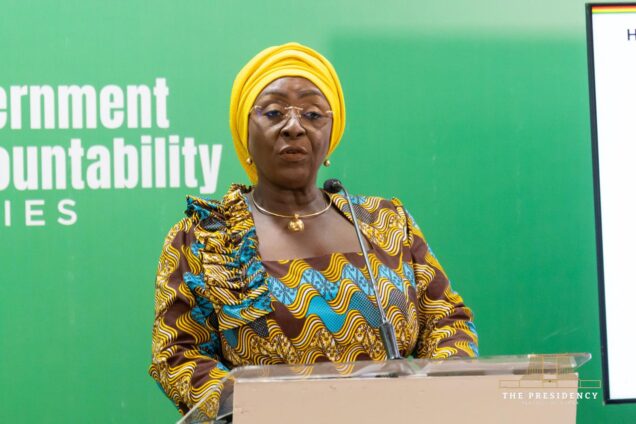
The prospect of an immediate tomorrow where no artist should die a pauper is the dream of Abla Dzifa Gomashie, the Minister. Last Tuesday, she had no excuses for promises unfulfilled. The reason was obvious: no big funds for big projects. Were she not strong emotionally, she could have broken down and wept, seeing as she is a creative herself.
With this 1% Creative Arts Levy, however, Dzifa should weep no more.
Latest Stories
-
Asos hackers took more personal details than first revealed, BBC finds
2 hours -
Fort Hood shooter’s execution by firing squad will be livestreamed, Pentagon says
2 hours -
Chrysler Building to get its crown restored after being sold
2 hours -
Infantino re-election boost as Concacaf chief will not stand
2 hours -
Everton’s Sherif fined for breaching betting rules
3 hours -
Suspended fine for Xhaka over Covid-19 certificate
3 hours -
Businessman dragged to court over GH¢480,000 fraud
3 hours -
Pregnant woman and husband found dead in a room at Anloga-Kportorgboe
3 hours -
Man, 87, jailed 20 years for defiling nine-year-old girl at Ofankor
3 hours -
Maresca says ‘feeling is fantastic’ among Man City squad
3 hours -
Sam George warns FBI Director against taking sole credit for Ghana cybercrime operation
3 hours -
Foreign capital no passport to Ghana’s informal retail market – GIPA CEO
4 hours -
E&P model should be seen as a blueprint for building local mining giants – GIPA Boss
4 hours -
Govt’s decision to reduce nurse training long overdue – GRNMA
4 hours -
Ghana needs emergency health fund to respond swiftly to outbreaks – SEND Ghana
4 hours