

Audio By Carbonatix
The CEO of the Ghana National Chamber of Commerce and Industry (GNCCI), says government's proposed 24-Hour Economy cannot succeed on ambition alone if the cost of doing business remains crippling.
Mark Badu-Aboagye, speaking on JoyNews’ PM Express on Monday, July 7, argued that producing more means nothing if local products cannot compete in the global market.
“Launching a 24-hour economy will not change the harsh business environment that we are facing now,” he said, calling for a hard look at structural barriers confronting Ghanaian manufacturers.
When host Kofi Agyei pointed to recent macroeconomic improvements such as the cedi’s appreciation, a drop in inflation to 13.7%, improved business confidence, and growing international reserves, Badu-Aboagye was firm in his response.
“It is a good start, but it’s not enough,” he said. “Having inflation down to 13.7% is a necessary condition, but not sufficient to change the structure of the economy.”
He stressed that Ghana needs to see how lower inflation translates into real benefits for producers.
“We want to see how inflation, lower inflation will reduce the cost of credit. We want to see how lower inflation will reduce the cost of utility, electricity and water. These are key components when it comes to manufacturing.”
Mr Badu-Aboagye revealed that the current electricity tariffs for manufacturers in Ghana are among the highest on the continent.
“In Ghana, the cost per kilowatt hour per manufacturing company, ranging from 12 to 15 cents, is among the highest. In what hour for them is less than five cents.”
He warned that with a monetary policy rate at 28%, which translates into commercial interest rates above 30%, Ghanaian exporters are already priced out of competitive markets.
“No company would want to manufacture and export under these conditions.”
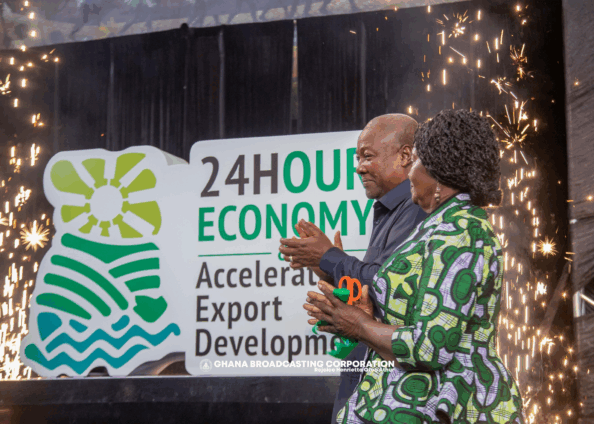
For Mr Badu-Aboagye, the 24-Hour Economy must not be reduced to a slogan for self-sufficiency.
“If it’s for local consumption, then we don’t need a 24-Hour Economy, because we can produce much to feed ourselves. We want to export. That is why the accelerated export is a component of the 24-hour economy.”
But exporting, he stressed, will depend on cost and quality, not patriotic labels.
“When you send your product abroad, people will not buy it because it’s coming from Ghana, because you have launched a 24-hour economy, hm? You will buy your product because one, it is competitive, yeah, two, it is of high quality.”
He urged policymakers to understand that Ghana’s products are competing with cheaper and equally high-quality goods from places like North Africa.
“So you produce and you send it there, and you won’t get people to buy because it’s very expensive.”
Mr Badu-Aboagye concluded by calling for a sharper focus on how the gains in inflation and currency strength can impact the policy rate.
“Let’s look at how the improvements we are seeing now—the lower inflation and the cedi appreciation—will impact the policy rate.”
Latest Stories
-
President Mahama ends Resetting Ghana tour of Ahafo Region
2 hours -
African negotiators seek delivery of climate commitments at COP31
2 hours -
BoG develops AI rules for financial sector
2 hours -
‘Big Push’: Government assures contractors of prompt payments
2 hours -
Court fines miner for breaking into gold buying shop
2 hours -
Tarkwa court jails labourer for three years over GH¢123,000 theft
3 hours -
GAEC must retain nuclear scientists for Ghana’s nuclear ambitions – Minister
3 hours -
Man reportedly mistaken for game and shot by hunter dead in forest
3 hours -
19-year-old mason jailed 15 years for defiling seven-year-old pupil
3 hours -
Ghana’s banking sector assets rise 20.47% to GH¢500.2bn – BoG Governor
3 hours -
22 injured as Sprinter bus overturns at Sege after tyre burst
4 hours -
UN housing expert urges Ghana to strengthen Rent Control Department amid housing affordability concerns
4 hours -
Delta-BCI partnership reaches 166,000 people with breast cancer education
4 hours -
Power restoration fault suspected in Kumasi Central Market fire
9 hours -
The 7-foot giant of Ngleshie Amanfro: Seven-foot Ghanaian Ephraim Saawa dreams of joining the national basketball team
10 hours