


Audio By Carbonatix
A rare and unfortunate sequence of events allowed a deadly type of malaria in gorillas to "jump" species and attack humans, according to scientists.
Hundreds of thousands of people die from malaria every year and Plasmodium falciparum - the type the researchers studied - accounts for most cases.
African great apes were the original host to the parasite.
But a chance genetic mutation about 50,000 years ago turned it into a threat to humans, experts have found.
 They studied the genetic make-up of different ancestral types of malaria parasite, focusing in particular on a gene called rh5 - the vital bit of DNA code that enables malaria to infect human red blood cells.
It is a target doctors are very interested in for developing new malaria vaccines.
The researchers believe thousands of years ago, two types of malaria parasite happened to co-infect a gorilla and they exchanged some genetic material between them.
Plasmodium falciparum picked up the rh5 gene.
Lead author Dr Gavin Wright said: "This was a very rare event that led to so much death and disease in humans.
"We were quite surprised by the findings. It was very satisfying because it makes sense with lots of other research that has been done by colleagues. It provides this molecular explanation now as to how this jump could have occurred.
"Rh5 currently is an important blood stage vaccine candidate for malaria and so if we can get any more information on this gene, that could really help us in trying to combat this disease."
He said the chances of the parasite mutating again soon were "very, very slim", although theoretically possible.
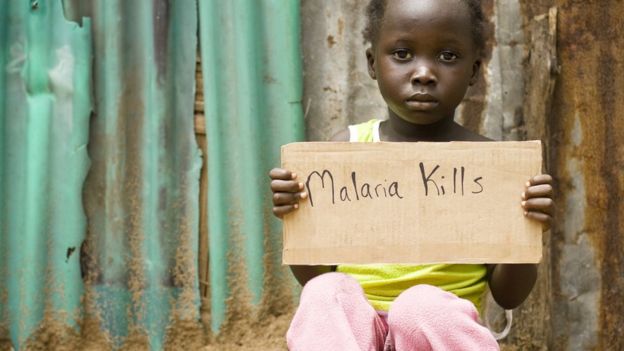
Nearly half of the world's population is at risk of malaria. The most cases and deaths occur in young children in sub-Saharan Africa, caused by Plasmodium falciparum.
They studied the genetic make-up of different ancestral types of malaria parasite, focusing in particular on a gene called rh5 - the vital bit of DNA code that enables malaria to infect human red blood cells.
It is a target doctors are very interested in for developing new malaria vaccines.
The researchers believe thousands of years ago, two types of malaria parasite happened to co-infect a gorilla and they exchanged some genetic material between them.
Plasmodium falciparum picked up the rh5 gene.
Lead author Dr Gavin Wright said: "This was a very rare event that led to so much death and disease in humans.
"We were quite surprised by the findings. It was very satisfying because it makes sense with lots of other research that has been done by colleagues. It provides this molecular explanation now as to how this jump could have occurred.
"Rh5 currently is an important blood stage vaccine candidate for malaria and so if we can get any more information on this gene, that could really help us in trying to combat this disease."
He said the chances of the parasite mutating again soon were "very, very slim", although theoretically possible.
Nearly half of the world's population is at risk of malaria. The most cases and deaths occur in young children in sub-Saharan Africa, caused by Plasmodium falciparum.
Mosquito bites
The findings, published in the journal PLoS Biology, could help uncover new ways to fight malaria, the Wellcome Sanger Institute researchers hope. Malaria is caused by a parasite that gets into the bloodstream when an infected mosquito bites humans - or animals. There are lots of different strains of parasite and one of the most important ones, which now affects only humans, is Plasmodium falciparum. It switched host from gorillas at about the same time as the first migration of humans out of Africa, some 40,000 to 60,000 years ago, the researchers say.
They studied the genetic make-up of different ancestral types of malaria parasite, focusing in particular on a gene called rh5 - the vital bit of DNA code that enables malaria to infect human red blood cells.
It is a target doctors are very interested in for developing new malaria vaccines.
The researchers believe thousands of years ago, two types of malaria parasite happened to co-infect a gorilla and they exchanged some genetic material between them.
Plasmodium falciparum picked up the rh5 gene.
Lead author Dr Gavin Wright said: "This was a very rare event that led to so much death and disease in humans.
"We were quite surprised by the findings. It was very satisfying because it makes sense with lots of other research that has been done by colleagues. It provides this molecular explanation now as to how this jump could have occurred.
"Rh5 currently is an important blood stage vaccine candidate for malaria and so if we can get any more information on this gene, that could really help us in trying to combat this disease."
He said the chances of the parasite mutating again soon were "very, very slim", although theoretically possible.
Nearly half of the world's population is at risk of malaria. The most cases and deaths occur in young children in sub-Saharan Africa, caused by Plasmodium falciparum.
DISCLAIMER: The Views, Comments, Opinions, Contributions and Statements made by Readers and Contributors on this platform do not necessarily represent the views or policy of Multimedia Group Limited.
DISCLAIMER: The Views, Comments, Opinions, Contributions and Statements made by Readers and Contributors on this platform do not necessarily represent the views or policy of Multimedia Group Limited.
Latest Stories
-
No room for another false start as Ghana begin AFCON qualifying campaign
14 minutes -
“We are grateful for what you have achieved” – AGI President tells Finance Minister
22 minutes -
“No Nation is Inferior”: Mahama champions human dignity and security council reform at the UN
45 minutes -
Manhyia South residents, NPP executives fume over botched EOCO arrest of MP
55 minutes -
Mahama unveils new deal with global philanthropy
1 hour -
Daily Insight for CEOs: Building customer-centric leadership
1 hour -
Democracy must deliver food, jobs and healthcare, not just elections – Mahama
1 hour -
Capacity constraints must never be a barrier to restitution – Mahama
1 hour -
COMAC pushes for suspension of sections of Customs Act 2026
1 hour -
Mahama calls for Great African Museum to anchor continent’s heritage revival
1 hour -
Mahama cites return of Mpomponsuo sword as model for restitution
1 hour -
Mahama: Africa must inherit more than the story of what it lost
1 hour -
Mahama pushes for permanent UN system for restitution of African artefacts
1 hour -
Ghana is arguably Africa’s most stable democracy, says Mahama
1 hour -
Mahama calls for investment in Africa’s cultural infrastructure
1 hour