


Audio By Carbonatix
Belgium's King Philippe has expressed his "deepest regrets" to the Democratic Republic of Congo for his country's colonial abuses.
The reigning monarch made the comments in a letter to President Felix Tshisekedi on the 60th anniversary of DR Congo's independence.
Belgium controlled the Central African country from the 19th Century until it won its independence in 1960.
Millions of Africans died during Belgium's bloody colonial rule.
There is a renewed focus on the European nation's history after the death of George Floyd in police custody in the US and the Black Lives Matter protests that followed.
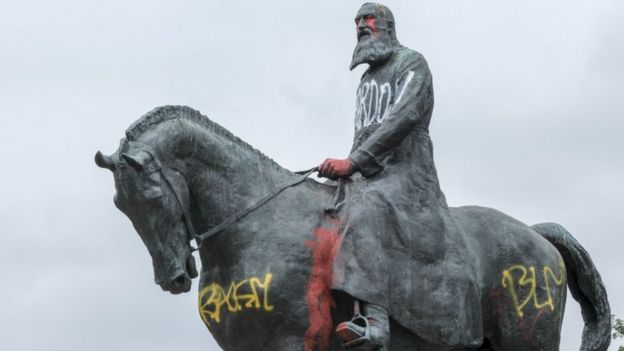
Thousands of Belgians have demonstrated in recent weeks and statues of Belgium's colonial leader King Leopold II have been vandalised. Authorities in Antwerp have removed a statue of him from a public square.
More than 10 million Africans are thought to have died during his reign. King Philippe is a direct descendant of the 19th Century ruler.
What did King Philippe say?
This is the first time a Belgian monarch has formally expressed remorse for what happened during the country's colonial rule.
In a letter sent to President Tshisekedi and published in Belgian media, King Philippe praises the "privileged partnership" between the two nations now.
But he says there have been "painful episodes" in their history, including during the reign of King Leopold II - who he does not directly name - and in the 20th Century.
"I would like to express my deepest regrets for these injuries of the past, the pain of which is now revived by the discrimination still too present in our societies," King Philippe wrote.
"I will continue to fight all forms of racism. I encourage the reflection that has been initiated by our parliament so that our memory is definitively pacified."
Just like the UK, Belgium is a constitutional monarchy - meaning King Philippe's statement will have been agreed beforehand with the government of Prime Minister Sophie Wilmès.
The mixed children Belgium took from their mothers under colonial rule
What's the history?
In the 19th Century, European powers began seizing large swathes of Africa for colonial exploitation.
King Leopold II was granted personal control over huge areas around the Congo river basin - what would become known as the Congo Free State.
The country lasted from 1885 to 1908. During this period more than 10 million Africans are thought to have died of disease, colonial abuses, and while working on plantations for the king.
Conditions became so terrible other countries exposed and condemned the atrocities. King Leopold II gave up direct control in 1908, and Belgium formally annexed the country, renaming it the Belgian Congo.
Colonisers continued to use Africans as wage labour and tried to turn it into a "model colony". Widespread resistance eventually led to the nation winning its independence in 1960.
Latest Stories
-
NPP’s new executives will not alter our 2028 preparations – Tanko-Computer
28 minutes -
Tema East MP urges men to take active role in breast cancer awareness
33 minutes -
Hawa Koomson vows to bring experience and maturity to NPP women’s wing
37 minutes -
Opare Addo cautions NDC against adopting NPP’s aggressive politics
39 minutes -
NPP has 35 months to prepare for 2028 after early reorganisation – Political strategist
44 minutes -
All six passengers presumed dead after plane went missing off US coast
55 minutes -
Teachers’ promotion arrears to be paid by Oct. 30 – Education Minister
1 hour -
Stop talking too much on stage – Kafui Dey warns MCs
1 hour -
Government has Ho, Volta Region at Heart — Warlord of Asogli
1 hour -
Mahama reaffirms commitment to Volta development at Asogli Te Za
1 hour -
REGSEC orders immediate demolition of fire-ravaged building at Koforidua Jackson Park
1 hour -
Ambassador Boateng congratulates new NPP leadership, urges reconciliation, rebuilding
2 hours -
50 vetted to contest Effutu NDC executive positions
2 hours -
GACL enhances security screening at Accra International Airport
2 hours -
COCOBOD raises GH¢3.39bn at 11% in first Commercial Paper tranche
2 hours