

Audio By Carbonatix
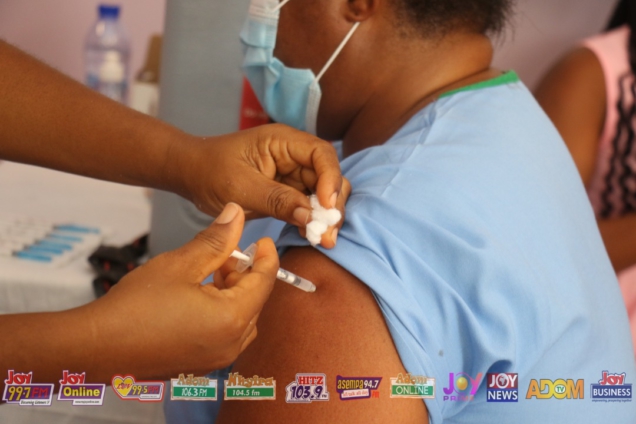
Programmes Manager of the Expanded Program on Immunisation of the Ghana Health Service (GHS), has debunked the assertion that recipients of Covid-19 first jab are at risk of reinfection if the second dose is not administered within the scheduled time frame.
According to Dr Kwame Amponsa-Achiano in an interview with JoyNews’ Emefa Apawu, the second dose which was supposed to be administered within 8 weeks will not tone down the efficacy of the vaccine despite the delays.
“8 weeks was the earliest time we choose to administer the second jab and it is not as if you miss the eight weeks it means your protection is gone. No that is not it at all, your protection is still there.”
He further added that the guidelines from the manufactures of the vaccination, also states that the suitable time frame to administer a second jab should be between four to 12 weeks after the first dose.
“If you look at the guidance from the manufacture, you see that the second dose can be given any moment from 4 weeks to 12 weeks.”
His comment comes after a virologist at the Kumasi Centre for Collaborative Research (KCCR), Dr Michael Owusu stated that those who have taken the first jab may lose the protection if the second doses do not arrive before the 12 weeks span.
“Assuming that we have to extend this to 12 weeks, the first thing is that, we cannot be sure of the efficacy and that has been indicated in the AstraZeneca drug. Because the efficacy indicated between 70 up to 90 percent is based on the data available which is 8-12 weeks.
"So beyond the 12 weeks, you can’t be sure. What it could also mean is that because you are not sure of the efficacy beyond 12 weeks, those who were vaccinated may like be susceptible to reinfection.”
In reaction to this, Dr Amponsa-Achiano indicated that postponement of the second face of the jab thus from April to May will be a four-week extension that falls within the guidelines.
“If there were a delay of about 4 weeks, there will be no problem the current data even suggest that if you give the second dose around 12 weeks or soon after it is even better. “
According to him, government and other stakeholders are exploring ways to bring in more doses within the shortest possible time.
This, he says, will ensure that recipients of the first jab will receive their second doses within the said time frame.
“You will remember we went fully electronic and we have taken everybody's data, we have that in the database and that in the appropriate time we will send reminders to those who are due to receive the vaccines when we have the vaccines available in the country," he told Emefa Apawu.
Latest Stories
-
Savio scores on debut as Spurs bounce back to beat Charlton
2 hours -
Uefa to push to remove Infantino after dropping boycott
3 hours -
GH¢1.7bn GoldBod loss misconstrued – IEA
3 hours -
Mahama unveils Bawku Revitalisation Fund Committee
3 hours -
Christians urged not to hide their gifts for church development
3 hours -
Deputy AG punches holes in Hannan’s counsels’ letters, medical reports
3 hours -
Field cashier of Cooperative Credit Union remanded for stealing
3 hours -
Ghana Armwrestling Federation engages Egyptian Ambassador over sports collaboration
4 hours -
NSMQ 2026: Augusco declared winners, book quarter-final spot after Anlo, Kumasi High walk off
4 hours -
Mourinho says hat-trick hero Mbappe hungry for Real Madrid history
4 hours -
Democracy Cup 2026: Winner to play in the United States in May 2027
4 hours -
NSMQ 2026: St. John’s Grammar knocks Mpraeso SHS off seeded spot, advances to quarter-finals
4 hours -
Rashid Pelpuo welcomes new role, thanks Mahama for keeping him in government
4 hours -
Mahama inaugurates committee to oversee GH¢1bn Bawku Revitalisation Fund
5 hours -
Berko’s US conviction does not automatically establish Ghana bribery claims – OSP
5 hours