

Audio By Carbonatix
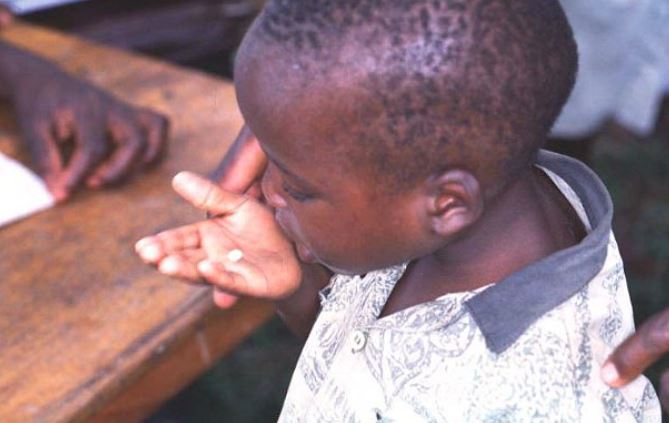
The Neglected Tropical Diseases (NTDs) Programme of the Ghana Health Service (GHS) will from August 23 to September 6, 2021, begin a Mass Drug Administration (MDA) for onchocerciasis in endemic regions in the country.
The exercise will be carried out in 66 districts across 13 regions as part of efforts to eliminate onchocerciasis from Ghana.
Children less than five years old, pregnant mothers, and seriously ill inhabitants in some endemic districts will be exempted from the exercise.
In Ghana, MDA is done twice in a year to ensure that every eligible person living in a defined geographical area, regardless of whether or not they are infected receives a single dose of the ivermectin drug.
The ivermectin medication have been used to control onchocerciasis and currently, it is being used to ensure the elimination of the disease from those infected and uninfected.
The GHS has indicated that the MDA, which has been implemented over several years, can significantly control and eliminate the burden of onchocerciasis.
Currently, 137 districts remain endemic for onchocerciasis in Ghana and the Ashanti region has the highest number of endemic districts.
Onchocerciasis is an infection caused by a parasitic worm called Onchocerca volvulus. It spreads by the bite of an infected blackfly known scientifically as Simulium.
It is also called river blindness because the blackfly that transmits the infection breeds in rapidly flowing rivers and streams and bites people living in settlements nearby and causes them to go blind.
Persons with heavy infections as a result of repeated bites by infected blackflies usually develop conditions such as unrelenting itching, unsightly skin disease, nodules under the skin, or eye disease which results in severe visual impairment and blindness.
The control of onchocerciasis in Ghana has been very successful, with an average high infection level of 69.13 percent in 1975, decreasing significantly to a very low level of 0.72 percent in 2015.
The most at risk of onchocerciasis are people who live or work near rapidly flowing streams or rivers where there are Simulium blackfly breeding sites.
Latest Stories
-
YEA records GH¢110.4m surplus after turning around 2024 deficit – SIGA report
1 minute -
Madina MP Francis-Xavier Sosu prioritises road rehabilitation, education and healthcare
6 minutes -
Valco-Kpone road turns nightmare as motorists fume, tanker drivers threaten fresh strike
7 minutes -
STC cuts net loss by 93% to GH¢5.18m despite 12% revenue decline
14 minutes -
Tanker drivers threaten strike over deplorable VALCO-TOR-Kpone road
19 minutes -
NPA surplus jumps 76% to GH¢447m in 2025 – SIGA
23 minutes -
Railway workers push for completion of Takoradi-Nsuta line by 2027
27 minutes -
Police arrest 6 suspected notorious armed robbers in Kumasi
30 minutes -
Opinion: GHS1m is welcome, but Ghana Premier League’s biggest problem remains unsolved
31 minutes -
Stylen Boy’s ‘Adole’ featuring Kurl Songx hits No. 1 on Ghana iTunes
34 minutes -
CBG’s assets rise to GH¢17.86bn as deposits, revenue and equity grow in 2025 – SIGA Report
37 minutes -
KNUST SHS considers slashing admissions over infrastructure deficit
42 minutes -
GEXIM Bank’s capital adequacy ratio rises to 75.3% in 2025 – SIGA Report
45 minutes -
CPC’s revenue plunges 47% as net loss widens to GH¢144m — SIGA
45 minutes -
Ghana Water turns GH¢3.06bn loss into GH¢635.23m profit in 2025 – SIGA Report
47 minutes