

Audio By Carbonatix
Italy is to make it compulsory for all workers to have a Covid "green pass" - proof of vaccination, a negative test or recovery from the virus.
The measures are a first for Europe and some of the strictest in the world.
Anyone without a pass will reportedly face suspension from work and may have their pay stopped after five days.
The measure, due to come into force on 15 October, aims to boost vaccinations in a country that has been badly hit by the virus.
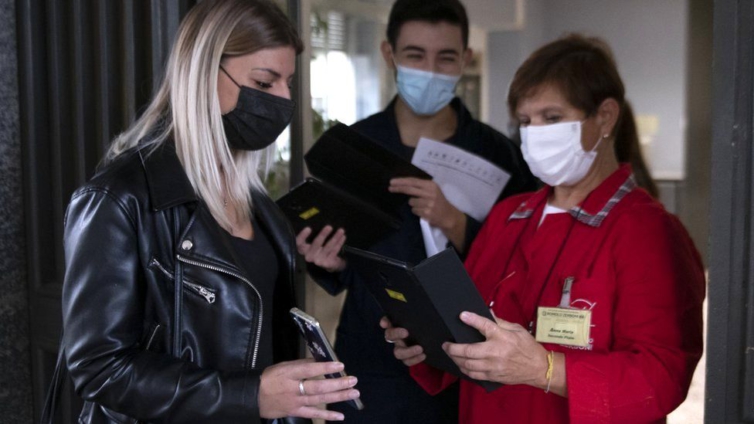
Green pass certificates for Covid-19, provided both digitally and on paper, are already required to access Italian train stations, cinemas, restaurants, gyms and swimming pools.
School staff are also required to show a pass and some teachers have reportedly been turned away from work.
On Thursday, the Italian government approved a new law to extend the requirements to all workplaces and employees across all sectors, including the self-employed.
Businesses and staff could face fines of up to €1,500 (£1,280) if people are found to be working without a valid green pass.
Announcing the decision, Health Minister Roberto Speranza said the new measures would improve safety and "make our vaccination campaign even stronger".
"The implementation of a pass such as the one we are bringing into force with this decree will, we are certain, help us push forward this vaccination campaign," he said.
Despite a vocal anti-vaccination minority, Italians have broadly backed the government's vaccination campaign.
Nearly 65% of Italians have now been fully vaccinated, but infections have been rising, driven by the Delta variant.
Italy has recorded more than 4.6 million cases of Covid-19 and over 130,000 coronavirus-related deaths since the start of the pandemic, according to Johns Hopkins University data.
The green pass was initially introduced to make travel within the EU more efficient, and several countries have since introduced requirements for people to show the certificate for different reasons.
France requires a health pass for access to restaurants, bars, planes and trains, while Austria and Cyprus are among other EU countries to have used similar schemes.
Latest Stories
-
Sentuo offers fuel supply reassurance as NPA sees steady output through December
44 minutes -
Ghanaian smock showcased at Lesotho Tourism Summit
1 hour -
Four pupils to one desk: The painful plight of schools in New Juaben North
2 hours -
Ipswich launch investigation into racist abuse of Abdul Fatawu
2 hours -
Arrest of Techiman nurse is purely political persecution – ‘Ghana Jollof’
2 hours -
Isak nets winner as Liverpool edge Bournemouth
3 hours -
I dare gov’t of Ghana to extradite me; they can never do it – ‘Ghana Jollof’ speaks
3 hours -
Semenyo scores twice as Manchester City beat Sunderland 5-3 in eight-goal thriller
3 hours -
Parliament calls for government-private sector collaboration to improve waste management
3 hours -
Volta Region described as cleanest so far in Parliament’s nationwide sanitation monitoring
3 hours -
Parliament urges MMDAs to enforce sanitation bylaws to curb indiscriminate waste disposal
3 hours -
Mohammed Kudus drops out of Ghana squad for AFCON 2027 qualifiers against Côte d’Ivoire and Gambia
4 hours -
Africa World Airlines unveils first Embraer E190 as part of 10-aircraft fleet expansion
5 hours -
Civilian hospitalised after alleged machete attack by prison officers, inmates
5 hours -
Toobu rejects calls to recall Parliament over 3.9-tonne cocaine shipment
6 hours