

Audio By Carbonatix
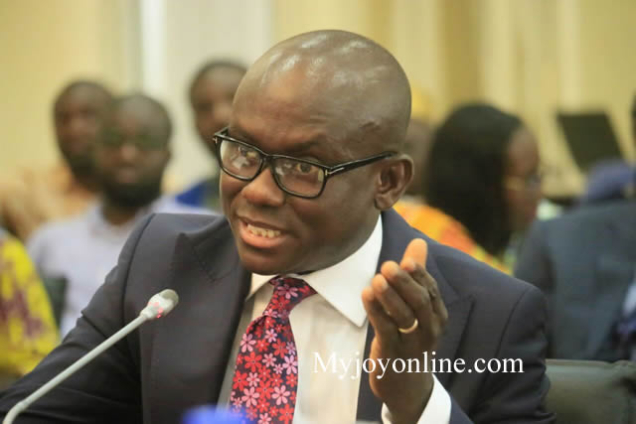
The Attorney-General, Godfred Yeboah Dame, has applauded the decision of the Supreme Court to allow Deputy Speakers to vote and be part of quorum while presiding over proceedings in Parliament.
In an interaction with the press after the ruling by the apex court, he stated that the Supreme Court decision is in order.
According to him, the right of representation is an essential principle, which the Court has upheld in its ruling on Wednesday.
“I think the reasoning by the Supreme Court is clearly sound and is in accord with the practice in other jurisdictions around the world. Nowhere in the constitution has any statement been made that he loses his right to vote whenever a deputy speaker presides. On the contrary, all the circumstances under which a member of Parliament loses his right to vote have actually been spelt in Article 104," he stated.
Meanwhile, Builsa North MP James Agalga is dismayed by the ruling of the Supreme Court on whether a Deputy Speaker of Parliament can vote and form part of the quorum while presiding.
In an interview with JoyNews’ Parliamentary Correspondent, Kwesi Parker-Wilson, on Wednesday, the NDC lawmaker said that based on his understanding of the relevant provisions, he disagreed with the apex court verdict.
“I am indeed shocked and surprised because I thought that for purposes of fairness, persons who assume the chair under normal circumstances should not be part of the decision-making process because you sit there as an umpire. And if you assume the role of an umpire, why should you be allowed to vote?" he stated.
Background
On Wednesday, March 9, the Supreme Court ruled that a Deputy Speaker of Parliament can be counted during the formation of a quorum for parliamentary decision-making and participation in voting while presiding.
The Court presided over by Justice Jones Dotse, therefore, affirmed the approval of the 2022 budget without NDC MPs’ participation.
Private Legal Practitioner Justice Abdulai filed the case against the Attorney General.
He had asked the Supreme Court to interpret Articles 102 and 104 of the 1992 Constitution and declare the action of Mr Osei Owusu as unconstitutional.
He also wanted the Supreme Court to declare the whole proceedings in Parliament on November 30, 2021, which led to the passage of the 2022 budget as unconstitutional insisting the Deputy Speaker should not have counted himself as an MP when he presided over proceedings.
However, in defence on behalf of the state, the Attorney-General (A-G), Godfred Yeboah Dame, argued that no express provision in the 1992 Constitution stops a Deputy Speaker presiding over proceedings from voting or counting himself as part of MPs present to form the right quorum.
He argued that the quorum in PParliamentformed under Article 102 is different from the quorum formed under Article 104 of the 1992 Constitution.
He stated that the quorum under Article 102 is for the conduct of business in Parliament, and that is why Article 102 provides that it should be one-third of members.
“Given that Parliament presently is made up of 275 members, the quorum under Article 102 for the conduct of its business is 92 MPs,” the A-G submitted.
According to the A-G, based on the clear provision of Article 102, any person presiding, either the Speaker or Deputy Speakers, is precluded from being part of that quorum.
On the other hand, the A-G believed that the quorum under Article 104 (1), which deals with the determination of matters through voting in Parliament, requires at least half of all MPs, and such a quorum is not the same as the one in Article 102.
Mr Dame contended that unlike Article 102, which precludes a “person presiding” from being part of the quorum, Article 104 (2) precludes explicitly “The Speaker”.
The A-G, therefore, held the position that only the person elected as “The Speaker” of Parliament is barred from forming part of the quorum under Article 104 when presiding, and not the Deputy Speakers who preside over proceedings.
The Apex Court comprising Justices Jones Dotse, Nene Amegatcher, Prof Ashie Kotey, Mariama Owusu, Lovelace Johnson, Clemence Honyenuga, and Emmanuel Kulendi affirmed the arguments of the Attorney General.
The Court also struck out portions of the standing orders of Parliament, which read: “A Deputy Speaker or any other member presiding shall not retain his original vote while presiding”.
Latest Stories
-
Cabinet approves facility manager for Borteyman Sports Complex – Kofi Adams
4 minutes -
Sanitation is improving; critics may be ‘living in another world’ – Salaga South MP replies Bekwai MP
10 minutes -
Government must do more to tackle sanitation crisis – Bekwai MP
11 minutes -
World Cleanup Day: GFF begins sanitation education in local communities
29 minutes -
EU Ambassador, IGP discuss stronger cooperation on policing and security
39 minutes -
Africa Nations Volleyball Championship: Ghana set up quarterfinal clash with Cameroon after beating Chad
55 minutes -
Meet Dr Benjamin Appiah Osei — Ghana’s three-time tourism awards winner
1 hour -
UEFA & CONCACAF demand Fifa pays $10m to all 211 members
1 hour -
Inter fight back again to snatch draw at leaders Roma
1 hour -
Suzuki proves worthy replacement for Martinez at Villa
2 hours -
Brighton humbling ‘a big lesson’ for Arsenal – Arteta
2 hours -
Arsenal handed first loss by brilliant Brighton
2 hours -
VIDEO: Akwatia MP ‘clashes’ with Kofi Bentil over 3.9-tonne cocaine seizure
2 hours -
Ratcliffe ‘must go’ says Man Utd Muslim fan group
2 hours -
Ignite Social Enterprise targets global market for locally manufactured Ghanaian products
2 hours