

Audio By Carbonatix
In the darkest corner of a grand museum that looks like a neo-classical palace lies a not-so-secret room.
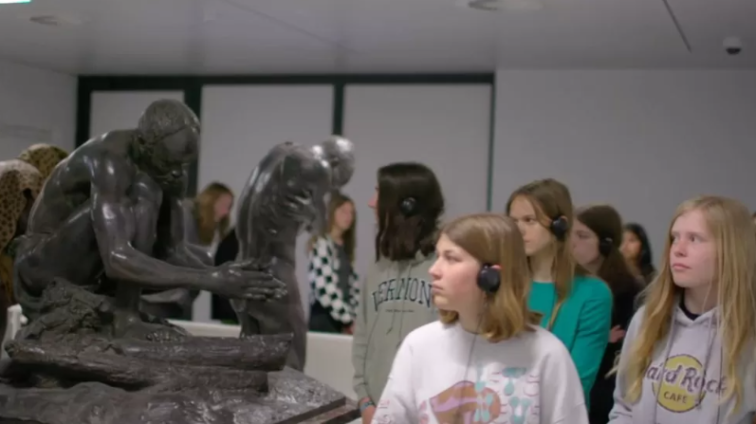
It is filled with statues of Congolese people, which have been regarded as racist, that were once part of the permanent exhibition.
Schoolchildren on educational tours file past the Leopard Man, men with spears and women almost naked.
This is the Africa Museum in Tervuren, just outside Brussels, and until recently those sculptures were part of the permanent exhibition.
After facing years of heavy criticism nationally and internationally, the museum worked with a group of experts from the African diaspora in Belgium to rethink the controversial statues on display.
Colonial history
The museum traces its origins back to when King Leopold II set up the International Exposition of 1897. As part of that, 267 Congolese men, women and children were taken by force to Belgium and exhibited to the public in fenced fake villages on the site where the museum now stands.
When Belgium gained independence from the Netherlands in the 19th Century, the Western nations' "scramble for Africa" was in full throttle. King Leopold II wanted his own slice of the continent, but without government backing he had to win over investors and the public.
The "human zoo" was a tool to convince visitors that Belgium had a duty to bring civilization and Christianity to the African country. The exposition was a huge success and so began Belgium's long and violent history in the Congo.
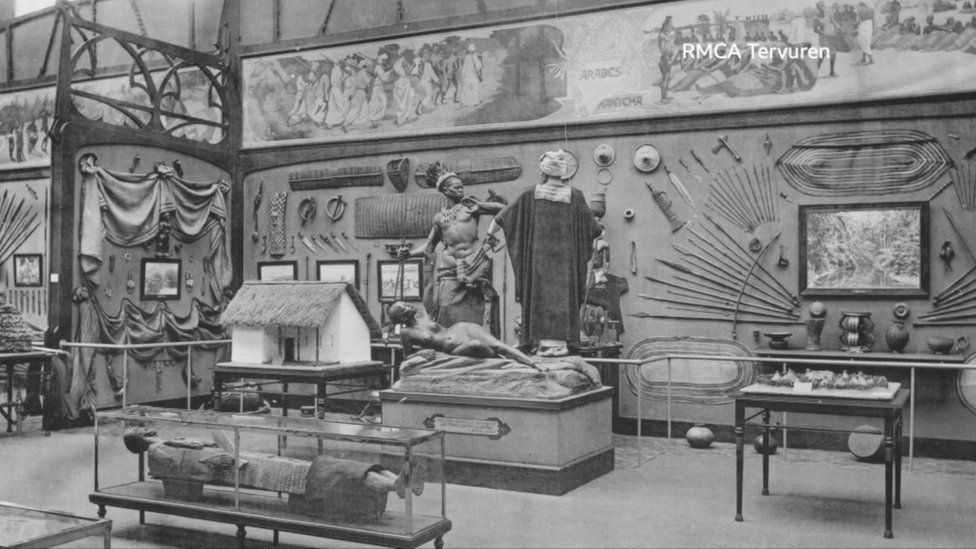
Fast forward to the present and the museum is now marking its 125th year. It is also five years since it underwent a massive renovation, where it removed problematic statues and changed the labelling around objects that created a negative stereotype about Africa.
Guido Gryseels was the director of the museum until he retired earlier this year, aged 70, and is largely responsible for ushering in change.
Visitor numbers have improved since the revamp, but some of the African diaspora believe more can be done and that the statues should be removed completely. Others say the museum just should not exist any more given its historical displays representing African people as primitive.
The museum says it cannot change the past but is committed in doing its part towards building a better future.
"We realised that most children had their first encounter with Africa through a visit to this museum, either when they came with the school or with their parent," Mr Gryseels told the BBC.
"For 100 years that impression was basically one of stereotypes, that Africa was good for providing nature and we were good for providing culture. From stereotypes you get pre-judgements and from pre-judgements you get a certain amount of racism."
When Mr Gryseels joined the museum in 2001, a survey showed 95% of Belgians thought colonisation was a good thing. In 2022 the survey was done again and the number dropped to 35%.
Work in progress
Despite the museum's best efforts, some of its history remains thinly veiled. In a beautiful round atrium called the Rotunda, colourful drapes hang around the walls.
Behind them you can see larger-than-life statues with matching French inscriptions such as "La Belgique apportant la civilisation au Congo", which translated means "Belgium brings civilisation to Congo".
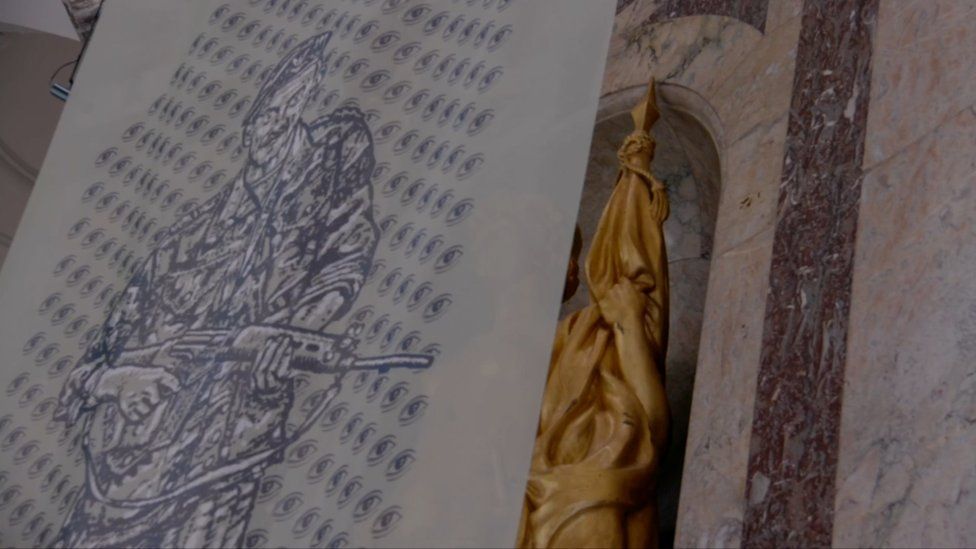
"Belgium brings security to Congo" is on a plaque under a golden goddess-like statue with a Congolese child at her feet. The counter-narrative image depicts an armed Belgium soldier holding a machine gun. Another statue shows a Congolese man wrestling a snake.
"Here you will notice the statue is black and the others are gold, because gold is seen as superior, as godly, but this is for someone who is inferior," Africa Museum collaborator Marie-Reine Iyumva explains.
She is part of a new generation of staff with African heritage especially brought in to help bring about change and provide context.
Ms Iyumva said their work is not as a simple as removing or changing items considered problematic.
"The building is protected, it's part of the Flanders Cultural Heritage, so we cannot touch anything from the walls of the building. So what we did is we commissioned contemporary artists to present their alternative interpretation."
The answer, it seems, lies in education. Visiting the Africa Museum is not part of the national curriculum and tours are up to a teacher's discretion.
But weekdays are busy with visiting school groups taking tours in French, Dutch, English and German. A big emphasis is on the workshops and open discussions addressing Belgium's colonial past and the role the museum has played throughout the past century.
One young female student admitted the experience was eye-opening.
"I think it's the first time we really learned about it. I wouldn't do it if I was queen of Belgium," she said.
Latest Stories
-
NPP’s new executives will not alter our 2028 preparations – Tanko-Computer
27 minutes -
Tema East MP urges men to take active role in breast cancer awareness
32 minutes -
Hawa Koomson vows to bring experience and maturity to NPP women’s wing
36 minutes -
Opare Addo cautions NDC against adopting NPP’s aggressive politics
38 minutes -
NPP has 35 months to prepare for 2028 after early reorganisation – Political strategist
43 minutes -
All six passengers presumed dead after plane went missing off US coast
54 minutes -
Teachers’ promotion arrears to be paid by Oct. 30 – Education Minister
1 hour -
Stop talking too much on stage – Kafui Dey warns MCs
1 hour -
Government has Ho, Volta Region at Heart — Warlord of Asogli
1 hour -
Mahama reaffirms commitment to Volta development at Asogli Te Za
1 hour -
REGSEC orders immediate demolition of fire-ravaged building at Koforidua Jackson Park
1 hour -
Ambassador Boateng congratulates new NPP leadership, urges reconciliation, rebuilding
2 hours -
50 vetted to contest Effutu NDC executive positions
2 hours -
GACL enhances security screening at Accra International Airport
2 hours -
COCOBOD raises GH¢3.39bn at 11% in first Commercial Paper tranche
2 hours