

Audio By Carbonatix
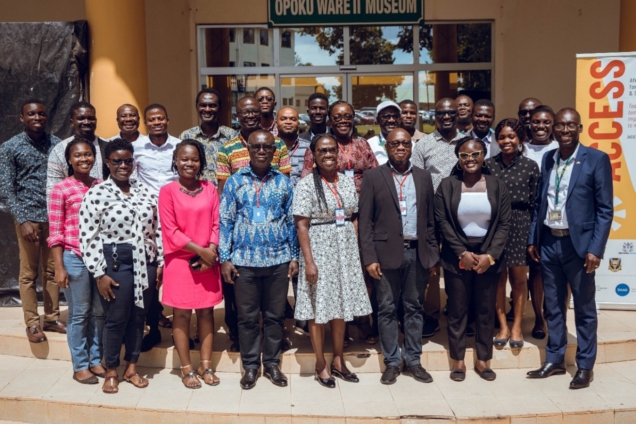
Fifty persons from eight universities across the country have been schooled on modern ways to equip students with industry-requisite employable skills.
The African Centre for Career Enhancement and Skills Support (ACCESS) workshop was hinged on three pillars - Employability Research, University-Business Linkage (UBL), and Capacity Building.
The sessions provided participants with practical insights and tools to enhance their understanding and application of strategies for developing employment skills among graduate students.
Held at KNUST, it was under the theme, “Effective Strategies for Developing Employability Skills in Graduates”. The three-day trainer-of-trainers workshop drew participants from the ACCESS Ghana partner universities.
Participants came from Accra Technical University (ATU), Koforidua Technical University (KTU), Takoradi Technical University (TTU), Akenten Appiah-Menka University of Skills Training and Entrepreneurial Development (AAMUSTED), Garden City University College (GCUC), University of Mines and Technology (UMAT), Ghana Communication Technology University (GCTU) and the host university, Kwame Nkrumah University of Science and Technology (KNUST).

Prof Ahmed Agyapong who led the first workshop session on employability research explained that collaboration is essential in research because it enhances the quality and impact of the work.
He continued that digital tools can be used to enhance teaching and learning, and collaboration between industry and academics in curriculum development is valuable.
“…the research should focus on addressing societal needs and making a positive impact. There is a need to recommend wealth-creation books alongside academic resources to students.
Digitalization and entrepreneurship integration across disciplines can contribute very well to requisite research innovations. That the building of relationships among stakeholders – government, industry, academia, utilizing e-tools for learning, and improving research knowledge are key outcomes.”
Prof Agyapong added that critical thinking and problem-solving skills are highly valued by the industry and should be prioritized in classroom activities. He also provided insights into the process, of publishing in reputable journals and addressed the challenges that researchers may face along the way
The workshop also exposed the participants to the fact that the industry expects students to have skills including good ethics, digital inclination, and innovativeness.
The first session concluded with a valuable discussion on navigating the landscape of journal publishing.
ACCESS Coordinator, Dr Nyadu-Addo prompted a discussion on how participants’ respective universities prepared students for the industry. He reiterated the need for universities to encourage follow-ups on industrial attachments and visits.
A highlight of the session was the discussion on teaching entrepreneurship versus teaching students to be entrepreneurs.

Business and Chairman of the Ghana Chamber of Commerce and Industry, Stephen Acheampong, who spoke on bridging the gap between academia and industry, stressed the importance of holistic education, defining it as a sustainable, just, and peaceful society in harmony with the earth and its life.
He highlighted the need for academia to produce well-rounded and versatile graduates.
Mr. Acheampong emphasized that a holistic curriculum should be interdisciplinary, integrating community and global perspectives.
“…that the industry seeks individuals with strong work ethics — people who consistently do the right thing, even when unsupervised. They are interested in graduates who work diligently and passionately, leaving a noticeable void when absent. These graduates should possess approachability, innovation, problem-solving skills, and the ability to work in teams. The industry values data-driven, research-oriented students, and is willing to learn on the job.”

Digital Tools
The first part of the final session of the three-day workshop led by Prof. Henry K. Mensah and Mr. Christopher Addo, focused on capacity building using digital tools to support online learning.
It was meant to equip participants with a diverse range of tools to enhance their teaching methodologies.
Participants were therefore introduced to the ACCESS wiki which served as the foundation for the subsequent discussions on leveraging digital resources for teaching.
Digital presentation tools like Mentimeter, Prezi, and Word Cloud were also introduced and demonstrated, empowering participants to utilize these tools effectively.
The session also held an interactive debate on the ethical use of resources like ChatGPT, highlighting its potential as a valuable resource for participants. The facilitators encouraged participants to explore other digital tools such as educational apps, learning management systems (LMSs), simulations, e-books, and online assessment platforms.
The session provided a comprehensive overview of digital tools and resources available for capacity building in online learning. The facilitators ensured that participants gained practical knowledge and hands-on experience with various tools, enabling them to integrate these resources effectively into their teaching methodologies.

University-Business Linkage (UBL)
Dr. Samuel Y. Akomea facilitated the second session on the final day of the workshop, focusing on University-Business Linkage (UBL).
Dr. Akomea emphasized that," the purpose of university education is to prepare students for life's challenges. It is important to establish relationships and connections with catalyst institutions and development partners like DANIDA, DAAD, and GIZ."
He discussed the triple helix of stakeholder contribution, highlighting the role of government, industry, and academia in achieving this objective.
Dr Akomea suggested that universities should implement a policy where UBL activities receive significant consideration for individual promotions. For him, the creation of a dedicated UBL office, like the Alumni Relations Office, with its own budget is relevant.
“…the UBL should not be limited to internships and entrepreneurial skills, but rather industry should actively participate in academia. This involvement could include industry-sponsored scholarships, industry engagement in curriculum development and review, industry experts as guest lecturers, and career fairs with industry representation. The universities should engage in service-learning programs, going beyond traditional internships.”
He also suggested that industries partner with academia to co-create and sponsor tailor-made programs with integrated service-learning components.
Additionally, industry professionals should be invited to university panels for project and thesis defense, as well as case study presentations, with the aim of exploring investment opportunities.
Latest Stories
-
NPP struggled even in traditional strongholds in 2024 – Annoh-Dompreh
1 minute -
NPP must elect strong parliamentary candidates to reclaim Greater Accra seats – Patrick Boamah
10 minutes -
Abdul-Aziz Abdu-Rahaman elected NPP Upper West Regional Chairman
13 minutes -
Iddrisu Sulemana edges Clifford Braimah to become NPP Savannah Regional Chairman
16 minutes -
‘Arrogance of power’ is driving voters back to NPP in Ashanti Region – Paul Adom-Otchere
26 minutes -
They demolish buildings and tell us they’re building 24-hour markets – Paul Adom-Otchere
39 minutes -
NPP’s 2024 Bolgatanga Central Parliamentary Candidate elected Upper East Regional Chairman
52 minutes -
Incumbent Northern NPP Chair wins as new faces break through in party executive elections
55 minutes -
Former Health Minister Okoe Boye elected NPP Greater Accra Regional Chair
1 hour -
Joseph Kobinah Esibu elected NPP Central Regional Chairman
1 hour -
Fernandez booed by Chelsea fans as Alonso offers glimpse of blueprint
1 hour -
PSG sign World Cup winner Torres from Barcelona
2 hours -
Odeneho Kwaku Appiah beats former EPA boss Kokofu, to emerge NPP Ashanti chair
2 hours -
TDC defends statutory mandate, says its authority to develop Tema predates TMA
2 hours -
Ignatius Kwesi Afrifa elected NPP Western Regional Chairman
2 hours