

Audio By Carbonatix
Hawaii's governor says he expects to see "significantly higher numbers" of fatalities in the coming days, as the death toll rises to 89.
Additional expert support has been deployed to the island of Maui, where forensic work is continuing to find victims of the devastating wildfires.
Hundreds of people are still unaccounted for days after the fires first broke out.
Many more remain in emergency shelters after fleeing from the flames.
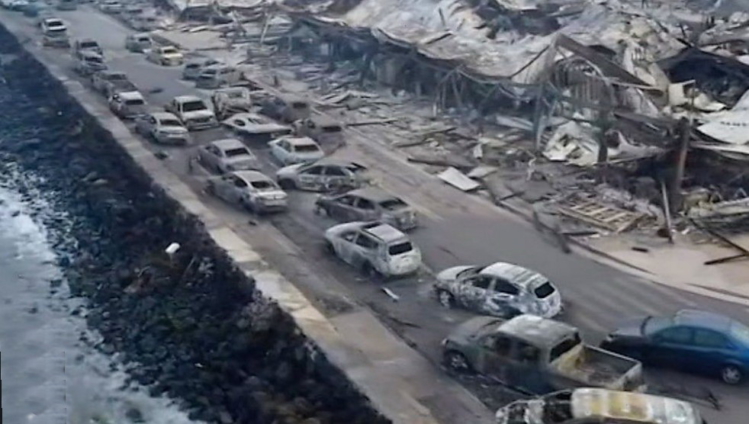
While the wildfires are now largely under control, efforts to fully extinguish them are continuing in parts of the island, including around the historic town of Lahaina, which has been devastated.
Jeremy Greenberg, a senior official at the Federal Emergency Management Agency (FEMA), has told the BBC that extra support being sent included urban search and rescue, and fire suppression teams.
"The absolute number one priority is survivor safety," he said.
Mr Greenberg added that while close to 1,000 people are still yet to be contacted, some of these may be safe but out of reach for a number of reasons.
Hawaii Governor Josh Green visited Maui on Saturday and told reporters the tragedy "will certainly be the worst natural disaster Hawaii ever faced".
"It may be the worst fire that America ever faced."
Sniffer dogs trained to detect bodies have been looking for signs of corpses under the rubble in Lahaina. So far, they have covered only 3% of the search area but more dogs will be joining the recovery operation.
Maui County's police chief, John Pelletier, said it is too early to appreciate the scale of the mission to recover and identify bodies, some of which have been incinerated.
There have also been reports of bodies being found around the local harbour, where people have been pulled out alive.
It is thought that more than 2,000 buildings have been damaged or destroyed since the fires broke out. The majority of these were homes in the Lahaina area.
The main road to Lahaina was briefly re-opened to residents on Saturday, before quickly being closed again.
The Kahakuloa road is open, but locals say it's far too dangerous to attempt to drive that way. The road - known simply here as "the backroad" to Lahaina - is barely wide enough for one car, has many hair-pin turns, and a steep drop-off.
"We can't drive this truck there. It's a cliff," said resident Ruth Lee who was stuck in traffic trying to bring supplies to her family that stayed behind.
Residents are furious about the decision to keep the main road closed to the potentially homeless survivors.
Hundreds who fled with proof of their residency are waiting in traffic, hopeful that they will be allowed through. But with the queue of cars stretching for about a mile, and news that the road has shut once again, they don't know whether they'll be forced to turn around.
Liz Germansky, who lost her home in the fire, is angry about the response. "The government's getting in the way of people helping," she says, while sat in the same traffic queue.
The cost of rebuilding Maui has been estimated at $5.5bn (£4.3bn), according to the Pacific Disaster Center (PDC) and FEMA, which is coordinating the relief effort to Hawaii from Washington.
"We're strong people, we're going to be okay," one local resident, Lars Johnson, told CBS News.
"We're going to do what we can to rebuild. And it'll be back and it'll be bigger and it'll be stronger than ever before."
Helicopter pilot Richard Olsten has flown over Maui and told the BBC that even most of the boats in the harbour were burnt and had sunk.
"The historic buildings, the church, the missionary building and so forth - all gone," he said.
"The main tourist area where all the shops and restaurants are, the historic front street - everything burnt to the ground."
Local groups have been trying to organise food, water and shelter for those who have been made homeless with the help of organisations such as the American Red Cross.
Their national spokesperson, Todd James, said that while the focus on now is providing support to survivors, they will eventually help with damage assessment and distributing emergency supplies to help with the clean-up.
As well as receiving aid, people who end up at emergency shelters that have been set up are also able to scan QR codes on their phones to report that they are safe and to alert the authorities that someone they know is missing.
Credit: The BBC
Latest Stories
-
Air India pilot’s reported cannabis test: What it can and can’t tell investigators
2 hours -
France’s top court blocks social media ban for under-15s
2 hours -
Fery wins on return as Djokovic reveals health condition after loss
2 hours -
‘Probably my last year’ – Ronaldo hints at retirement
2 hours -
Arsenal cruise to Community Shield win against disappearing Man City
2 hours -
Barcelona agree £65m deal to sign Rodri from Man City
3 hours -
UHAS halts semester exams over administrative, logistical issues
3 hours -
ECG announces planned maintenance outages in parts of Ashanti Region
3 hours -
Sexual harassment has no place in educational institutions – Education Ministry
4 hours -
The growing culture of vacation classes in Ghana: Should students rest or continue schoolwork?
4 hours -
E.P. Church secures radio frequency, prepares to launch Bremen Radio
5 hours -
Two dead and hundreds evacuated as twin fires break out on Greek island
5 hours -
EPCG clears over GH¢11.7m in debt as outgoing moderator calls for tighter controls on borrowing
5 hours -
Mövenpick Ambassador Hotel Accra marks 15 years of premium hospitality
5 hours -
T-bills auction: Government exceeds target by 88%, interest rates tumble
6 hours