

Audio By Carbonatix
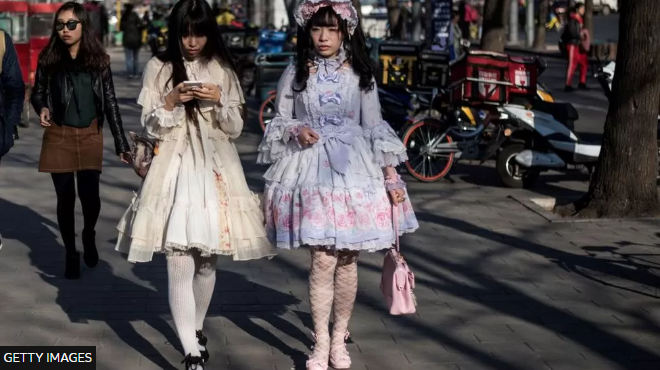
A draft law banning speech and dressing "detrimental to the spirit of Chinese people" has sparked debate in China.
If the law comes into force, people found guilty could be fined or jailed but the proposal does not yet spell out what constitutes a violation.
Social media users and legal experts have called for more clarity to avoid excessive enforcement.
China recently released a swathe of proposed changes to its public security laws - the first reforms in decades.
The clothing law has drawn immediate reaction from the public - with many online criticising it as excessive and absurd.
The contentious clauses suggest that people who wear or force others to wear clothing and symbols that "undermine the spirit or hurt the feelings of the Chinese nation" could be detained for up to 15 days and fined up to 5,000 yuan ($680; £550).
Those who create or disseminate articles or speech that do so could also face the same punishment.
The proposed legal changes also forbid "insulting, slandering or otherwise infringing upon the names of local heroes and martyrs" as well as vandalism of their memorial statues.
Online, people questioned how law enforcers could unilaterally determine when the nation's "feelings" are "hurt".
"Will wearing a suit and tie count? Marxism originated in the West. Would its presence in China also count as hurting national feelings," one user posted on Chinese Twitter-like platform Weibo.
Legal experts in the country have also criticised the law's vague phrasing, saying it could be open to abuse.
Zhao Hong, a law professor at the Chinese University of Political Science and Law said the lack of clarity could lead to an infringement of personal rights.
"What if the law enforcer, usually a police officer, has a personal interpretation of the hurt and initiates moral judgment of others beyond the scope of law," she wrote in an article published on Wednesday.
She cited one case that drew headlines in China last year where a kimono-clad woman was detained in the city of Suzhou and accused of "picking quarrels and provoking trouble" because she had worn the Japanese garment. The incident sparked outrage across Chinese social media.
There have been other examples of a crackdown.
In March this year, police detained a woman donning a replica of a Japanese military uniform at a night market.
And earlier last month, people who wore rainbow print clothing were denied entry to a concert by Taiwanese singer Chang Hui-mei in Beijing.
"To wear a kimono is to hurt the feelings of the Chinese nation, to eat Japanese food is to jeopardise its spirit? When did the feelings and spirit of the time-tested Chinese nation become so fragile?" wrote one popular social commentator online, who writes under the pen name Wang Wusi.
The draft law is but one example of how Chinese President Xi Jinping has sought to redefine what makes a model Chinese citizen since he rose to leadership in 2012.
In 2019, his Chinese Communist Party issued "morality guidelines" which include directives like being polite, traveling with a lower carbon footprint, and having "faith" in Mr Xi and the party.
Latest Stories
-
Video: Immunity should be exercised without creating classism – Inusah Fuseini on cocaine bust
3 minutes -
Ghana Air Force passes out 293 recruits after six months of intensive training
11 minutes -
EOCO vrs Baffour Awuah: EOCO should have secured warrant before arrest attempt at court – Inusah Fuseini
15 minutes -
Triple fibre cuts disrupt telecom services across Northern, Oti regions – Sam George
18 minutes -
Politicisation could undermine parliamentary probe into cocaine seizures – Dr Osae-Kwapong
25 minutes -
EOCO chases MP: Can Section 41 cure lacuna in EOCO Act? – Inusah Fuseini asks
28 minutes -
GNFS, GWL inspect fire hydrants in Ministries enclave; 23 found faulty
33 minutes -
Gov’t directs release of 50,000 bags of grain to ECOWAS
35 minutes -
Ghana, Germany deepen cooperation on railways, labour mobility
40 minutes -
Huge crowds greet Pope in Paris for open-air Mass
51 minutes -
‘I never said I’ll declare a state of emergency’ – President Mahama on galamsey
2 hours -
Bobby Banson condemns EOCO’s attempted arrest of Nana Agyei Baffour Awuah
2 hours -
When Kumasi begins to look like somebody is in charge
2 hours -
Parliamentary probe into cocaine seizure would be a waste of time – Inusah Fuseini
2 hours -
Cocaine seizure: Focus on Ghana’s reputation, not partisan blame – Osae-Kwapong
2 hours