

Audio By Carbonatix
The International Monetary Fund (IMF) has made it clear to the Government of Ghana that it cannot impose or intensify import restrictions for balance of payments purposes.
This is an agreement contained in the IMF bailout package which has pledged to support Ghana’s balance of payment with some $3 billion between 2023 and 2026.
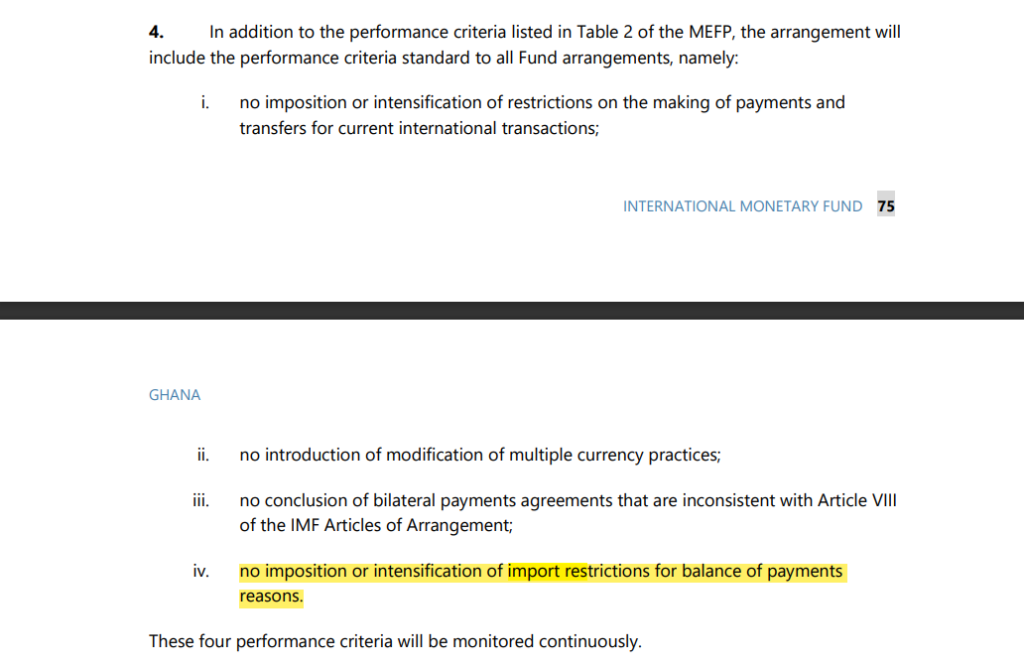
“No imposition or intensification of import restrictions for balance of payments reasons”, the Fund stressed on page 76 of the programme document. Amongst other things, there are four decisions the Government of Ghana cannot take while it is still under the IMF programme. These decisions align with performance criteria common to all Fund arrangements, which include:
- No imposition or intensification of restrictions on making payments and transfers for current international transactions.
- No introduction or modification of multiple currency practices.
- No conclusion of bilateral payments agreements inconsistent with Article VIII of the IMF Articles of Arrangement.
- No imposition or intensification of import restrictions for balance of payments reasons.
The Fund emphasised that these four performance criteria will be monitored continuously.
The Government of Ghana on Thursday made a surprising suspension of the decision to put the L.I. before parliament, which sought to place the importation of 22-listed products under restrictions. It had tried on three occasions, without success, to lay the bill before the house.
The Minority in Parliament urged President Akufo-Addo to immediately withdraw the regulation seeking to restrict the importation of rice, cement, fish, sugar, guts, bladders, and animal stomachs, known as 'yemuadie'.
The Trade Minister, K.T Hammond, who was pushing this regulation hoped it will help the cedi appreciate as well as help grow local industries.
Per the proposed regulation, any person seeking to import the selected products would have been required to obtain permission from the Trade Minister.
Ghana’s import bill according to Finance Minister Ken Ofori-Atta, exceeds $10 billion annually and is accounted for by a diverse range of items including palm oil, toilet roll, and even toothpick. While Ghana needs over $500 million to import rice, the trade minister says the importation of ‘yemuadie’ cost the state some $164 million in imports.
Latest Stories
-
UHAS halts semester exams over administrative, logistical issues
2 hours -
ECG announces planned maintenance outages in parts of Ashanti Region
2 hours -
Sexual harassment has no place in educational institutions – Education Ministry
3 hours -
The growing culture of vacation classes in Ghana: Should students rest or continue schoolwork?
3 hours -
E.P. Church secures radio frequency, prepares to launch Bremen Radio
4 hours -
Two dead and hundreds evacuated as twin fires break out on Greek island
4 hours -
EPCG clears over GH¢11.7m in debt as outgoing moderator calls for tighter controls on borrowing
4 hours -
Mövenpick Ambassador Hotel Accra marks 15 years of premium hospitality
4 hours -
T-bills auction: Government exceeds target by 88%, interest rates tumble
5 hours -
Western North: Confusion erupts over NPP chairmanship election results
5 hours -
Bawumia congratulates newly elected NPP regional executives
5 hours -
Bawumia urges unity after NPP regional elections ahead of 2028
6 hours -
Russia says at least seven killed in largest Ukrainian attack of 2026
6 hours -
Ghana and Netherlands sign pact to combat illicit drugs and drug markets
6 hours -
Akandoh warns Boards against interfering in day-to-day management of health institutions
6 hours