

Audio By Carbonatix
Ghana continues to grapple with price hikes as the year-on-year inflation rate for January 2024 sees a marginal rise.
It hits 23.5%, making it one of the Sub-Saharan African countries experiencing the highest inflation with its current rate being almost 3 times the combined rates of neighbouring Ivory Coast, Burkina and Togo.
Within the ECOWAS bloc, both Ghana and its economic counterpart, Nigeria, share inflation rates above 20%, with Nigeria’s nearing 30%.
In contrast, neighbouring countries like Ivory Coast, Togo and Burkina Faso boast of single-digit inflation rates. In fact, Burkina Faso which is currently under military leadership has its current inflation rate pegged at 4.3% with Togo recording as low as 2%. The 2023 AFCON winners, Ivory Coast also boast of a single-digit inflation with its most recent rate positioned at 3.1%.
It is noteworthy that Ghana’s inflation has not touched single digits for almost four years, with the last instance occurring in March during a lockdown. Despite receiving close to $2 billion from the IMF, World Bank and the African Development Bank within the past year and a half under the Extended Credit Facility Programme, Ghana is struggling to maintain healthy international reserves.
The country’s Gross International Reserves have plummeted from a historical peak of $11 billion, providing almost six months of import cover, to $5.9 billion as of January 2024, affording less than three months of import cover. This decline has intensified pressure on the local currency, the cedi, leading to its depreciation against major trading currencies such as the US dollar.
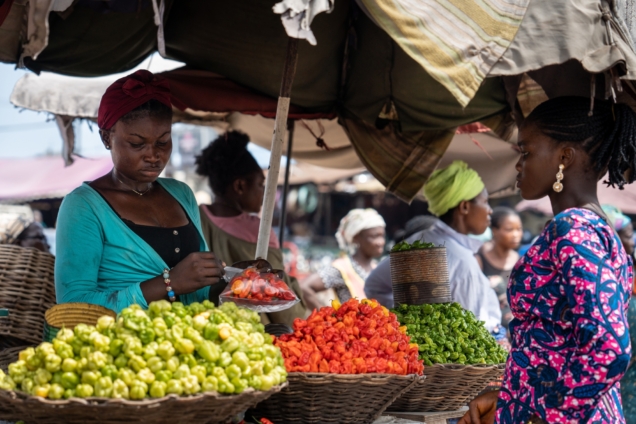
The exchange rate fluctuations impact import duties and other costs, contributing to the rising domestic prices of imported goods. Food inflation stands at 27.1%, persistently rising for four consecutive months and surpassing the overall inflation rate of 23.5%. Ongoing border restrictions in Niger, Mali, and Burkina Faso continue to impact the prices of essential farm produce like onions and tomatoes imported into Ghana.
Notably, key ingredients for common household meals, including jollof, banku and fufu, have recorded inflation rates above 40% in January. With a substantial weight of 1.2 in determining national inflation, fresh tomatoes have surged by 52.3%. Other crucial ingredients like cassava, fish, carrots, and garden eggs have inflation rates twice the national average.
With the December 2024 general election approaching, Ghanaian voters prioritise key issues such as price stability, a resilient currency, and tackling unemployment. Addressing these concerns as the country faces economic headwinds has become paramount for the electorate.
About the writer:
Isaac Kofi Agyei is a Data & Research Analyst/Journalist at JoyNews based in Accra, where he covers mostly finance, economics, banking, and politics across Ghana and West Africa, from detailed analytical reports on all key issues to debt crises to IMF programmes. He also serves as the data and research correspondent for SBM Intelligence, an Africa-focused market/security leader in strategic research, providing actionable analyses of West Africa’s socio-political and economic landscape. With his solid academic background in economics and statistics and additional training from credible institutions such as the UNDP, Afrobarometr, Ghana Statistical Service, and a host of others, Isaac has honed his skills in effective data storytelling, reporting, and analysis.

Isaac Kofi Agyei
Latest Stories
-
Ghana’s economy grows by 7.4% in July 2026
8 minutes -
NDC member challenges Dennis Yeboah Twumasi’s eligibility for Bono Regional Secretary elections
18 minutes -
Popular Nigerian gospel singer Toluwanisings dies
28 minutes -
Spio-Garbrah proposes debt swaps to fund reparative justice in Africa and Caribbean
36 minutes -
Alban Bagbin calls for governance reforms and coordinated action to address Africa’s debt crisis
38 minutes -
AAK Academy Ghana trains 22 chocolate and confectionery companies in production techniques
40 minutes -
Adwumawura Programme trains second cohort of young entrepreneurs in Bono East
41 minutes -
Destroying Jimi River for gold could cost us our lives – Asantehene
48 minutes -
Sammy Gyamfi didn’t say BoG has ceded its forex role to us – GoldBod
2 hours -
High Court sets November 4 for ruling on Wontumi’s bail application
2 hours -
Tetteh Kwetey files nomination for NDC Greater Accra Regional Chairmanship
2 hours -
Korle Bu appeals for more doctors, nurses as A&E Centre struggles under pressure
2 hours -
AFCON 2027Q: ‘I’m optimistic Black Stars can turn things around’ – Agyemang-Badu
2 hours -
Digital innovation could widen Africa’s inequalities if people are left out – Sam Jonah
2 hours -
Galamsey is an economic, health and moral problem – Sam Jonah
2 hours