

Audio By Carbonatix
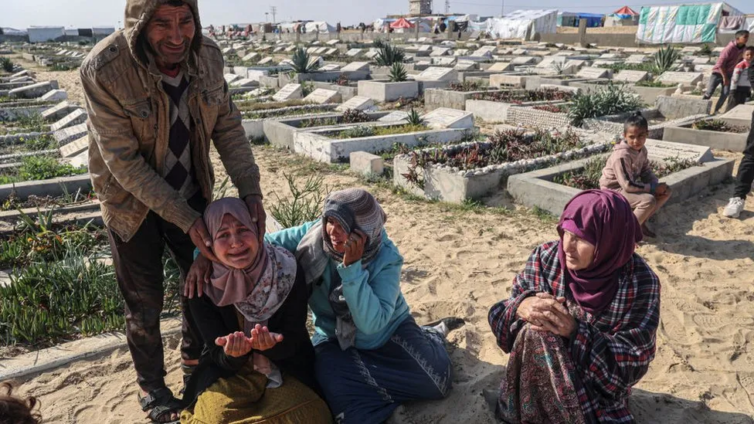
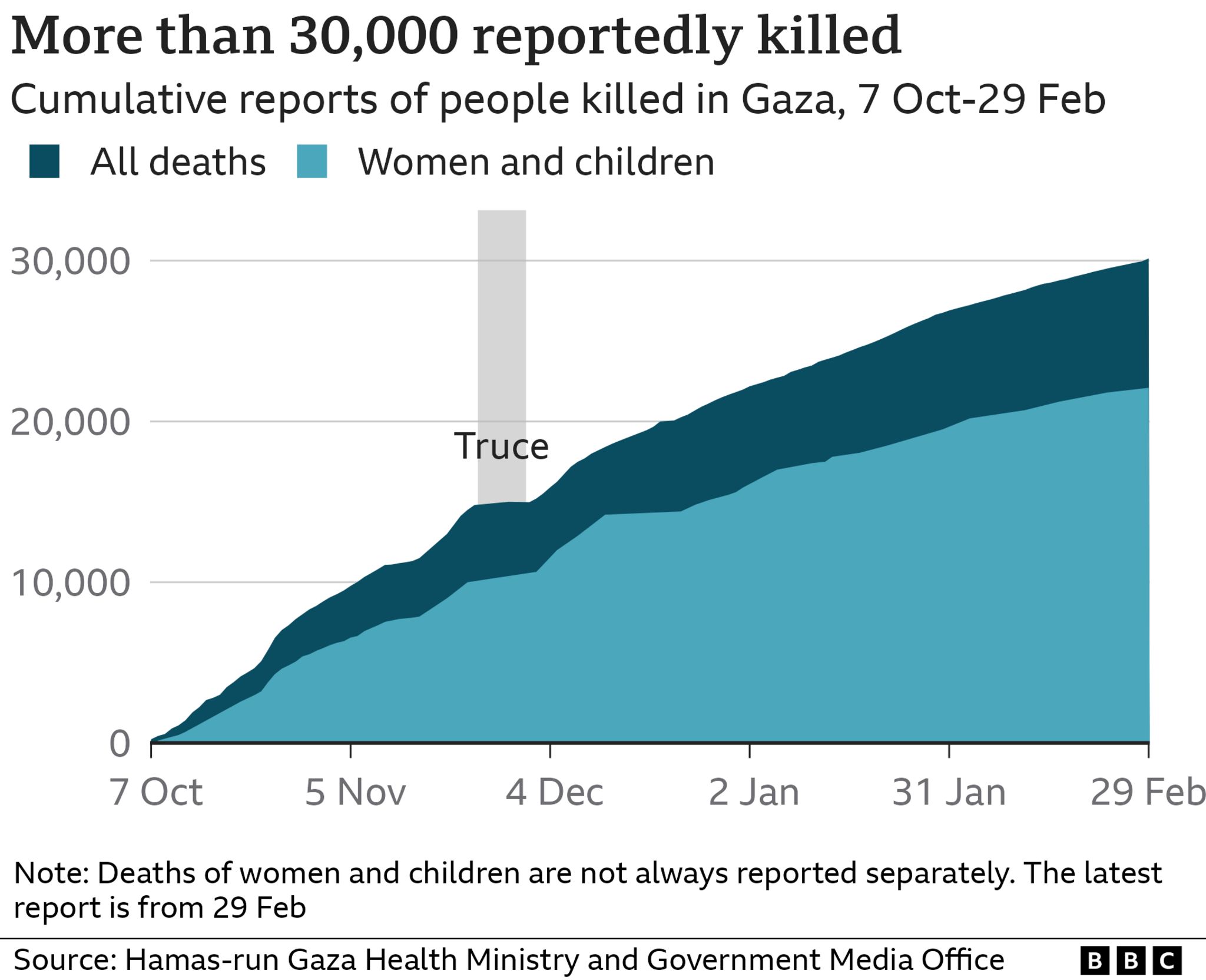
More than 30,000 Palestinians have now been killed in Gaza since 7 October, the Hamas-run health ministry says.
That number equates to about 1.3% of the 2.3 million population of the territory - the latest grim marker of the awful toll of this war.
The ministry says that the majority of those killed were women and children.
Its figures do not differentiate between civilians and fighters when identifying those killed.
In its daily update on Thursday, the ministry said 81 people had been killed in the last 24 hours, bringing the total to 30,035.
The actual number of dead is likely to be far higher as the count does not include those who have not reached hospitals, among them thousands of people still lost under the rubble of buildings hit by Israeli air strikes.
More than 70,000 injured people have been registered by the Gaza ministry of health (MoH), which is the only official source for casualties. Its data is quoted by UN agencies and other international institutions.
The World Health Organization (WHO) says it has a "long-standing co-operation" with the Gaza body and that it has "good capacity in data collection/analysis". Its previous reporting has been considered credible and "well developed" by the UN agency.
The WHO notes that when the current breakdown of deaths is compared with previous data recorded by the UN from past conflicts in Gaza, "it clearly shows an increasing number of civilians being killed, with a higher proportion of children and women fatalities".
Asked about its assessment on the number of fatalities and the breakdown of civilians and fighters, Israel's military told the BBC only that "the number of terrorists killed stands at approximately 10,000".
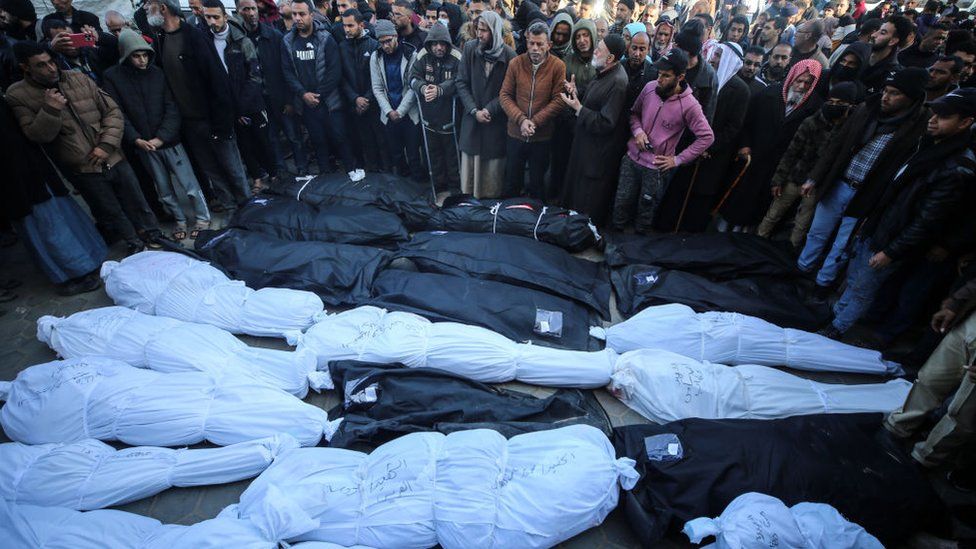
For a Palestinian death to be registered in Gaza, a corpse or remains must be seen by hospital staff or medical workers. At the end of each day, hospitals send lists of all casualties including - where known - names, identity numbers, dates of injury or death, and details of injuries and condition to a centralised MoH system. Its operators are now based in Rafah.
The Palestinian Red Crescent also contributes data.
During this war it has been more difficult than ever to report figures because of overflowing mortuaries, fighting in and around hospitals and clinics, and poor internet and phone connectivity.
However, if and when a longer-term truce is agreed or the war ends, efforts to recover bodies and trace the missing should allow a clearer picture to emerge of numbers killed, including numbers of combatants. The UN and rights groups, as well as the Israeli military, can be expected to carry out their own investigations.
Getty Images
An ongoing criticism of the existing figures is that they do not give a sense of how Palestinians were killed - whether this was as a result of Israeli air strikes, artillery shelling or other means such as misfired Palestinian rockets. All casualties are currently counted as victims of "Israeli aggression".
In recent days, the Gaza MoH has highlighted more cases of what the WHO calls "indirect mortality" - that is people dying as a result of the war but not directly because of the fighting.
On Wednesday, it said six children had died from dehydration and malnutrition at hospitals in northern Gaza. Two were at al-Shifa Hospital in Gaza City and four at the Kamal Adwan Hospital in the town of Beit Lahia.
The UN is warning that a quarter of Gaza's population is now at risk of famine and that there has been a dramatic increase in infectious diseases compounded by a general shortage of medicines and lack of medical care.
The war began when thousands of Hamas fighters stormed into southern Israel on 7 October, killing about 1,200 people and seizing 253 hostages, according to Israeli tallies.
Latest Stories
-
Mahama’s proposed airline looks to South America, Caribbean as Ghana confronts mounting drug trafficking cases
5 minutes -
5% progress on Suame Interchange Phase One inadequate – Roads Minister tasks contractor to speed up work
8 minutes -
Photos: Vice President joins GAAS Awards to celebrate outstanding women leaders
9 minutes -
OSP vs Ken Ofori-Atta, SML and others: Court gives OSP four more weeks to serve Ofori-Atta with summons
11 minutes -
High Commission sends caution to Ghanaians in South Africa ahead of planned protests
13 minutes -
Okai Mintah outlines vision for NDC Youth Wing as he engages MMDCEs
19 minutes -
Mahama Ayariga leads renewed push for stronger local governance through partnerships
23 minutes -
NDC youth organiser aspirant Okai Mintah consults MMDCEs ahead of elections
24 minutes -
PHOTOS: Ayikuma Methodist Basic School wins National Juniors Challenge
26 minutes -
Silence has entered our homes : Salomey Awiti Bafoh and the chilling effect of free expression in Ghana
27 minutes -
UG Pro-VC calls for stronger research funding to curb brain drain
29 minutes -
Woman in critical condition after shooting at funeral grounds in Yeji
31 minutes -
Breast Cancer awareness must lead to action – Deputy Health Minister
33 minutes -
UK identified as leading destination for Ghana’s illicit cannabis exports – Report
35 minutes -
Drug money allegedly finances Ghana’s political parties and real estate – Global Organised Crime Index
40 minutes