

Audio By Carbonatix
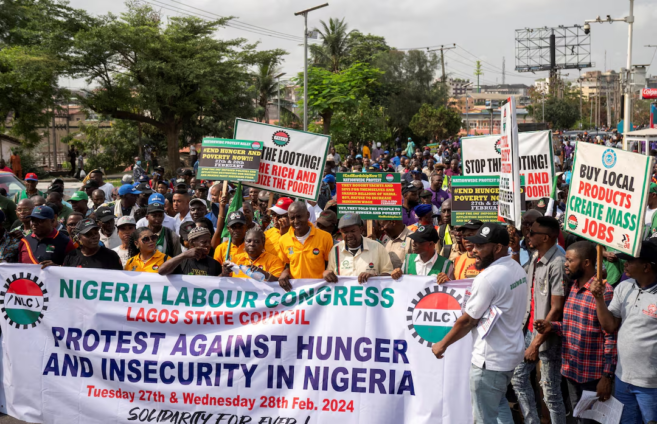
Nigerian security forces deployed in major cities and the government said it was open to dialogue ahead of planned protests on Thursday against a cost of living crisis and poor governance that authorities fear could turn violent.
After taking office more than a year ago, President Bola Tinubu swiftly removed some fuel subsidies, devalued the naira currency and later hiked electricity tariffs, moves that have sent inflation soaring past 34%, eroding incomes.
Nigerians are also grappling with widespread insecurity, which has damaged the farming sector, while armed gangs kidnap residents and school children for ransom in the north.
Inspired by Kenyan protests, Nigerians are mobilising online to demand the reinstatement of petrol and electricity subsidies, free primary and secondary education and an end to insecurity, among other demands.
A senior government official, George Akume, said the protests could be infiltrated and become violent, without elaborating.
"We prefer dialogue, we are ready for dialogue," he told reporters, without saying whether the government had been in contact with the protest organisers.
"Nigeria is a work in progress and things will soon improve."
Tinubu's government has so far used a mix of threats and cajoling to discourage the protests.
In the capital Abuja, the commercial hub Lagos and the northern city of Kano, armed police deployed on major roads, set up security check points and searched cars.
Police occupied the main square in Abuja that protesters planned to use, while military vehicles parked nearby.
A court order confined Lagos protesters to two venues on the outskirts of the city.
Some Lagos residents said they were worried that protests could turn violent as happened during anti-police demonstrations, known as EndSars, in October 2020, when lives were lost and properties destroyed.
At one of Kano's largest malls, Sufi Mart, workers were busy reinforcing windows with shutters.
"I don't want it (the protest) to extend into the night so that it doesn't turn out to be another thing like EndSars," said Nneka Ochiachebe, who sells second-hand clothes at a Lagos market.
Latest Stories
-
55-year-old woman gives birth to triplets after 25 years of marriage at Brofoyedru
1 minute -
UniMAC students take ‘Project Dignity’ to Weija Leprosarium
10 minutes -
Ghana’s gaming industry emerges as $121m digital economy opportunity
17 minutes -
Why Ghana needs Regional Tribunals and why history shouldn’t prevent their establishment
27 minutes -
DVLA to print driver’s licenses at offices across the country
31 minutes -
ASEC calls on GRIDCo to publish full report on recent power outages
34 minutes -
CAGD orders covered entities to seek approval before opening bank accounts
34 minutes -
AFREIKH Summer School opens with focus on managing Africa’s extractive future in energy transition
40 minutes -
UPSA challenges students to turn classroom knowledge into real-world solutions
58 minutes -
Ghana urged to build capacity to maximise China’s zero-tariff policy
1 hour -
NSMQ 2026: TEMASCO returns to one-eighth stage after last year’s heartbreaking loss
1 hour -
Photos: Republic Bank JoyNews Habitat Fair Day 1 draws visitors as they engage exhibitors
1 hour -
NSMQ 2026: AHEMAA silence AHENEMMA – Kumasi Girls storm into one-eighth stage as OKESS stumble
1 hour -
Profs4Agyarko hail newly elected NPP regional executives
1 hour -
Bono Police arrest suspect over alleged GH¢1.1m fake gold deal in Berekum
1 hour