

Audio By Carbonatix
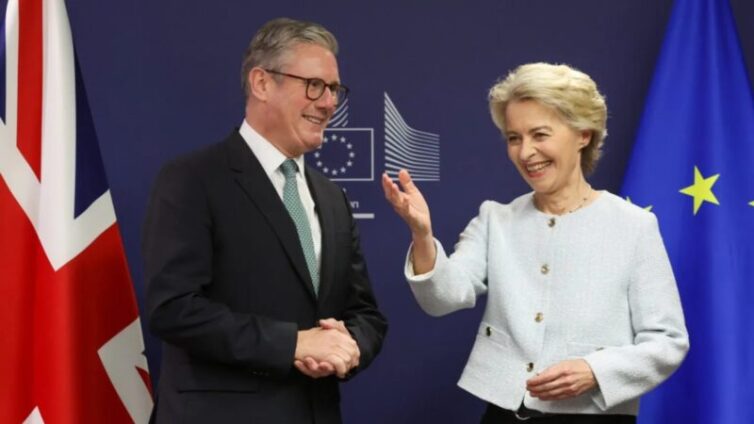
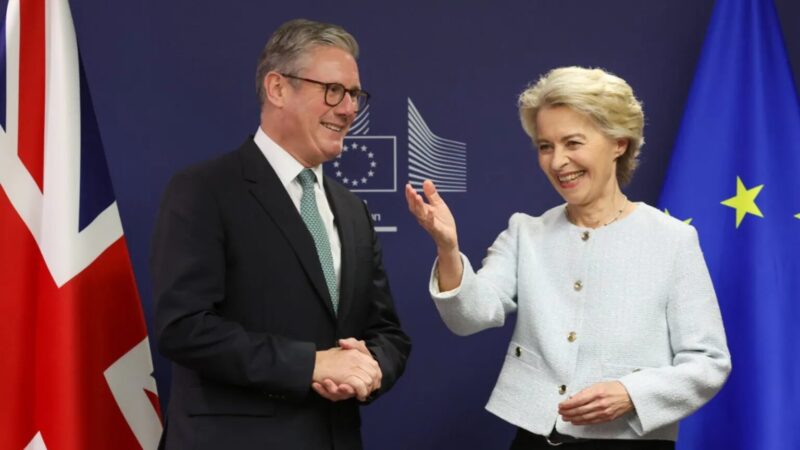
Sir Keir Starmer has made his first visit to Brussels since becoming prime minister.
His main message: to rebuild ties and trust with the EU after the bitter bickering of Brexit negotiations.
The moment was predictably rain-soaked but not insignificant.
Union flags were placed next to EU ones on press podiums. The red carpet at the European Parliament was washed down and hoovered ahead of Sir Keir’s arrival.
Ursula von der Leyen, the powerful president of the European Commission, gushed that his welcome was a warm one.
And the prime minister did not come empty-handed.
The wish list he brought here was long.
He called for closer cooperation on defence and security, including energy security, as well as on climate change, irregular migration, labelled 'illegal migration' under the previous Conservative government and on delivering economic growth - to help make Brexit work in the UK’s interest, he said.
He insisted the British public wanted a return to what he called sensible leadership when it came to the EU.
His European interlocutors nodded but without much evident enthusiasm.
The bloc still regrets losing the UK as a member. It bemoans the huge amount of time and political capital Brussels spent on Brexit negotiations.
It has little appetite for more protracted talks – and that was what was announced today - if the risk is high of going around in circles.
Working together better on security and defence is the most straightforward and uncontentious path of rapprochement.
Relations have steadily improved since Russia’s full-scale invasion of Ukraine. The two sides worked rapidly and closely to impose sanctions on Moscow and boost Kiev’s defences. The UK leading the way on the latter.
One point of division amongst EU member states, though, is whether British businesses could or should be involved in the bloc’s rearmament drive.
On migration, there’s clear cross-Channel agreement that people-smuggling gangs must be stopped and irregular migration, tackled.
The 'How?' could get thorny though. The French and German interior ministers recently asked the European Commission to reach a formal agreement with the UK, urging it to open more legal avenues to allow asylum seekers and others to enter the country.
The ministers said up to a third of irregular migrants coming their way, actually wanted to go to the UK.
Meanwhile, Sir Keir has been in Rome, taking notes from Italy on how to stem migration at source in Africa and the Middle East with economic agreements.
Human rights groups have been highly critical of Italy’s and similar EU deals, saying they often result in the abuse of migrants.
But of all the points on the prime minister’s wish list, the EU is most wary of Labour’s zeal to strip away what it calls ‘unnecessary trade barriers’.
Brussels says those barriers are a result of the UK’s own choices: leaving the single market and customs union. Something the prime minister insisted again today was not up for renegotiation.
In which case, says the EU, our hands are tied.
The reality is: trade add-ons will require trade-offs. On both sides.
The government wants to ease the movement of food and drinks exports. It wants easier access for UK artists, including musicians to the EU.
Some EU member states want enhanced fishing rights in UK waters.
The bloc as a whole has asked for a youth mobility scheme where young Europeans study and work in the UK for a visa-limited time period. British youngsters would be offered the same deal in the EU.
But Sir Keir – who has pledged to reduce immigration levels – said again today that ‘free movement is a red line’.
He tried to avoid directly addressing prickly issues when pushed by the press.
He insisted that the focus of Wednesday’s meetings was the bigger picture, with an emphasis on “what we can do, not what we can’t do, and on deliverables rather than a running commentary.”
But the European Commission has emphasised it wants the already-negotiated post-Brexit deals with the UK - the Withdrawal Agreement, the Windsor Framework on Northern Ireland and the Trade and Cooperation agreement – to be fully respected before it embarks on brand new chapters.
This summer it alleged non-compliance in a number of areas.
Behind-closed-door talks start imminently, we’re told, with the first of now-to-be regular EU-UK summits planned for the new year.
The joke once shared amongst us Brussels-based journalists during the Brexit process, that negotiations would go on forever, might be coming to pass.
Latest Stories
-
Public money belongs to the people, not government officials – Ato Forson
3 minutes -
Power, politics and the battle for electoral credibility: Is Ghana’s electoral commission truly independent?
6 minutes -
Sports Fund Administrator urges boxing fraternity to pursue partnerships beyond government funding
8 minutes -
Total number of jobs advertised increased 32% year-on-year to 3,578 in 7 months of 2026
31 minutes -
KNUST to receive 2,000 additional laptops for One Million Coders Programme
34 minutes -
President Mahama urges churches to provide safe spaces for children and vulnerable people
39 minutes -
George Dadzie Junior highly tipped in NDC regional secretary race due to grassroots experience
48 minutes -
Passenger arrivals at airport improved by 23% in first 7 months of 2026
50 minutes -
Aklerh returns to reggae roots with new single ‘Wo Dor’
51 minutes -
Stacy Mense’s ‘W’ahyira Me’ gains airplay on radio, digital platforms
60 minutes -
Economic activities mixed in 7 months of 2026; Cement sales decline by 10%
1 hour -
GFA and Sports Ministry must not rush Black Stars head coach appointment – Nana Fitz
1 hour -
Nkrumah Showboy: Chief Moomen’s play to explore Ghana’s first President’s early years
1 hour -
SEC to develop Social Bond Guidelines; over half of listed firms report on ESG indicators
2 hours -
Insurance firms have up till January 2027 to incorporate ESG in financial reporting
2 hours