

Audio By Carbonatix
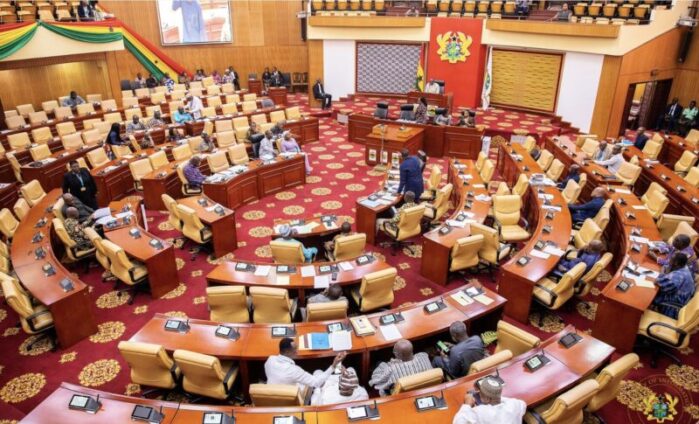
Parliament has gone into a closed-door session to deliberate on emoluments for Article 71 officeholders, specifically the executive and the judiciary.
The decision is part of a long-standing constitutional arrangement governing salaries, allowances, and benefits for specific public office holders under Ghana’s 1992 Constitution.
Under Article 71, public officers in these categories are paid their salaries in arrears, based on prior approvals from a similar committee. For the four years they serve in office, their salaries are pegged at the previously approved rates and finalized at the end of their tenure, with any balance paid accordingly.
Additionally, these officeholders receive ex gratia payments at the conclusion of their service, determined by a specific formula. The responsibility for approving these benefits is shared between Parliament and the executive.
Parliament approves the emoluments for members of the executive and the judiciary. The executive, in turn, approves the benefits for Members of Parliament (MPs), the Speaker, and Deputy Speakers.
This reciprocal arrangement has often been criticized as a “scratch my back, I scratch your back” system, with both arms of government favouring each other.
Article 71 outlines the framework for determining salaries, allowances, and benefits for key officeholders, including the President, the Vice President, the Speaker of Parliament, Deputy Speakers, and MPs.
Others are the Chief Justice and Justices of the Superior Courts, the Auditor-General and other independent constitutional officers as well as Ministers, Deputy Ministers, and members of the Council of State.
Determination of these emoluments is based on recommendations from a committee appointed by the President in consultation with the Council of State.
The Constitution also provides for retirement benefits for Article 71 officeholders.
Article 98 provides that MPs shall receive salaries and allowances as determined under Article 71.
Article 114 also provides that MPs who have served for at least four years are entitled to gratuity payments upon leaving office or upon their death.
The arrangement has sparked debates over the years over its fairness and transparency.
Critics argue that the mutually beneficial approvals lack accountability, especially when contrasted with the limited benefits provided to ordinary public sector workers and the nation’s economic challenges.
Calls for constitutional reforms to review the emolument system and align it with the country’s fiscal realities have grown louder in recent years. However, the political will to amend this entrenched provision remains uncertain.
Incoming President John Mahama has promised to scrap the Article 71 ex gratia arrangement.
Read Also: NDC will scrap payment of ex gratia – Mahama
Latest Stories
-
Ghana explores centre of excellence for hearing, communication and cochlear implant care
1 hour -
Schizophrenia-related disorders lead mental health cases recorded in Ghana
1 hour -
Dutch authorities enlist Ghana in hunt for fugitive drug lord Bolle Jos
2 hours -
Ghana housing finance conference adopts communiqué to improve affordable housing access
6 hours -
Special Initiatives Minister urges Wa Technical Institute to enrol more girls as EU-backed solar training lab opens
7 hours -
In the matter of my first year at the Bar
7 hours -
ActionAid Ghana calls for an end to child marriage, greater investment in girls’ rights
7 hours -
Newsfile to tackle World Cup visa scandal, beach demolitions, education strikes, BRICS bid
7 hours -
UK-Ghana Trade & Investment Summit: Trade Resource Centre to help businesses maximise UK-Ghana trade opportunities
8 hours -
Embassy of Denmark celebrates World Maritime Day
8 hours -
Linking LEAP to productive inclusion could cut extreme poverty by 2030 – UNICEF
9 hours -
Trade Ministry backs use of creative arts to rehabilitate prison inmates
9 hours -
Negotiations with government to continue despite strike suspension – GNAT
9 hours -
‘Ghana cannot afford to waste public resources; every cedi has a job’ – Ato Forson
9 hours -
Ghana expects economic boost as World Assemblies of God Congress brings 10,000 delegates to Accra
9 hours