

Audio By Carbonatix
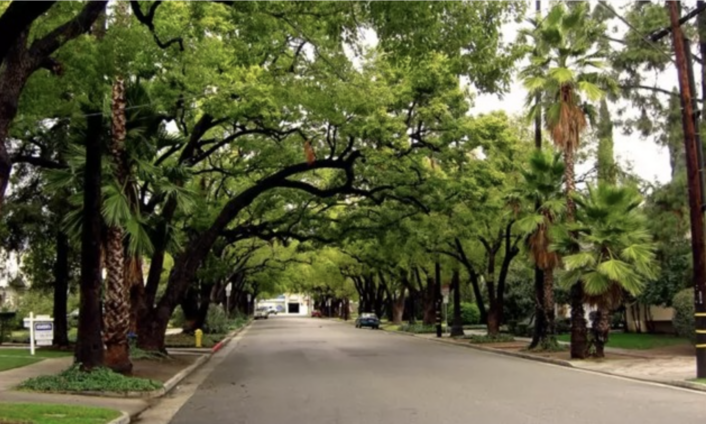
Dr. Prosper Mensah, an engineer with the Wood Industry and Utilisation Division, has made a case with empirical evidence that planting the right trees at the right place in cities and urban areas has an enormous economic benefit.
He said it also had social, environmental, and aesthetic benefits directly linked to sustainable development.
He said the haphazard management of urban forestry, especially lack of maintenance of trees and other forest resources in urban areas poses serious risks to humans?
Planting the wrong trees species at the wrong side of the road, according to a Research Scientist at the Forestry Research Institute of the Council for Scientific and Industrial Research (CSIR-FORIG), exposes humans to the dangers of vehicular interactions he said.
A presentation he has put together dubbed “Engineering Urban Forestry: Right Tree at the Right Place,” Dr Mensah highlighted the urgent need to plant the right trees at the right places with acceptable standards complemented by monitoring, evaluation, and stewardship.
The environmental benefits, according to the presentation, include storm water management, beautification, and provision of shade and wildlife habitat and refuge for urban courses and carbon storage.
He noted that urban green spaces also contributed to the local economy by enhancing real estate prices, attracting economic activities, improving local tax base as people tend to shop in cities with more trees.
Properly engineered urban forestry reduces attention deficit hyperactivity disorder symptoms, eliminates nature deficit disorder, build stronger communities, according to the presentation.
Touching on the properties of suitable tree for urban forestry, Engr. Dr. Mensah mentioned drought tolerance, aesthetic qualities, low maintenance requirements, pest and disease resistance, resistance to girdling, and compact growth habit as some of the characteristics to look out for.
Among some of the tree species he recommends are West Africa Cedar, West African Mahogany, African Mahogany, Neem Tree, Silk Cotton Tree, West African Ebony, and Golden Shower Tree.
He also identified biotic and abiotic conditions, anthropogenic pressures, and social developments such as changing politics, economics, conflicts, wars, and other crises as some of the challenging environment inimical to a thriving urban forestry.
According to him, Ghana has demonstrated great ambition to plant trees over the years but what is lacking is adequate planning, consultation, assessment, stewardship and monitoring and evaluation after planting.
He therefore called on the government and relevant stakeholders to prioritise well-engineered urban forestry not only for the economic and social benefits but the safety of the people as well.
Latest Stories
-
Ghana, India explore armwrestling collaboration as Golden Arms prepare for World Armwrestling Championship in New Delhi
8 minutes -
What Is Wrong With Us: We sign off on value for money before we have even defined it
20 minutes -
2026 U20 WWC: Black Princesses final squad for tournament revealed
20 minutes -
ECG liabilities hit GH¢82.31bn as SIGA flags persistent financial risks
22 minutes -
Why Dr Bawumia’s latest church-building gesture has shamed the bigots who are building walls of division
27 minutes -
Kenya airport staff strike delays thousands of passengers
34 minutes -
Youth Forum “Africa’s Freedom Is In Our Hands” in Accra to examine debt, colonial extraction and Africa’s future
38 minutes -
Jada Yankey bags six individual medals at 2026 Africa Aquatics Zone II Championships
39 minutes -
Ghana’s Farida Iddriss elected Secretary-General of Africa Aquatics Zone II
1 hour -
Amin Adam commissions four health facilities in Karaga
1 hour -
Ghana’s state-owned enterprises return to profit with GH¢19.8bn gain in 2025 — SIGA
2 hours -
Fuel prices set to rise again from Sept 1; petrol could hit GH¢16.21 – COPEC
4 hours -
REGSEC restricts Akwasidae celebrations in Denkyira amid security concerns
4 hours -
Eric Adjei distributes free fertiliser to farmers in Jaman North
4 hours -
Akufo-Addo urges NPP factions to unite behind Bawumia for 2028 victory
4 hours