

Audio By Carbonatix
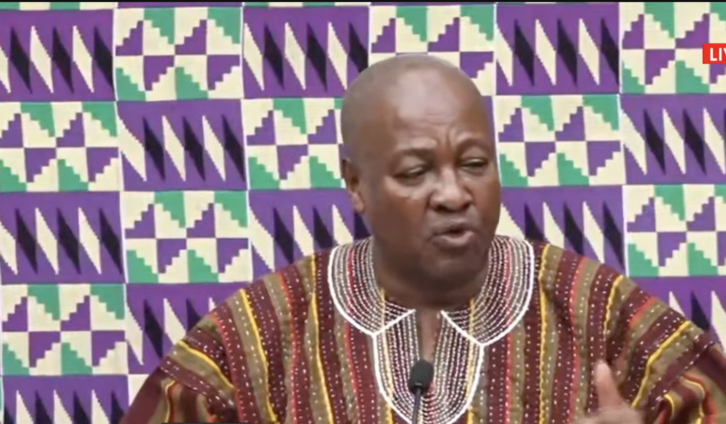
President John Mahama is proposing new legislation to criminalise the destruction of cash crops like cocoa for mining purposes.
According to him, it is economically prudent to cultivate cocoa, which can generate income all year-round, compared to mining, which leaves the land barren once the gold is extracted.
Speaking after a courtesy call from the Ghana Cocoa, Coffee, and Sheanut Farmers Association, he noted that preserving cocoa production is vital for the country’s economy.
“We have to ensure that people are not cutting down cocoa trees to mine gold. Once the land is mined out, it becomes useless, whereas cocoa trees can yield revenue for 30 years or more. It makes more sense to preserve cocoa farms than to mine the land and render it barren for future generations,” Mahama stated.
“We are exploring legislative measures to prevent cocoa farm destruction for mining,” he added.
President Mahama also declared the year 2025 as the "Year of Correction" to bring the cocoa sector back on track.
He criticised the Ghana Cocoa Board under the previous administration for its management of the industry, specifically calling out the spending of GH₵3.4 billion last year, which he says was largely used for administrative and headquarters expenses.
“COCOBOD's total debt today is GH₵ 3.2 billion, and GH₵9 million must be paid by September. This is money that should have gone to farmers but is now being used to service debts,” he lamented.
“Production has declined, yet COCOBOD’s staff numbers have increased, which is counterproductive. In business, when production and revenue decrease, workforce adjustments are made. However, under the previous administration, employment at COCOBOD increased while production dwindled.”
President Mahama emphasised that the key to sustaining cocoa production is ensuring fair pricing for farmers.
He criticised previous policies that saw producer prices fall below 40% and advocated for a minimum of 70% to incentivise farmers.
“In the first four years of the past administration, there was virtually no increase in producer prices, despite currency depreciation. This year will be a year of correction to address these issues and restore the industry to a strong footing,” he noted.
Latest Stories
-
Family demands answers after dialysis patient dies at TTH during power outage
21 minutes -
Foreign Ministry repatriates nearly 7,000 distressed Ghanaians since 2025 – Ablakwa
44 minutes -
Gender Ministry steps up community campaign against social vices
1 hour -
Police bust armed robbery gang targeting gold dealers, mining sites in Ashanti and Western regions
1 hour -
Galamsey causes 1 in 4 fibre cuts in Ghana – Sam George
2 hours -
Police link Labone bank robbery suspects to earlier attacks on customers
2 hours -
Accra-Kumasi Expressway will be Mahama’s major road legacy – Agbodza
2 hours -
Ghana spends over US$20m repairing fibre cuts – Sam George
2 hours -
GACL wins two awards at ACI World Airport Experience Summit
2 hours -
Tomato prices to drop sharply in coming weeks – John Dumelo
2 hours -
Ashanti Region crowned 2026 MTN Elite U-19 champions after seven-goal thriller
2 hours -
Stranded Ghanaians in South Africa plead for fresh evacuation window
2 hours -
Kpone-Katamanso MUSEC summons emergency meeting over chieftaincy tension
2 hours -
Foreign Affairs Ministry to launch Diaspora Consular Fund
2 hours -
Police veers into investigations of death of a woman at Have Etoe
2 hours